THE CHANGE LEADER

Category: Transformation

Changing Higher Ed podcast 321 with host Dr. Drumm McNaughton and guest Michael Avaltroni | Building Fairleigh Dickinson’s Lifelong Learning Ecosystem Across Five Generations

How Fairleigh Dickinson Is Building an Ecosystem of Lifelong Learning Across Five Generations:

Changing Higher Ed podcast 321 with host Dr. Drumm McNaughton and guest Michael Avaltroni

Program discontinuation is supposed to be the third rail of a presidency. When Fairleigh Dickinson University compiled a significant list of programs to discontinue or consolidate, President Michael Avaltroni took the list to a faculty referendum. Roughly 88 percent of the faculty endorsed it. He credits the result to faculty who understood the evidence, had been brought along on the journey, and could see the decisions inside FDU’s larger redefinition of the university: a shift away from the four-year, time-dependent degree toward an ecosystem of lifelong learning.  In this episode of the Changing Higher Ed® podcast, Dr. Drumm McNaughton and Michael Avaltroni, the first FDU graduate to hold the presidency, walk through the framework driving that redefinition, a university-of-the-future model built on four Ps: programs, people, partnerships, and place. Together,
Changing Higher Ed Podcast 312-Dr. Drumm McNaughton and Nikki Barua-Human-First Transformation: Closing Higher Education’s AI Readiness Gap

Human-First Transformation: Closing Higher Education’s AI Readiness Gap:

Changing Higher Ed podcast 312 with host Dr. Drumm McNaughton and guest Nikki Barua

AI adoption among students is running at 80 to 90 percent. Only 9 percent of CIOs believe their institutions are ready. That gap is not closing on its own. Higher education has a well-practiced response to disruption: study it, pilot it, committee it, and implement it over several budget cycles. That approach worked for the internet. It worked for mobile. It will not work for AI. The difference is speed. The internet took roughly 30 years to reach mass adoption. Mobile took 10 to 15. AI has achieved massive adoption in under three years, and the technology is improving itself week by week without waiting for anyone’s strategic plan to clear shared governance. That timeline changes the nature of the problem. Incremental change, the model higher education knows best, assumes

Changing Higher Ed Podcast 308-Dr. Drumm McNaughton and Mike Toguchi - Higher Ed Technology Change Management and Digital Transformation

Higher Education Change Management for Technology Projects and Digital Transformation:

Changing Higher Ed podcast 308 with host Dr. Drumm McNaughton and guest Mike Toguchi

Higher education’s track record with technology change is uneven for a reason, and the reason is rarely the technology. It is the placement of change management in the project lifecycle. When change management is treated as a rollout activity, handled near the end after vendor selection, contract execution, and configuration, it cannot do the work that determines adoption. By that point, the decisions that govern trust, governance, agility, and stakeholder ownership have already been made, often without the people who will be expected to live with the consequences. The result is a familiar pattern: ambitious initiatives that launch on schedule, generate friction within a semester, and quietly settle into legacy mode without ever delivering the outcomes that justified them. The case for treating change management as a planning discipline rather

Changing Higher Ed Podcast 303-Dr. Drumm McNaughton and France Hoang - When AI Handles the Task, Higher Education Has to Build Human Judgment

When AI Handles the Task, Higher Education Has to Build Human Judgment:

Changing Higher Ed podcast 303 with host Dr. Drumm McNaughton and guest France Hoang

AI has pushed higher education past the point where policy alone is enough. If students can generate summaries, draft papers, and produce plausible answers in seconds, colleges now have to answer a harder question: what are they teaching that still matters? France Hoang, founder and CEO of BoodleBox, pushes the AI conversation toward the issue that matters most for presidents, provosts, boards, and academic leaders. The central challenge is no longer access to the tool. The challenge is whether colleges and universities will redesign learning, advising, and implementation in ways that strengthen judgment, expertise, and human decision-making rather than weaken them. That is what makes AI a strategic issue for institutional leadership. A campus can publish guidelines, approve a platform, and hold a few workshops without addressing the deeper problem.

Changing Higher Ed Podcast 302-Dr. Drumm McNaughton and Jeff Dinski - Students Are Acting Like Consumers. Higher Ed Needs to Catch Up

Students Are Acting Like Consumers. Higher Ed Needs to Catch Up:

Changing Higher Ed podcast 302 with host Dr. Drumm McNaughton and guest Jeff Dinski

Jeff Dinski spent six years at NBC and ESPN learning that if you do not give your audience what they want, they change the channel. Higher education has never had to worry about that. Until now.   The case for treating students as consumers, aligning program portfolios with workforce destinations, and rethinking how faculty are qualified to teach draws on perspectives from Dr. Drumm McNaughton, a higher education consultant who works with institutional presidents and boards on strategy, governance, and transformation, and Jeff Dinski, Chief Strategy and Corporate Development Officer at Ellucian, the largest edtech company in the world serving approximately half of all U.S. colleges and universities. Dinski brings more than 20 years of experience across sports media, consumer internet, and edtech, including roles as an operating executive at

Cover Image: Changing Higher Ed Podcast 297 Closing the Change Gap: Agile Change Management for Today’s Higher Education Leaders -Dr. Drumm McNaughton and Dr. Christine Janssen

Closing the Change Gap: Agile Change Management for Today’s Higher Education Leaders:

Changing Higher Ed podcast 297 with host Dr. Drumm McNaughton and guest Dr. Christine Janssen

Higher education is facing a convergence of change unlike anything in its history. Within the past six years alone, institutions have navigated three major transitions: political shifts under the first Trump administration, the COVID-19 pandemic, and now a second Trump administration coupled with the rapid emergence of AI. Demographic decline, funding uncertainty, and shifting student expectations compound these pressures. Change is no longer optional, yet many institutions continue to operate as though incremental adjustments will be sufficient. They will not be. The case for transformational change management draws on the combined perspectives of Dr. Christine Janssen, founder and CEO of Edstutia, an immersive learning platform leveraging virtual reality and AI, and Dr. Drumm McNaughton, a higher education consultant specializing in institutional transformation. Dr. Janssen brings entrepreneurial expertise and a background

Changing Higher Ed Podcast Cover Image-Podcast 292: How Stevens Tech Became One of the Strongest Transformation Stories in Higher Education

How Stevens Tech Became One of the Strongest Transformation Stories in Higher Education:

Changing Higher Ed podcast 292 with host Dr. Drumm McNaughton and guest Dr. Nariman Farvardin

Strategic Planning and Academic Realignment at Stevens Institute of Technology Stevens Institute of Technology has become a living example of how disciplined strategic planning, academic realignment, and institutional follow-through can transform a university for long-term relevance and success. This episode of the Changing Higher Ed podcast features Dr. Nariman Farvardin, President of Stevens Institute of Technology. Since assuming the presidency in 2011, Dr. Farvardin has led a remarkable institutional transformation driven by comprehensive planning, academic realignment, and sustained execution. Under his leadership, Stevens moved from incremental change to structural transformation, producing outcomes that place the institution among the strongest performers in the country. The result is not theoretical success. It is measurable, sustained performance across enrollment demand, student outcomes, research activity, and institutional reputation. Under Dr. Farvardin’s presidency: Undergraduate applications

Innovation in Higher Education: How Leaders Build the Capacity to Adapt with Insights from AFIT | Changing Higher Ed Podcast 286 with host Dr. Drumm McNaughton and guest Erika Liodice

Innovation in Higher Education: How Leaders Build the Capacity to Adapt with Insights from AFIT:

Changing Higher Ed Podcast 286 with host Dr. Drumm McNaughton and guest Erika Liodice

Innovation in higher education often breaks down long before it reaches implementation. Leaders see where the institution needs to go, but the structures beneath them move at a pace built for a different era. Teams struggle to make sense of unfamiliar challenges. Planning cycles are misaligned with the rate of external change. Initiatives stall because the institution lacks the shared practices, cross-functional coordination, and environmental intelligence necessary for action. These gaps are not caused by a lack of commitment. They are symptoms of organizations that were never designed to operate in today’s conditions. This episode examines how colleges and universities can build the internal capacity required for innovation. The discussion draws on field examples from the Alliance for Innovation and Transformation (AFIT), where leaders from community colleges, technical colleges, and

How to Execute a Debt-Free Higher Education Turnaround Through Real Estate and Risk Planning | Changing Higher Ed podcast 280 with host Dr. Drumm McNaughton and guest Dr. Beth Martin

How to Execute a Debt-Free Higher Education Turnaround Through Real Estate and Risk Planning:

Changing Higher Ed podcast 280 with host Dr. Drumm McNaughton and guest Dr. Beth Martin

When every board meeting is about cuts, deficits, or another “strategic realignment,” leaders start asking what it would take to actually fix the institution instead of managing its collapse. When higher education institutions reach that point, recovery depends on disciplined execution, clear governance, and a business plan rooted in measurable outcomes. We explore how to stabilize and transform a university when real estate is part of the equation—and how systems theory, change management, and risk planning can guide a true debt-free higher education turnaround instead of another temporary fix. In this episode of the Changing Higher Ed podcast, Dr. Beth Martin, President of Notre Dame de Namur University (NDNU), joins Dr. Drumm McNaughton to share how she led NDNU through a financial and operational turnaround. Drawing from her earlier career

Changing Higher Ed podcast 271 cover image for University Transformation: Tough Calls, Program Realignment and Mental Health Support featuring Andy Vaughn and Dr. Drumm McNaughton

How University Leaders Can Transform Institutions with Program Realignment and Scalable Mental Health Services:

Changing Higher Ed podcast 271 with host Dr. Drumm McNaughton and guest Andy Vaughn

  Ten years ago, Alliant International University was hemorrhaging money and struggling operationally—today, they produce 40% of all licensed doctoral psychologists in California and 10-12% nationwide. The transformation happened by making the hardest decision in higher education: deliberately eliminating programs to focus on what they could dominate. In this episode of Changing Higher Ed® podcast, Andy Vaughn, President and CEO of Alliant International University, shares how institutional leaders can build scalable mental health support systems by embedding them into the core mission, academic programs, and leadership practices of their institutions. He outlines Alliant’s strategic shift to focus on licensure-driven programs, the integration of clinical mental health services into operations, and the leadership imperatives necessary to address the rising mental health demands facing higher education. Vaughn’s leadership during the university transformation

Changing Higher Ed podcast 266 - How Utah State Is Using a Connected Campus to Boost Student Engagement and Persistence with host Dr. Drumm McNaughton and guest Rene Eborn

How Utah State Built a Connected Campus That Boosts Retention, Equity, and Student Support at Scale:

Changing Higher Ed podcast 266 with host Dr. Drumm McNaughton and guest Rene Eborn

  Connected Campus strategies are transforming how universities deliver services, and Utah State University is a clear example of how this can be done with focus and intention. Redesigning the Student Experience Around a Connected Campus Model When Utah State University set out to improve student engagement and outcomes, they didn’t start with new software—they started with a vision. As Rene Eborn, Associate VP of Strategic Initiatives and Deputy of Digital Transformation, explains, digital transformation at USU is rooted in student equity, operational efficiency, and a campuswide strategy to connect students with the tools and relationships that fuel persistence. This meant building a digital environment where students don’t have to hunt for help—and where help can find them. That environment needed to work for traditional and nontraditional learners alike. Whether

Confronting the Storm: Resistance to Change and Current Attacks on Higher Education-Changing Higher Ed podcast 259 with host Dr. Drumm McNaughton and guest Dr. Brian Rosenberg

Confronting the Storm: Resistance to Change and Current Attacks on Higher Education:

Changing Higher Ed podcast 259 with host Dr. Drumm McNaughton and guest Dr. Brian Rosenberg

  Navigating an Era of External Pressures and Internal Resistance to Change in Higher Education Higher education faces unprecedented challenges from declining public trust, external political pressure, and a deeply ingrained resistance to change. In this episode of Changing Higher Ed®, Dr. Brian Rosenberg, former president of Macalister College and author of “Whatever It Is, I’m Against It: Resistance to Change in Higher Education,” shares insights on the current attacks on higher education, how resistance to change has contributed to the sector’s vulnerabilities, and what institutional leaders must do to navigate this turbulent environment. The conversation explores how higher education’s traditional structures and decision-making processes have created barriers to the transformational change needed in today’s volatile higher ed environment, while offering actionable strategies for presidents and boards. Current Attacks on

How Lumina’s 2040 Vision Can Help Restore Public Confidence in Higher Education: Creating Pathways to Rebuild America's Trust in Colleges and Universities

How Lumina’s 2040 Vision Can Help Restore Public Confidence in Higher Education:

Creating Pathways to Rebuild America's Trust in Colleges and Universities

A staggering one-third of the American population reports having no confidence in higher education. Once viewed as the gateway to opportunity and upward mobility, colleges and universities are now in a trust crisis—increasingly perceived as inaccessible, unaffordable, and disconnected from the realities of today’s learners. The consequence? The drop in public confidence exacerbates the effects of the demographic cliff, leading to even greater enrollment declines. At the center of efforts to understand and respond to this shift is Lumina Foundation, a national private foundation dedicated to expanding access to postsecondary learning. With decades of research and policy leadership behind it, Lumina has taken the long view—and a bold one. Its newly announced national goal calls for 75 percent of the U.S. workforce to attain a college degree or a credential

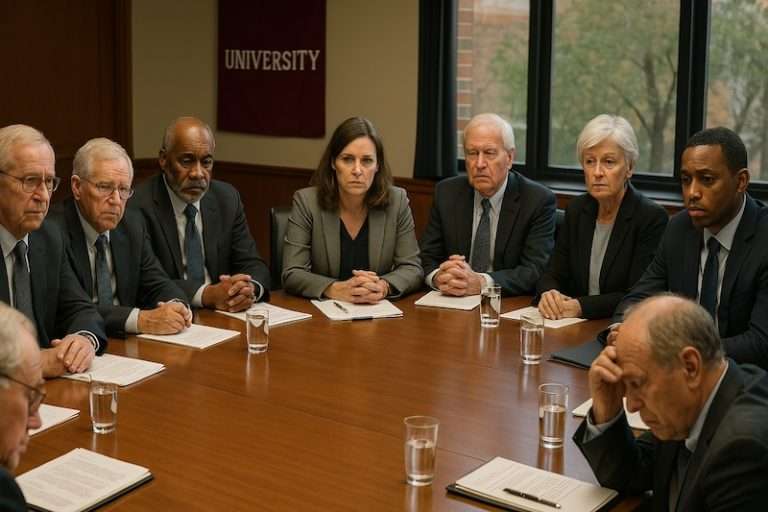
Top 12 Challenges Facing Higher Ed in 2025—and the Exemplars Solving Them: A university board meeting with concerned board members discussing the challenges.

Top 12 Challenges Facing Higher Ed in 2025—and the Exemplars Solving Them:

An overview of the most urgent issues impacting higher education, with examples of how some institutions are beginning to respond.

The Greatest Challenges Facing Higher Education: A Comprehensive Analysis for 2025 with Exemplars in Navigating Solutions Higher education is no longer coasting—colleges and universities now face a defining moment. In the “go-go” days just 15 years ago, higher education had 21 million students (graduate and undergraduate) and 18.1 million undergraduates. When there was a recession, higher ed institutions could count on an uptick in enrollment. Institutions were building multiple new buildings and programs to offer students, and new buildings and dormitories to teach and house the same students. Unfortunately, those go-go days did not last. Today, undergraduate enrollment has dropped by 2.6 million to 15.5 million, leading to a significant overcapacity. In industry, what happens when there is more inventory than there are customers? A recession. And that is where

Changing Higher Ed podcast 245 - The Glass Cliff in Higher Education: Challenges Faced by Women University Presidents with guest Dr. Lori Varlotta

The Glass Cliff in Higher Education—Challenges Faced by Women University Presidents:

Changing Higher Ed podcast 245 with host Dr. Drumm McNaughton and guest Dr. Lori Varlotta

  According to recent ACE presidential survey data, women now constitute 33% of university presidencies, yet a troubling pattern has emerged: these leaders are often appointed during times of institutional crisis, creating what researchers call “the glass cliff” phenomenon.  In this episode of Changing Higher Ed®, Dr. Lori Varlotta, former president of Hiram College and California Lutheran University and current Distinguished Professor of Higher Education Leadership at Cal Lutheran, shares insights from her research on the glass cliff phenomenon in higher education. Drawing from her first research sabbatical in 40 years, she explores how women presidents are often hired during periods of institutional vulnerability and what can be done to ensure their success. Understanding the Glass Cliff in Higher Education The glass cliff differs significantly from the well-known glass ceiling

academic realignment frameworks higher education board or directors in a conference room discussing academic realignment frameworks for their institution

Three-Year College Degrees: A Strategic Response to Enrollment Challenges:

An Academic Realignment Framework for Modern Higher Education

The Urgency for Strategic Adaptation in Higher Education Higher education is in deep need of innovating and changing some of its core beliefs, one of which is the “myth” that to be successful, students must graduate with a four-year college degree. And one of the best examples to bust this myth is Bill Gates, founder of Microsoft. In 1975, Bill Gates famously left Harvard after only three semesters, driven by the conviction that his opportunity in personal computing couldn’t wait for the traditional four-year degree. Today, students are making similar decisions, but their motivations often center on prohibitive costs and a desire for faster, more direct pathways to meaningful careers. Almost half of U.S. college students fail to complete their degrees, and college tuition has continued to rise, outpacing inflation

Changing Higher Ed podcast 232 - Improving Public University Systems at Scale with Drumm McNaughton and Jim Johnsen

Improving Public University Systems at Scale:

Changing Higher Ed podcast 232 with Dr. Drumm McNaughton and guest James R. Johnsen

  In this podcast, host Dr. Drumm McNaughton welcomes guest James R. Johnsen, the former President of the University of Alaska System, who is now a Vice President of Executive Search for Greenwood Asher & Associates. Johnsen discusses his new book, “Public University Systems: Leveraging Scale in Higher Education,” which examines the importance of and challenges facing public university systems across the U.S. What higher ed leaders will gain from this podcast: Here are some of the insights higher education presidents, boards, and executive leadership will gain from listening to the podcast: Understanding Public University Systems in Higher Education Governance A comprehensive overview of public university systems, their prevalence, importance, and the challenges they face. The different types of systems – homogenous and heterogeneous – and how they are structured,

Changing Higher Podcast 218 - Using Technology to Upgrade Higher Ed Branding and Marketing - with host Drumm McNaughton and guest Nuno Fernandes

Using Technology to Upgrade Higher Ed Branding and Marketing:

Changing Higher Ed podcast 218 with host Dr. Drumm McNaughton and guest Nuno Fernandes

  Higher education hasn’t fundamentally changed in nearly a millennium. While the world has witnessed revolutions in technology, commerce, and communication, the core model of a professor lecturing to a classroom of students remains largely unchanged since the founding of the University of Bologna in 1088. This stagnation in the face of global digital transformation presents a critical challenge—and opportunity—for higher education institutions. In an era where students expect the same level of personalization and digital interface they experience with services like Uber or Netflix, colleges and universities must radically rethink their approach to branding, marketing, and the overall student experience. American Public University System (APUS) President Nuno Fernandes brings a wealth of experience from the business world to higher education. His insights offer valuable perspectives on how institutions can

Changing Higher Podcast 215 - Institution Wide AI Integration Strategy-Future Proof College Like MDC with host Dr. Drumm McNaughton and guest Madeline Pumariega

Institution Wide AI Integration Strategy: Future Proof College Like MDC:

Changing Higher Ed podcast 215 with host Dr. Drumm McNaughton and guest Madeline Pumariega

  Higher education institutions that fail to integrate AI into their ecosystem are not just falling behind—they’re undermining their institution and their students’ futures. The reluctance to embrace AI isn’t just short-sighted; it’s a disservice to the very mission of education in the 21st century.   An AI integration strategy isn’t just about preparing students—it’s about transforming entire institutions. Colleges that fully embrace AI can revolutionize their operations, from personalized learning experiences to streamlined administrative processes. Miami Dade College’s comprehensive AI strategy demonstrates how institutions can leverage this technology to create a more responsive, data-driven educational ecosystem that benefits students, faculty, employers, and administrators alike.   Under President Madeline Pumariega’s leadership, Miami Dade College (MDC)—serving 125,000 students from 167 countries speaking 63 languages—has pioneered a large-scale institution-wide approach to AI

Changing Higher Podcast 211 Embrace AI as a Performance Tool to Benefit Higher Ed | host Dr. Drumm McNaughton and guest Bruce Dahlgren

Embrace AI as a Performance Tool to Benefit Higher Ed:

Changing Higher Ed podcast 211 with host Dr. Drumm McNaughton and guest Bruce Dahlgren

  Artificial intelligence (AI) has emerged as a tool with immense potential to revolutionize various aspects of higher education. In a recent survey, 94% of professors reported significant time savings when using AI-powered tools like Anthology’s design assistant for course creation. As colleges and universities navigate this transformative technology, leadership must approach AI not with trepidation but as a performance tool that can yield immense benefits for all stakeholders.   In this episode of the Changing Higher Ed podcast, Dr. Drumm McNaughton and Bruce Dahlgren, chief executive officer at Anthology and a trustee at Stetson University, discuss the benefits, address ethical concerns, and highlight how AI enhances institutional performance. They emphasize the importance of starting with a clear AI policy framework and building trust through pilots and communication to harness

Subscribe To Our Newsletter

Get the Latest News, Posts, and Podcasts in Our Monthly Newsletters