
December 30, 2025 · Episode 292
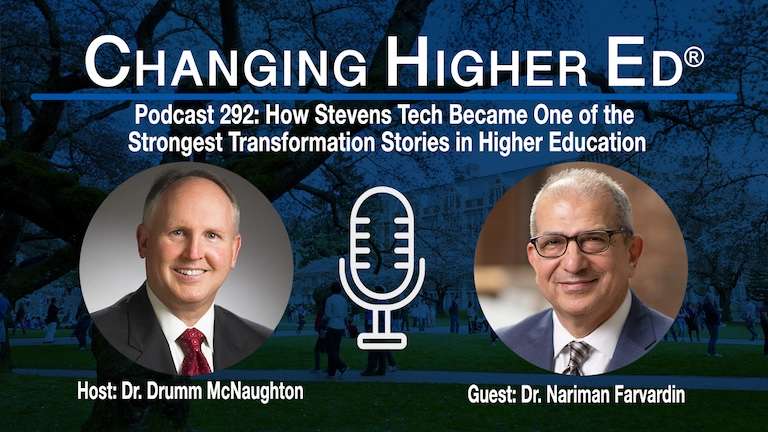
How Stevens Tech Became One of the Strongest Transformation Stories in Higher Education
42 Min · By Dr. Drumm McNaughton
Stevens’ president explains how disciplined strategic planning and execution delivers industry leading results and transformed the institution.
Strategic Planning and Academic Realignment at Stevens Institute of Technology
Stevens Institute of Technology has become a living example of how disciplined strategic planning, academic realignment, and institutional follow-through can transform a university for long-term relevance and success.
This episode of the Changing Higher Ed podcast features Dr. Nariman Farvardin, President of Stevens Institute of Technology. Since assuming the presidency in 2011, Dr. Farvardin has led a remarkable institutional transformation driven by comprehensive planning, academic realignment, and sustained execution.
Under his leadership, Stevens moved from incremental change to structural transformation, producing outcomes that place the institution among the strongest performers in the country.
The result is not theoretical success. It is measurable, sustained performance across enrollment demand, student outcomes, research activity, and institutional reputation.
Under Dr. Farvardin’s presidency:
- Undergraduate applications increased by 294 percent
- Total enrollment increased by approximately 75 percent
- Research funding increased by 199 percent
- More than $500 million in campus improvements were completed
- First-year retention now approaches 96 percent
- Graduation rates are near 90 percent, placing Stevens among the top universities nationally
- Approximately 97 percent of graduates are employed or enrolled in graduate school within six months of graduation
These outcomes did not emerge from a single initiative. They are the cumulative effect of a strategic system deliberately designed to prepare students for a technology-driven world, while aligning faculty, staff, trustees, and administrators around shared goals and shared accountability.
A Clear Value Proposition Anchored in Technology
One of the defining choices Stevens made early in its transformation was to fully embrace its identity as a technology-centric university. This was not framed narrowly as computer science or engineering excellence. Instead, technology was treated as a foundational driver of human progress that must permeate every discipline.
Dr. Farvardin articulated a simple but consequential premise. In today’s economy, every major sector is shaped by technology, including finance, healthcare, energy, transportation, pharmaceuticals, and retail. The most influential companies in the United States, measured by market capitalization and societal impact, are fundamentally technology-oriented. This reality creates an obligation for higher education to prepare graduates who are fluent in technological thinking regardless of their chosen field.
At Stevens, this meant integrating technology into business education, the humanities, social sciences, and the arts, not isolating it within a single school or department. The institution’s location in Hoboken, New Jersey, directly across from Manhattan, further reinforced this strategy by providing proximity to global financial institutions, technology firms, healthcare organizations, and cultural enterprises. That geographic advantage was intentionally leveraged to strengthen experiential learning, internships, faculty-industry collaboration, and career placement.
The institutional value proposition became clear and credible. A Stevens education promised relevance, durability, and opportunity in a world where technological change is constant.
Strategic Planning as a Living Institutional Practice
Stevens’ transformation did not begin with a static strategic plan document. It began with a planning process designed to build ownership across the institution and an execution framework designed to ensure follow-through.
Dr. Farvardin emphasized that strategic planning at Stevens is facilitative rather than directive. Faculty, staff, students, trustees, and administrators are actively involved in generating ideas, defining priorities, and shaping institutional direction. Because the plan reflects collective input, it is collectively owned.
This ownership is reinforced through disciplined execution practices:
- The strategic plan is treated as a living document rather than a finished product
- Progress is reviewed and communicated multiple times each year
- Faculty and staff receive regular institutional updates on implementation status
- The Board of Trustees receives structured updates at each meeting
- An annual written report documents progress, setbacks, and priorities for the coming year
Execution accountability is further reinforced through annual objectives letters issued to each vice president. These letters define specific goals for the year that directly align with strategic plan priorities. Institutional goals are broken down into actionable responsibilities distributed across divisions, reviewed annually, and adjusted as conditions change.
This system ensures that strategy does not remain aspirational. It becomes operational.
Equally important, Stevens institutionalized honesty in execution. When goals are not met, the shortfall is acknowledged publicly. External factors are named when relevant. Adjustments are made transparently. This candor reinforces institutional trust and signals that planning is a serious governance discipline rather than a public relations exercise.
Academic Realignment Through the SUCCESS Curriculum
One of the most consequential outcomes of Stevens’ strategic planning process was a complete rethinking of the undergraduate core curriculum. Dr. Farvardin concluded that many general education models across higher education remain anchored in the needs of the previous century rather than the realities students will face after graduation.
In response, Stevens developed and implemented the SUCCESS curriculum, formally known as the Stevens Undergraduate Core Curriculum for Essential Skills for Success. This curriculum applies to every undergraduate student, regardless of major.
The core premise is straightforward. All graduates should possess baseline literacy in the technologies shaping the modern world, while retaining strong foundational skills that enable lifelong learning.
The SUCCESS curriculum ensures that every Stevens graduate has exposure to five critical domains:
- Artificial intelligence
- Data science
- Biotechnology
- Quantum computing
- Sustainability
This exposure is not designed to replace disciplinary depth. Instead, it provides conceptual fluency that allows graduates to engage intelligently with emerging technologies throughout their careers, even as specific tools evolve.
Dr. Farvardin emphasized that Stevens intentionally balances relevance with durability. Students are not trained for skills that will expire in five years. They are equipped with mathematical, analytical, and learning foundations that allow them to adapt for decades.
First-Year Experience as an Institutional Investment
The SUCCESS curriculum extends beyond content into student support structures, most notably the first-year experience program. Every incoming first-year student participates in a small, faculty-led course during their first semester. Stevens offers approximately 45 to 47 sections each year, with class sizes capped around 20 to 25 students.
This initiative represents a significant institutional investment. Its purpose is to address the academic, social, and personal transition students experience when entering college.
Each faculty instructor also serves as a coach for their cohort. From the first semester forward, students have a designated individual they trust and know personally. When students encounter challenges, academic or otherwise, they are not left to navigate institutional complexity alone.
This coaching model contributes directly to Stevens’ exceptional retention outcomes. First-year retention now approaches 96 percent, a figure Dr. Farvardin attributes in large part to this early support system.
Student-Centered Operations Beyond the Classroom
Academic realignment at Stevens was accompanied by a broader commitment to student-centered operations. Institutional leadership recognized that student experience extends well beyond classroom instruction.
Stevens established a cultural expectation that staff take ownership of student issues rather than redirecting students from office to office. If a student approaches an office that cannot resolve their issue directly, that staff member becomes responsible for ensuring the problem is addressed elsewhere.
This approach required retraining, reinforcement, and institutional commitment. Over time, it eliminated a common source of student frustration and strengthened trust in the institution’s support systems.
Stevens also employs predictive tools that identify students who may be at academic risk before issues escalate. Early intervention allows advisors and faculty to engage students proactively, reinforcing the institution’s commitment to student success rather than reactive remediation.
The results are visible in graduation outcomes. Graduation rates now approach 90 percent, even after temporary disruption during the COVID period, placing Stevens among the top institutions nationally in this category.
Faculty Engagement and Change Management
Dr. Farvardin rejected the assumption that faculty are inherently resistant to change. At Stevens, faculty culture is shaped by the institution’s technological orientation and by leadership practices grounded in transparency and respect.
Faculty were not presented with pre-determined solutions. They were invited into the problem-solving process. Because academic realignment initiatives emerged from shared deliberation, faculty viewed them as collective projects rather than administrative mandates.
This collaborative approach proved essential in implementing significant curricular change, including the SUCCESS curriculum and first-year experience model. Faculty engagement was sustained by clear articulation of institutional purpose, consistent communication, and visible follow-through.
Execution as the True Differentiator
Throughout the conversation, Dr. Farvardin returned repeatedly to execution discipline as the defining differentiator in Stevens’ transformation. Many institutions produce thoughtful strategic plans. Far fewer operationalize them consistently.
At Stevens:
- Strategy is revisited continuously
- Accountability is distributed and explicit
- Progress is measured and reported
- Setbacks are acknowledged openly
- Adjustments are made deliberately
This approach turns planning into governance practice rather than episodic exercise.
Three Takeaways for University Presidents and Boards
- A well-designed strategic plan paired with disciplined execution is essential. Strategic planning is time-consuming and often requires difficult and sometimes unpopular decisions, but without a clear plan and a system to execute it, institutions cannot move forward in a sustained way.
- The relationship between the president and the board is critical. A strong, functional partnership between governance and leadership directly affects an institution’s ability to make progress and sustain momentum.
- Trust-based working relationships between the president, faculty, and staff matter. Institutional transformation depends on collaboration, shared purpose, and transparency. Leadership is not sustainable without these relationships, and neither is long-term success.
Final Perspective
Stevens Institute of Technology’s transformation demonstrates that sustained institutional improvement is possible when strategic planning is treated as a living system rather than a static artifact. The so-called secret sauce is not a single initiative. It is the alignment of mission, curriculum, student experience, governance, and execution around a clear and credible value proposition.
For presidents and boards navigating strategic planning in an era of demographic pressure, technological disruption, and heightened accountability, Stevens offers a practical model grounded in discipline, transparency, and institutional courage.
About Our Podcast Guest
Dr. Nariman Farvardin, Stevens Institute of Technology’s seventh president since 2011, has transformed the university into a nationally prominent technological research powerhouse. Under his leadership, undergraduate applications surged 294%, enrollment rose 62% and career outcomes reached an impressive 96.8% of graduates employed or in graduate school within six months. Farvardin’s tenure has driven a 199% increase in research funding and $500 million in campus improvements, including the landmark University Center Complex. His innovative academic initiatives and creation of new research centers have positioned Stevens at the forefront of technology education, preparing graduates to excel in an increasingly complex, technology-centric world.
Connect with Dr. Nariman Farvardin on LinkedIn →
About the Host
Dr. Drumm McNaughton is the founder, CEO, and Principal Consultant at The Change Leader, Inc. A highly sought-after higher education consultant with 20+ years of experience, Dr. McNaughton works with leadership, management, and boards of both U.S. and international institutions. His expertise spans key areas, including accreditation, governance, strategic planning, presidential onboarding, mergers, acquisitions, and strategic alliances. Dr. McNaughton’s approach combines a holistic methodology with a deep understanding of the contemporary and evolving challenges facing higher education institutions worldwide to ensure his clients succeed in their mission.
Read the Podcast Transcript →
Transcript: Changing Higher Ed podcast 292 – with host Dr. Drumm McNaughton and guest Dr. Nariman Farvardin
Introduction to Changing Higher Ed®
Welcome to Changing Higher Ed®, a podcast dedicated to helping higher education leaders improve their institutions. With your host, Dr. Drumm McNaughton, CEO of The Change Leader, a consultancy that helps higher ed leaders holistically transform their institutions. Learn more at changinghighered.com. And now, here’s your host, Drumm McNaughton.
[00:00:31] Introduction and Guest Welcome
Drumm McNaughton: Thank you, David.
My guest today is Dr. Nariman Farvardin, President of Stevens Institute of Technology. Since joining Stevens in 2011, Nariman has transformed the university into a nationally prominent technologically research powerhouse. To wit undergraduate applications have surged 294%, enrollment up almost 70%, career outcomes and impressive 97%, in that graduates are employed or graduate school within six months. They’ve increased research funding by 199%, multiple campus improvements. It’s what I refer to as “The Stevens Miracle”. Under his leadership, Stevens has become a case study on how to transform a university for the modern era using strategic planning and academic realignment and collaborative strategic planning.
And he joins me today to talk about how trust, transparency, and planning can lead to great student outcomes.
Nariman, welcome to the program.
Nariman Farvardin: I am delighted to participate in your show. Thank you very much for inviting me.
Drumm McNaughton: It’s my pleasure. I am looking forward to our conversation.
[00:01:50] Dr. Nariman Farvardin’s Background
Drumm McNaughton: You have done some amazing things at the Stevens Institute of Technology. You’ve transformed the university into a nationally prominent technology research powerhouse.
Before we get into how you’ve done that, please tell our audience a little bit about yourself.
Why a presidency? What, you’ve done so many great things in your lifetime.
Nariman Farvardin: Drumm, thank you very much. I’m happy to answer your question, but at the outset I would like to make a small correction. You gave me just way too much credit. I do not deserve that. A lot of great things have happened at Stevens and I acknowledge that, but it is the result of the work of a very large number of extremely dedicated, smart, experienced, and knowledgeable people.
So, I get a lot of credit for the good work that they do, and I just didn’t want to forget about acknowledging what they’ve done.
[00:02:47] Early Career at University of Maryland
Nariman Farvardin: But about me, I have been in higher education for a long time. I started my first job at the University of Maryland as an assistant professor in electrical engineering in 1983.
That makes me—
Drumm McNaughton: Almost as old as me.
Nariman Farvardin: Well, I’m not so sure, but I’ve been in higher education for 42 years. The first approximately 26 years of which was at the University of Maryland where I started as an assistant professor. I moved up the ranks being in the Department of Electrical Engineering for the first approximately 10 years.
Then I became chairman of that department in 1994. I stayed chairman until the year 2000. At which time I became Dean of the Clark School of Engineering at the University of Maryland. I loved that position. I stayed on that job for seven years until 2007. At that point, I became provost and Senior Vice President for Academic Affairs at the University of Maryland.
And four years later in 2011, I joined Stevens Institute of Technology as its seventh president. And therefore, I have held a disposition for the past 15 years, making me one of the longest serving presidents certainly among the four year colleges and universities in the state of New Jersey.
I’m going to stop here. Unless you would like to know more about my academic background.
Drumm McNaughton: No, that’s really good. It sets a real good stage. And you and I have a very good mutual friend, Dr. William “Brit” Kirwan, who you worked with when he was the president there at the University of Maryland.
Nariman Farvardin: Very true. I had a lot of admiration for Brit. And I worked with him closely for an extended period of time. Brit was at the University of Maryland when I was there. Then for a period of time, he left the University of Maryland, joined Ohio State University, and I was delighted to welcome him back to the state of Maryland this time as the chancellor of the University system.
So I know him well, indeed.
Drumm McNaughton: Yes, he’s an incredible man. I have learned so much from him, as I’m sure you did as well.
Nariman Farvardin: Absolutely. That goes without saying.
[00:05:13] Stevens Institute of Technology Overview
Drumm McNaughton: So… well tell us a little bit about Stevens and thanks for giving us your background. I was just amazed. I’d heard of Stevens peripherally before we decided to do the podcast together, but in doing some research, you have done some incredible things.
Nariman Farvardin: Thank you for asking me this question. Obviously I know you have a limited amount of time and I need to be very brief and to the point, but I can speak chapter and verse for hours and hours about this university that I feel so strongly about. Stevens is a very special place, Drumm. This university was established in 1870, 155 years ago in Hoboken, New Jersey. Stevens was the first College of Mechanical Engineering in the nation. And I don’t want to spend time on the genesis of the university and on the contributions of the founding family, but I do want to say that today Stevens is a private research university with a very distinctive mission.
As I said, we are an old technological university and we are very proud of leaning into our identity as a technology centric institution. I think in this day and age, this is a very important differentiator for our university, and I will come back if you ask me appropriate questions to highlight this extremely important point.
[00:06:46] Stevens’ Strategic Location and Opportunities
Nariman Farvardin: We are located in Hoboken, New Jersey exactly on the West Bank of the Hudson River, right across from Midtown Manhattan. So I tell a lot of people we are closer to Midtown than a lot of other universities that are set to be in New York City but they’re farther distanced from Midtown Manhattan.
As a result of that, we have what I refer to as an unfair advantage, and that is our location. We have not only a beautiful view of the New York City skyline, it’s a breathtakingly beautiful view, but much more importantly, we have access to unparalleled opportunities. We have access to financial firms, technology companies, healthcare organizations, all kinds of cultural institutions in better ways that most other universities in the nation do. This proximity, this access to opportunity, creates very special opportunities for our students and for our faculty members. And it paves the way for a better relationship between the university and the corporate world and businesses.
Drumm McNaughton: And which is so critical in today’s day and age.
[00:08:09] Stevens Institute of Technology’s Impressive Growth and Achievements
Drumm McNaughton: But I want to go over a little bit of the stats that have happened under your leadership there at Stevens. And yes, you can’t do it without great people, but a symphony needs a conductor. Your applications have surged to almost 300% of what they were, enrollment up 62%, career outcomes 96.8% of your graduates are employed or in graduate school within six months, increase of almost 200% of research funding, 500 million in campus improvements. Those are some pretty impressive numbers. Now, one of the things that really struck me when we spoke last week is you’re a strong believer in tech-centric work that it’s the driver of human progress.
[00:09:00] Tech-Centric Philosophy at Stevens
Drumm McNaughton: Tell us a little bit about that and how that philosophy helps drive you at Stevens.
Nariman Farvardin: Well, first of all, I must commend you for your memory remembering all these stats. But I do want to make one correction, you said 62% increase in enrollment. Actually, I checked those numbers this morning in anticipation of having conversation with you. The correct number is 75%, which is truly remarkable.
I would also add that the growth in the number of applications is correct. It’s 294%, but again, this morning I checked the flow of applications for fall of 2026 for the next admission cycle, and we are already up an additional 30% compared to this fall. So it seems like the demand for a Stevens education continues to be extremely strong and certainly on the rise.
Drumm McNaughton: So why is that? Why is it that people want to come to Stevens?
Nariman Farvardin: Well, in short, the answer is very simple. It’s the value proposition of the university.
Drumm McNaughton: Okay.
Nariman Farvardin: Okay, now I can dig deeper into it and tell you what it means when I talk about value proposition, but that also gets me to your main question, which is the role of technology at Stevens and how we have utilized that as a significant differentiator.
So let me just say a few key, facts about this.
[00:10:32] The Role of Technology in Education
Nariman Farvardin: You said it, I did not, but I strongly believe that these days technology is the key driver of human progress. There are no sectors of our economy, no significant aspects of our society, whether it’s healthcare or energy or transportation or pharmaceuticals or retail that is not profoundly impacted and does not profoundly benefit from technological advancements.
I would mention something that I think your audience would relate to. If you look at the most successful, the most impactful, and the largest market cap companies in our country, what names come to your mind? Does Microsoft come to your mind? Does Nvidia come to your mind? Does Amazon come to your mind? How about Tesla? How about Alphabet? How about Meta? Not a single one of these companies, not a single one, is not a technology oriented company. Now, if you go back a hundred years ago, the largest market cap companies in the United States were manufacturing companies or companies that were in the business of processing food or metals and the like.
Things have changed dramatically. And that is a reflection of this heavily technologically oriented world that we live in. So what does this mean? It means higher education, which is responsible for disseminating knowledge and generating knowledge for the good of society and for the good of the world, has a responsibility to recognize the world in which we live and to prepare the future generation of workforce for this world.
[00:12:20] The Impact of Integrating Technology Across Disciplines
Nariman Farvardin: So at Stevens, we have embraced technology in every aspect of what we do. And what I mean by that is not that we have a strong computer science department, okay? There are many universities with very strong computer science departments. There are universities with computer science departments that are much bigger than Stevens. For us, the notion of embracing technology goes way beyond computer science. What I mean by that is that we have successfully integrated technology in all aspects of our education and our research program. We have integrated technology in business education, in the humanities, in social sciences, in the arts, and I don’t think there are very many universities that have done that successfully.
And I think this is one of the key drivers of increased demand for Stevens education and kind of a direct answer to the question that you asked me.
Drumm McNaughton: Yes. And that’s really smart of you. I can remember my own education at the Naval Academy. 80% of our students were required to major in STEM technical and I was a physics major. So even though my major was physics, a lot of naval science courses, but we were still required to take a lot of humanities courses, English, political science, law.
I could count off probably 10 courses. I still remember the opening stanza from Chaucer and his age in the middle English. It was that much Drummed into us. No, no pun intended, of course. That’s what you’re doing with STEM courses. And when we spoke last week, you were telling me about how your new program success, your strategy, does all those things, and we’re going to get to that in just a little bit.
But what you’re doing by that is you’re preparing students for the real world once they get past graduation. You’ve got a lot of internships there. You’ve got a lot of, technical things. So frankly, they do better after they graduate.
[00:14:31] Preparing Students for Future Success Not the Past
Nariman Farvardin: this is such an important point you make. We’re very thoughtful, very intentional about preparing students for success going forward. And what does that mean? It means that we recognize that the world is changing. We recognize that we need to prepare our students for success in this new world.
But we are not going to teach students skills that will expire, that will lose their attractiveness in five years. You see what I’m saying? We’re continuing to emphasize the basics, the fundamentals. So I still would like our students to be mathematically savvy enough that they can learn new math if they ever need to, 20 years, 30 years, 40 years down the line. We are teaching our students how to continue to learn on their own, many years after they graduate from our university.
At the same time, we recognize the fact that artificial intelligence is going to be a fact of life. And we realize that by not giving an appropriate introduction to artificial intelligence to our students, we are actually depriving them of access to great professional opportunities going forward. As you know very well Drumm, if you are an employer and you’re interviewing two people, let’s say in an area like finance, and they’re both graduates of two strong finance programs, but one of them is technology savvy and the other one is not. Which one will you hire?
Drumm McNaughton: Yes, definitely.
Nariman Farvardin: It’s a no brainer. That’s what we are trying to do. We are trying to give them skills that are relevant, but also skills that have a lasting power for many decades.
[00:16:26] Stevens IT SUCCESS Program Overview
Drumm McNaughton: Let’s talk a little bit about your success program that you have. It came out of your recent strategic plan, which I want to get to in a little bit because how you’re doing strategic planning to me is exactly the right way to do it. But part of your success, you’ve got all students taking courses in AI and data science, bioscience, tell us about that.
Because what you’re doing is you’re training students not only for this world, you’re training them for the future, and you’re giving them a curiosity to learn, which I would argue is probably the most important of all those things.
Nariman Farvardin: Yes, that’s a very good question. So I’d like to go back to the way we do strategic planning and quite frankly, more importantly, the way we do the implementation or the execution of the strategic plan. But I’ll come back to that.
[00:17:22] Strategic Planning, Core Curriculum, and Essential Skills
Nariman Farvardin: To respond to your question about success, which is a part of the core education at Stevens, which means every student who graduates from this university, regardless of their major, whether they’re a computer science major or a finance major or a music major, they have to fulfill this part of the curriculum.
The program is called SUCCESS (Stevens Undergraduate Core Curriculum for Essential Skills for Success). It’s a beautiful acronym, which actually, I don’t remember what it stands for. But it stands for something like Stevens Undergraduate Core Curriculum for Essential Skills for Success or something. But what is the genesis of this? We were doing strategic planning, and the strategic planning was an exercise that involved a large number of stakeholders from the university, academic administrators, faculty, staff, students, members of the board of trustees, and we came to one important realization.
Universities have had a habit of placing a lot of their energy and emphasis ensuring that students go through a general education program that is solid and robust and durable, but they’re very sluggish in affecting any change. And as a result, most general education programs in other universities are programs that are great for the previous century, but not for the next century. However, I’m educating my students for the future, not for the past.
Drumm McNaughton: Really, you mean higher ed doesn’t change anymore quickly than that?
Nariman Farvardin: Well, I know that you are an expert in this area, so I don’t need to dwell on that point.
So we decided as a result of that observation, that one important thing that we want to do, as part of the implementation of the strategic plan, is to revisit the core curriculum and to ensure that the core curriculum is designed to prepare students for success in the 21st century.
That was the promise that we made to ourselves. Immediately after the strategic plan was approved by the board, we put together a working group of the most thoughtful faculty in the university, and we gave them that charge: come up with a change in our core curriculum so that it ensures that all students graduating from this university are prepared for success in the 21st century.
So they started thinking and they started collecting information. What do we need to know for success in the 21st century? And I will now summarize, the conclusion was that there are five sets of skills, five technologies that our students need to have at least a preliminary exposure to.
Obviously, if they want to learn more, they can learn more through subsequent courses. But these five are now artificial intelligence, quantum computing, biotechnology sustainability, and data science. So every student who graduates from this university at least has some basic knowledge in these five areas.
And that makes me very proud because I think that puts our students in the forefront of technology. It gives our students better tools for success in their future professions, and it enhances their chances of securing jobs in the best corporations and firms in the nation.
Drumm McNaughton: Oh, absolutely. I think what you’re doing is brilliant in that respect. When I think back to people going through dental school or medical school, a very highly specialized law school, they teach them how to do their profession, and they do a good job of it. But they don’t teach them how to run a business. They don’t teach them some of those other things that are really necessary. So a student comes out of these schools with anywhere from $200,000 to $400,000 in debt. They don’t know how to start a business. They don’t know how to run. It obviously gives, business to consultants who work in those areas.
Or you go out, you look to buy somebody’s practice and you get the people with that practice who know how to run it. You’re great with skills. But what you’re doing is preparing students so that they can live in a world that is technology driven. And they’re not going to be a Luddite.
They’re going to have at least some knowledge when someone says, oh Yes we just got a new generative AI tool called X, Y, Z, and they won’t go, huh? What’s AI?
Nariman Farvardin: Exactly. In fact, in all likelihood, they know a lot more about AI than the recruiter who is interviewing them.
Drumm McNaughton: More than likely, this is true.
[00:22:18] Strategic Planning Built Around Student Support Structures
Drumm McNaughton: The other piece with this, the curriculum changes focused on student and graduate success, but you also put in place support structures that focused on the student experience. Tell us a little bit about those, please.
Nariman Farvardin: Yes. I think that’s another thing that distinguishes Stevens, or the Stevens of today, in that 15 years ago when I came to the university, we developed our first strategic plan. And one of the major themes of that strategic plan was student centricity. We recognized that our primary customers are students. Without students, we will not exist.
Like any other business that focuses on its product and its customers, we have to be focused on our customers. So we said we want to do our damnedest to give the best possible experience to our students. And when I say experience, this experience thing is a multidimensional thing. It’s not only what happens in the classroom between the student and the professor.
It is also a lot of things that happens outside the classroom between the student and the professor. It is a lot of things that happens on the athletic field. It is the relationship between the student and their academic advisors.
It is the relationship between the students and the health center and the counseling center and so many other things. So one of the things that we did, we now have an annual event where all staff members, all, they come together. So in one room we bring about, I don’t know, 400 people. And one of the things that we discuss is that when a student comes to your office with an issue, whether it’s the registrar office or the international student’s office or the health center and anything else, if you can’t solve their problem, which is fine because sometimes students go to an office not knowing that office is not responsible, if you can’t solve the problem, you will become the owner of that problem. It will become your job to make sure that the other office that is an expert gets to the bottom of the issue and solves the problem for the student. So we are not going to deflect the student from one office to another office. We are going to take responsibility.
I think this attitude has made a gigantic difference in our overall student experience. Students know that we are here to support them. And I can tell you, Drumm, 12 to 15 years ago, I used to get complaints, not a lot of complaints, but some complaints from students that I’ve gone to Office X and they haven’t been able to solve my problem. I don’t know what to do now. I don’t get any of that anymore. None of that. So that’s something about the student experience.
But there are other concrete things that we are doing to enhance the student experience, and the proof is in the pudding. You’ll look at the graduation rate at Stevens. It’s now close to 90%. Actually, this most recent year, it was 89%. The year before that, it was 90%, but we lost 1% because of COVID, because COVID did a lot of harm. But this is one of the highest graduation rates in the nation, we’re among the top 50 universities in the country in that regard. You look at retention rate, we are now approaching 96% in our first-year retention rate.
Drumm McNaughton: Yes.
Nariman Farvardin: And you mentioned yourself, our placement statistics, about 97% of the students who graduate are either employed or they’re in graduate school. 97% that’s a remarkable number. Especially when you compare against what’s happening in the rest of the nation.
Drumm McNaughton: Absolutely. There’s a couple other things that really impressed me about what you’re doing. You’ve already mentioned you’ve got a well integrated support system there. You’ve got tools using AI that are predictive for student success and it raises an alarm flag well before a student may realize they’re in trouble. So you’ve got people who can reach out.
[00:26:38] First Year Experience Program
Drumm McNaughton: What really impressed me though was you’ve got a course, your first year experience, all freshmen in their first semester attended. You said you had 45 sections of this course. It’s amazing because what most folks have forgotten is that huge transition between walking out of high school graduation in your parents’ home, walking into a college environment, and it’s okay, I’m responsible for myself now. I don’t have my parents looking over my shoulder— Well, I can’t say that that does still happen, but supposedly you’re responsible for your own. Moving forward, you’re preparing students for a different life than what they had in high school.
Nariman Farvardin: You know, you hit the nail on the head. Absolutely. I think this course has been a transformational thing for our university and for the overall experience of the students in our university. So this is a huge investment as you can imagine. When we decided to, by the way, this is part of the SUCCESS curriculum. I didn’t go over all the details of SUCCESS. I only had mentioned one piece of it, but this is the second piece of it, which is the first year experience. So gigantic investment by the university that every incoming first year student will go to a small class of about 20 to 25 students.
So we have 45 or 47 sections of this course every year. Each one with its own faculty in charge. And these students, not only, so this is like a shock absorber because students come to the university and they’re shocked, from 18 years of living at home. Receiving love and attention and oversight from their parents. Suddenly they’re on their own. Okay? Some of them become homesick, some of them become wild. All kinds of things happen. So we want to make sure that each and every student at Stevens receives attention and is prepared for success in the subsequent seven semesters. So the first semester they get this.
And the other thing that I’m very proud of. Each one of the instructors of the first year experience becomes a coach to these students. So from day one, they have a person to go to if they don’t know where else to go to. So regardless of what their problem is, whether it’s a problem with their lacrosse coach, or a problem with a professor, or a problem with the registrar office, or problem registering for the next semester, they go to their coach that they now know very closely from that first semester and and they receive the assistance that they need. This has been a transformational experience for our students and quite frankly for Stevens. I told you our retention rate is now approaching 96%, which is amazingly high, and it’s in large part because of this.
Drumm McNaughton: Yes. It reminds me of something somebody told me years ago on an accreditation visit. He said, students don’t care how much you know until they know how much you care.
Nariman Farvardin: Yes, exactly. Of course.
Drumm McNaughton: There’s one other piece that I’d like to get to, and I know as part of this, you change the rules and regulations to reflect all this.
[00:30:11] Faculty Collaboration and Change Management
Drumm McNaughton: The change management piece, especially with faculty governance, you promote a collaborative environment. You do this with your strategic planning, but a lot of times faculty don’t want to change.
So how did you do it?
Nariman Farvardin: First of all, I want to give our faculty a lot of credit. The faculty at Stevens are not the typical faculty that you hear about in other universities. Not only are they extremely caring, but they’re very open-minded and not change averse. So to begin with, they were embracing change. Remember, this university is called Stevens Institute of Technology, so a lot of our people are very technology savvy, very technology oriented, very much in line with the modern way of conducting life. And they realize that we live a rapidly changing world. So that’s one thing. But the other thing is faculty, like any other group of people, appreciate the fact that you are transparent with them. You tell them the truth. You outline a future for the university that they find not only compelling, but something that they would subscribe to. And the project of advancing the university or moving the university forward, it’s not my project, it’s their project, or maybe I should say it’s our project. Once it’s owned collectively the faculty go out of their way to participate.
[00:31:55] Strategic Planning and Execution
Nariman Farvardin: So if you don’t mind, I’d like to go back to the strategic plan and the way we do it at Stevens that I’m so proud of. The strategic planning process is one that is extremely inclusive. And part of the success is because of that. It’s not a strategic plan that I direct, it’s a strategic plan that I facilitate. But all the good ideas come from the community, many of them from the faculty. So because it’s their good ideas, they take ownership of it. They feel it’s their responsibility to make it happen and make it successful. So that’s one thing that I think is extremely important.
But I want to acknowledge the fact that a lot of other universities do a good job of strategic planning. But as you pointed out correctly, not all universities do a good job of executing on the good strategic plan they have developed. They develop it, they produce a beautiful document, nice cover page, and then the document sits on a shelf. So I think what we’ve done very well, extremely well, is the execution of our strategic plans.
So our strategic plan is a fundamentally living document.
Drumm McNaughton: I agree.
Nariman Farvardin: It’s so alive that I can’t just describe in word. So every year I have two meetings with all faculty and staff in the university. So six, 700 people show up at the meeting, and in those meetings I give them an update about the strategic plan.
We have three meetings of the Board of Trustees. In those meetings, I give an update to the Board of Trustees about the strategic plan. And once a year at the conclusion of each fiscal year, we produce, in writing, a report about the success of the strategic plan implementation in the year that we concluded.
And we also outline a plan for implementation for the coming year. In addition to all of these, we do one other thing that, again, I think is a reflection of the kind of discipline that we use in our execution. And that is that each vice president every year, in the beginning of the fiscal year, receives what we call an objectives letter.
So the objectives letter is extremely specific. And we talk about the objectives for that vice president, that he or she should work on— when I say he or she, I mean that whole division— should work on during the course of the coming year. And all of those objectives tie to the strategic plan goals.
So we break down the strategic plan into a very large number of small goals.
The goals are distributed among people and divisions, and the goals are updated every year, and that is our secret sauce. This is why the plan gets implemented.
Drumm McNaughton: I agree. And it’s critical what you’re doing. I’ll say three things. One, people support what they help create. You’ve got a large group of folks throughout stakeholders who have input into the plan.
Second, you’ve developed an implementation plan so that it isn’t suffering from the strategic plan on the top shelf gathering dust.
And lastly, you go back every year, you look at what you’ve accomplished, you revise the plan if necessary. But you definitely revise the implementation piece of it. So it is that living, breathing document and it does provide an accurate and current roadmap for where you want to go.
Nariman Farvardin: Absolutely.
[00:35:45] Honesty and Transparency in Leadership
Nariman Farvardin: And if you don’t mind, I’ll add one more thing, which I think is critically important.
There is a very serious level of honesty and transparency involved also. As we move forward to execute on the strategic plan, we’re not successful in our execution every step of the way, all the time. The nice thing is that we acknowledge it. We recognize it, we publicize it, and we say, well, in this particular area we didn’t achieve what we had set out to achieve, but we will try to do it next year. Or we didn’t achieve it because of some external forces that we had not anticipated, and maybe therefore, next year things should be done differently.
So it’s also this level of honesty and transparency that makes the community believe that this is a serious process. Okay? And there is no fluff in here.
Drumm McNaughton: That is so, so important, and thank you for bringing that up.
[00:36:43] Final Thoughts and Takeaways
Drumm McNaughton: We are at the end of our time. And I knew this conversation was going to do this, especially when we had such a great conversation last week.
I want to thank you for being on the program and wrap it up with our two standard questions.
[00:36:59] Three Takeaways for University Presidents and Boards from Stevens’ Academic Alignment & Strategic Planning
Drumm McNaughton: Three takeaways for your fellow presidents and boards. What can they learn from the Stevens Miracle and around academic alignment and strategic planning?
Nariman Farvardin: I’ll respond to the second part of your question because that’s very easy and straightforward. I think having a solid well thought out, well organized strategic plan, and plan for the execution of the strategic plan is critically important. It is extremely time consuming. From time to time, you have to make unpopular and difficult decisions, but it’s a primary key to success. I have no doubt about that. I’ve experienced this at Stevens. I experienced it at the University of Maryland. I know this like the back of my hand. I know this is very important for any institution of higher education. But in terms of \ other pieces of, I wouldn’t call it advice, but experiences that I found very helpful.
I think first of all, the job of university president, especially in the modern era and in particular these days, is extremely demanding, challenging, and it could potentially be very, how should I say, discouraging. So, in my opinion, one important key to success for a president is to find a way to make the job gratifying and rewarding.
Not necessarily every day, because there are some days where the job could be very ugly. But over a period of time, an extended period of time, if the job is not sufficiently gratifying and uplifting, I would say the president should ask herself or himself, why am I doing this? One important aspect of this is a great working relationship with the board because the relationship between presidents and their boards is critical.
And the other aspect of it is the relationship between the president, or the leadership team, and the faculty and staff. These two relationships are critical, and I’ve been extremely fortunate in that both relationships have worked very well over the past 15 years. That’s why I consider myself extremely fortunate and privileged that I’ve had this opportunity at Stevens. I have enjoyed what I do. I continue to enjoy it. Every morning, I get up early in the morning and I’m kind of impatiently waiting to get to my office. I think that’s probably rare. And I cherish that and I hope I can continue to do it for a few more years.
Drumm McNaughton: Well, I’m sure you will given your energy and being the young kid that you are.
Nariman Farvardin: I appreciate that and I’ll share that with my wife.
Drumm McNaughton: Very good. Well, Nariman, thank you.
[00:40:05] Closing Remarks and Future Plans
Drumm McNaughton: What’s next for you?
Nariman Farvardin: I still have a lot of big projects in mind for Stevens. I’m working extremely hard. I can’t reveal all the details, but I can tell you, going back to the comment about technology, we are very strong believers that computing and AI will play a big role in the future of higher education.
So we are working on a couple of significant initiatives, and I hope in the next few months you will listen to some of the announcements coming out of our university.
Drumm McNaughton: Absolutely. Please have your PR person put me on distribution for those. I look forward to hearing about them.
Nariman Farvardin: I will be sure to do that. Thank you very much. It was a pleasure spending time with you.
Drumm McNaughton: Likewise, sir. Thank you for being on the show.
Nariman Farvardin: Thank you so much. Take care.
Drumm McNaughton: Thanks for listening today and a special thank you to my guest, Dr. Nariman Farvardin, President of Stevens Institute of Technology. Nariman, it was a pleasure having you on the show. Thanks for sharing with us so many of the great things that’s happening at Stevens, and I look forward to the next time our paths cross.
To my audience, thanks again for tuning in. See you next week.