THE CHANGE LEADER

Category: Distance & Online Education

Scaling online education with centralized operations for state university systems - Building Centralized, Scalable Online Models for Higher Education Financial Sustainability

Scaling Online Education for State University Systems:

Building Centralized, Scalable Online Models for Higher Education Financial Sustainability

A Strategic Approach to Expanding Online Education in State University Systems Higher education is at a critical crossroads. As traditional enrollment declines due to demographic shifts and waning public confidence, scaling online education has emerged as a lifeline for state university systems aiming to stay relevant and financially sustainable. Once relegated to the periphery of higher education, online programs are now integral to institutional strategy, attracting a diverse demographic of “nontraditional students,” which includes working professionals, caregivers, mid-career learners, and even traditional students who want the flexibility to attend classes when they want to. Multiple institutions have demonstrated the potential for scalable success through centralized online operations. By focusing on scaling online education to meet the needs of non-traditional learners, institutions have set benchmarks for growth, efficiency, and workforce alignment.

Changing Higher Ed podcast - STEM Enrollment Growth-Online Labs Drive Student Retention with host Dr. Drumm McNaughton and guest Dr. Caitlin Runne-Janczy

STEM Enrollment Growth: Online Labs Drive Student Retention:

Changing Higher Ed podcast 230 with host Dr. Drumm McNaughton and guest Dr. Caitlin Runne-Janczy

  Online science lab enrollments have surged by more than 70%, while traditional on-campus participation has plummeted by 56%. This seismic shift in STEM education delivery signals a fundamental change in how higher education institutions must approach science education to maintain enrollment and ensure institutional sustainability. Traditional approaches to science education that rely solely on campus-based laboratories are proving insufficient for today’s diverse student population. Universities are discovering that the absence of flexible lab options directly impacts enrollment, with 60% of students indicating they would either choose a different institution or abandon their educational pursuits entirely without online alternatives. In this podcast, Dr. Drumm McNaughton, in discussion with Dr. Caitlin Runne-Janczy, Chief Academic Officer for Science Interactive, shares insights from, “Annual Lab Report: The State of Online & On-Campus Science

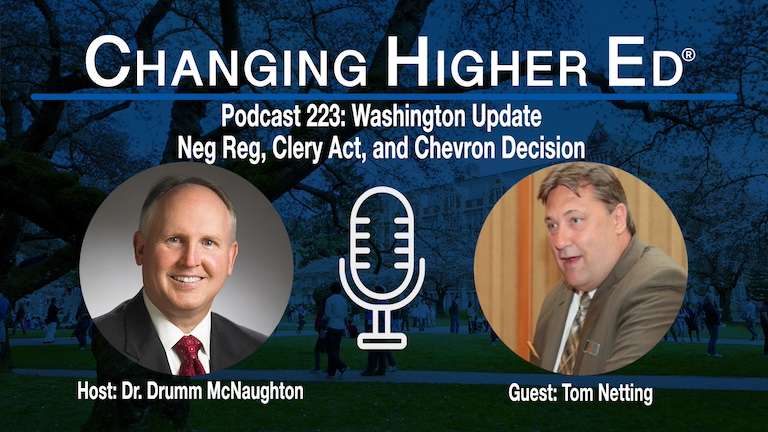
Changing Higher Ed podcast 223 – Washington Update: Neg Reg, Clery Act, and Chevron Decision with Tom Netting

Washington Update: Neg Reg, Clery Act, and Chevron Decision:

Changing Higher Ed podcast 223 with host Dr. Drumm McNaughton and guest Tom Netting

  Covering FAFSA, Title IX, FSA, IDR, SAVE, NC-SARA, NACIQI, PPA, TRIO, Clery Act, Gainful Employment, Title IV, and Chevron Decision Impacts Title IX implementation has created a chaotic regulatory environment, with 26 states under injunction and the rest required to implement new rules as of August 1st, 2023. This state-by-state variation, coupled with potential exemptions for certain student groups, forces institutions to navigate multiple, sometimes conflicting policies simultaneously. The Department of Justice is challenging these injunctions up to the Supreme Court, mirroring legal battles over other higher education policies like the SAVE program for Income-Driven Repayment. This complex situation exemplifies the broader regulatory challenges facing higher education, as detailed in this Washington Update featuring our frequent guest, Tom Netting, President of TEN Government Strategies. This update aims to provide

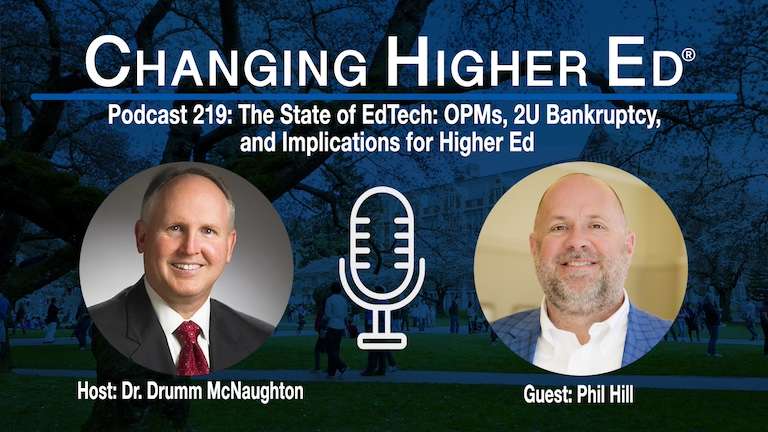
Changing Higher Podcast 219 - The State of EdTech: OPMs, 2U Bankruptcy, and Implications for Higher Ed with host Drumm McNaughton and guest Phil Hill

The State of EdTech: OPMs, 2U Bankruptcy, and Implications for Higher Ed:

Changing Higher Education podcast 219 with host Dr. Drumm McNaughton and guests Phil Hill

  The bankruptcy filing of 2U, a major player in the online program management (OPM) market, has raised questions about the future of EdTech and its impact on universities and colleges. Phil Hill, publisher of the On EdTech newsletter at Phil Hill Associates and resident EdTech expert, joins Dr. Drumm McNaughton to discuss the current state of EdTech, exploring the implications of 2U’s bankruptcy, regulatory changes, and the shifting dynamics of online education. They analyze what university presidents and boards need to know to navigate these changes and effectively leverage current market forces.   The Evolution of EdTech and Regulatory Activism The EdTech landscape has transformed dramatically since the early 2000s. Initially viewed with optimism and supported by government initiatives, the sector now faces increasing scrutiny and regulatory challenges. The

Changing Higher Podcast 187- 2023 Higher Education Year in Review & 2024 Predictions

2023 Higher Education Year in Review and 2024 Predictions:

Changing Higher Ed Podcast 187 with Host Deborah Maue and Guest Dr. Drumm McNaughton

  Join us in our 2023 Higher Education Year in Review and Predictions for 2024. In this sixth annual year-end podcast, Deborah Maue, Aurora University Senior Vice President for Enrollment and Marketing, takes the mic as our special host of the Changing Higher Ed podcast to interview Dr. Drumm McNaughton as they review (and grade) last year’s 2023 higher ed prognostications. The duo share their insights on 2023, discuss the unexpected developments, and what to prepare for with the higher education predictions for 2024.   Reviewing Dr. Drumm McNaughton’s Predictions for 2023 Continuing Decline in College Enrollment: A Closer Look at 2023’s Trends 2022 Prediction for 2023: College enrollment will continue to decline. Grade given by Deb Maue: A. In 2023, college enrollment continued its downward trajectory. Despite a contrasting

Changing Higher Ed Podcast 176-How CSCU is Building Strong Institutional Foundations

How CSCU is Building Strong Institutional Foundations:

Changing Higher Ed Podcast 176 with Host Dr. Drumm McNaughton and Guest Terrence Cheng

  Strategies for Seamless K-12 to Higher Ed Transitions, Embracing Online Learning, and Building Strong Institutional Foundations The second half of this two-part series with Connecticut State Colleges and Universities (CSCU)’s Chancellor Terrence Cheng explores the strategy CSCU uses for building strong institutional foundations to better communicate to high schoolers how connected K-12 is to higher ed and to ensure equity and accessibility for all students. Cheng also shares how his system is revolutionizing its online learning model to better serve local businesses and CSCU’s students across numerous campuses.   Evolving Online Learning Beyond COVID-19 Specifications Although in the early stages, CSCU is working to deliver online learning that’s effective, accessible, and cost-efficient. Cheng communicates to his presidents that the system-wide implementation of the online program does not have to

Changing Higher Ed Podcast 172 - Post University's Career Readiness Model for Not-for-Profit Universities

How Post University’s Career Readiness Model Can Help Not-For-Profit Universities and Graduates:

Changing Higher Ed Podcast 172 with Host Dr. Drumm McNaughton and Guest Camille Dumont

    Although a for-profit institution, Post University employs a unique and effective two-fold approach to its career readiness model to ensure graduates are career-ready with lifelong learning skills that “not-for-profit” universities can emulate on their campuses.   In this podcast episode, Dr. Drumm McNaughton speaks with Director Camille Dumont of the Center for Career and Professional Development (CCPD) about how she aligned career services with academia at Post University to better prepare students for the workforce. Camille discusses how Post ensures students are thinking about their careers from the moment they enroll and how online-only learners receive and benefit from the same services as those who attend the university on campus.     Podcast Highlights   Camille’s mindset on lifelong learning is influenced by personal experience. She successfully transferred

Higher Ed OPM Marketplace Transformation

Higher Ed OPM Marketplace Transformation:

Changing Higher Ed Podcast 125 with Host Dr. Drumm McNaughton and Guest Phil Hill

Changing Higher Ed Podcast 125 with Host Dr. Drumm McNaughton and Guest Phil Hill – Higher Ed OPM Marketplace Transformation   In this episode of Changing Higher Ed podcast, Dr. Drumm McNaughton, a leading expert on change management in higher education, and Phil Hill, one of the top experts on educational technology and online project management, discuss the current—disrupted—state of the industry and the answers college and university presidents must come up with to survive the existential questions facing institutions today. For years, Phil Hill performed small company market analyses, then developed expertise in online and digital education from their very beginnings. When leaders at colleges and universities suggested that he specialize in the unique and complex needs of academia, he jumped at the opportunity. Here, with high-level understanding and

Changing Perceptions About the Quality of Online Education – Changing Higher Ed Podcast 118 with Host Dr. Drumm McNaughton and Guest Brandon Busteed

Changing Perceptions About the Quality of Online Education:

Changing Higher Ed Podcast 118 with Host Dr. Drumm McNaughton and Guest Brandon Busteed

Changing Perceptions About the Quality of Online Education – Changing Higher Ed Podcast 118 with Host Dr. Drumm McNaughton and Guest Brandon Busteed Brandon Busteed is the Chief Partnership Officer and Global Head of Learn-Work Innovation at Kaplan. In his recent article published by Forbes, Busteed cites data showing a monumental shift in Americans’ perspectives about the quality of online education. According to a New American survey, 55% of Americans now rate the quality of online education as being equal to or better than in-person education. In this podcast, Busteed joins Drumm McNaughton for an important discussion about why perceptions are changing so quickly, how online education modalities offer advantages for students and other stakeholders, and what potential implications might lie just around the corner for the higher education industry.

Increase Student Enrollment with Smartphone Delivered Degrees

Increase Student Enrollment with Smartphone Delivered Degrees:

with Dr. Drumm McNaughton and Frank Rojas | Changing Higher Ed Podcast 071

Offering smartphone delivered degrees in higher education is no longer just nice to have; it’s going to increase student enrollment and student success, rendering it a must-have. Higher education online courses are under pressure to meet student needs through increasing online access, inclusion, and engagement. A study by Wiley and Education Dynamics published in June 2020 found that 74% of students in online programs wanted to use their mobile devices to engage in coursework. However, only 13% had done so. To meet this need, Los Angeles Pacific University (LAPU) has created its myLAPU app, a human-centered design effort built in partnership with Ready Education that allows students to complete their full degree on their smartphones. Student-Centered Approach to Smartphone Delivered Degrees LAPU prides itself on creating student access to education.

New Online Education Regulations Create Problems for Higher Ed

New Online Education Regulations Create Problems for Higher Ed:

with Russ Poulin | Changing Higher Ed 061

In this podcast, we discuss how new online education regulations are creating problems for colleges and universities. The implementation of some of the latest higher education regulations is in limbo, thanks to the coronavirus pandemic. However, higher education institutions need to keep an eye on how decisions to move to online or digital courses will be governed by other regulations that are still in place. In addition, leaders need to analyze how the hiatus of some regulations could lead to unexpected impacts for an institution. This podcast’s guest is Dr. Russ Poulin, the executive director of WICHE Cooperative for Educational Technologies (WCET). Online Education and Substantive Interaction All Neg Reg 2019 guidance has been published, including the latest one on online education. This regulation includes the definition of distance education,

How Universities Use Crises to Innovate | with Dr. Drumm McNaughton and Dr. Eric Boynton | Changing Higher Ed Podcast 050

How Universities Use Crises to Innovate:

with Dr. Drumm McNaughton and Dr. Eric Boynton | Changing Higher Ed Podcast 050

 How Universities Use Crises to Innovate podcast discusses how higher education institutions are still reeling from dealing with the coronavirus pandemic during the spring term. However, now they are faced with the challenge of making critical decisions that also offer flexibility moving into the fall semester. Beloit College already is far ahead on this path. This podcast featured Dr. Eric Boynton, Beloit College’s provost and dean of the college. He was instrumental in helping lead the development of a unique plan for moving forward. Universities Use Crises to Innovate by Creating a Task Force In March as the pandemic emerged in the United States, Beloit started creating a COVID-19 task force that included individuals from across the institution that was going to be affected. The institution’s COVID task force,

Higher Ed Leadership Styles in Crisis with Dr. Risa Dickson | Changing Higher Ed Podcast 036

Higher Ed Leadership Styles in Crisis with Dr. Risa Dickson | Changing Higher Ed Podcast 036

Higher Ed Leadership Styles in Crisis Episode Summary Palo Alto University (PAU) has faced several crises over the past few years that ended up serving the institution well in dealing the COVID-19 pandemic. Dr. Risa Dickson, the university’s interim vice president for academic affairs, said the institution is committed to putting the students first, followed by the faculty in order to move through this crisis. The institution is located in Santa Clara County, which was one of the first places in the nation where the virus emerged. Getting Ahead of the Curve Like many private non-profit higher ed institutions, Palo Alto University had no formal risk planning or contingency plans in place to deal with a black swan event such as the COVID-19 crisis. However, several recent challenges prompted institutional

Tips for Higher Ed To Survive and Recover From COVID

Tips for Higher Ed To Survive and Recover From COVID

Tips for Higher Ed To Survive and Recover From COVID. Higher education is in a hurricane created by the COVID-19 virus. In many respects, it is sweeping away plans for the Spring 2020 semester, even in areas where a case hasn’t been identified yet. We’re seeing on-campus classes being canceled, some of which are being moved online; enrollments and finances affected, e.g., deposit dates for AY 2020-2021 being pushed back; study abroad programs and foreign travel are being scrapped; and events—whether that’s the NCAA basketball tournament, conferences or campus art gallery exhibits—canceled. Yet despite the current chaos, higher education still goes on. And when the all-clear sounds (and it will), this won’t be a typical “students are back from summer break” event. Think about 9/11 and how peoples’ mental models shifted–how

TRACS Annual Meeting Learnings | Changing Higher Ed 028

TRACS Annual Meeting Learnings:

Changing Higher Ed Podcast 028

The TRACS Annual Meeting Learnings – Transnational Association of Christian Colleges and Schools, an accreditation body for Christian institutions of higher education, works with approximately 100 institutions. Founded in 1979, the organization is a voluntary non-profit self-governing body that promotes the welfare, interests, and development of higher education institutions that have a distinctly Christian purpose. The TRACS Annual Meeting provides opportunities for networking and learning about best and emerging practices among the members. This podcast features the following individuals who attended the recent TRACS Conference: Ann Rill, Chief Academic Officer at Veritas Baptist College. Bryan McCabe, Academic Dean at Bakke Graduate University Steve Hase, Chief Operating Officer and Chief Financial Officer at Southern Evangelical Seminary Key Learnings from Dr. Ann Rill Veritas Baptist College started as a Bible institute in

The Future of Online Program Management

The Future of Online Program Management Services:

with Dr. Drumm McNaughton and Grant Aldrich | Changing Higher Ed Podcast 026

This program focused on the future of online program management (OPM). When online education began to emerge, many higher education institutions didn’t have the wherewithal and talent to ramp up online programs so many companies started offering OPM services in program conception and creation. Over time, OPMs have expanded to include student recruitment, student retention, and support. These additional services provided by an external company can actually be beneficial to colleges and universities because most higher education institutions don’t do these things very well. However, the role of OPMs in higher education continues to spark controversy. For instance, the most recent negotiated rulemaking process at the federal level saw a push by OPMs and some for-profits to allow outside entities to develop and provide 100% of the curriculum, thus bypassing

New Approaches to Online Education | Changing Higher Ed 016

New Approaches to Online Education:

with Dr. Drumm McNaughton and Russ Poulin | Changing Higher Ed 016

New Approaches to Online Education with Russ Poulin and Dr. Drumm McNaughton podcast discusses how online education continues to grow. And with the constant developments in technology, the delivery systems are rapidly evolving. Therefore, institutional need to be thoughtful about which programs they offer online, who they contract with to offer these services, what types of systems and support structures they put into place, and how they get faculty buy-in. Background on WICHE and WCET Western Interstate Commission for Higher Education (WICHE) is a regional organization that was created in 1953 to facilitate resource sharing among higher education systems in western states and territories. WICHE’s members include New Mexico, Montana, Arizona, Utah, Oregon, Colorado, Wyoming, Idaho, Alaska, Washington, California, Nevada, Hawaii, North Dakota, South Dakota, and the Commonwealth of the

Growing Universities with Post-Traditional Students

Growing Universities with Post-Traditional Students:

with host Dr. Drumm McNaughton and guest Carol Aslanian | Changing Higher Ed Podcast 009

Growing Universities with Post-Traditional Students podcast with host Dr. Drumm McNaughton and  guest Carol Aslanian, a market researcher who helps colleges build strategies and new programming to increase enrollment by focusing on post-traditional students, those students who used to be called “adult students.” Carol began her career in higher education research in the 1980s at The College Board. Her first project in the post-traditional student world was called Youth and Direction for a Learning Society that got hard data to help colleges grow the population of older students coming back to school at two-year and four-year colleges by talking to employers about their needs.   The Current Higher Ed Marketplace is 70% Post-Traditional Students The demographics of the “typical” college student have changed in the last 30-40 years. According to

The Growth of Online Education

The Growth of Online Education Provides Opportunities:

The Changing Face of Higher Ed Part 9

The growth of online education has greatly accelerated. Technology continues to make its mark on college campuses across the nation.  With the rapid changes in what’s available in devices and software, leaders of higher education institutions and faculty are being forced to think creatively about how to utilize and even embrace online education. Technology now offers a myriad of facets and offerings in a place where huge mainframes once were the gold standard and Apple Macintosh Plus computers were the norm. Today’s world is one in which students are digital natives who take technology for granted and non-traditional students need high-quality education delivered at a distance. Therefore, college professors and administration – many of whom are not technologically savvy – must consider the instructional potential of handheld devices, the opportunities

Experiential Education – The Colleges and Universities of Tomorrow

Experiential Education – The Colleges and Universities of Tomorrow

Is Experiential Education the foundation of  Colleges and Universities of tomorrow? How will higher education function in the future? Look beyond distance and online education to more experiential education. The future of residential colleges and universities in America is a hotly debated topic right now. Many are asking how higher education could, and should, look in 20, 30, or 50 years from now. Having students better prepared for the workforce is a hot topic in corporate America. Trying to predict events decades before they unfold may be a fool’s errand, but there is good reason to create an informed forecast. An inspiring vision of the future can be the fuel needed to drive change in the present. Here are some humble predictions about what may lie ahead for higher education

Subscribe To Our Newsletter

Get the Latest News, Posts, and Podcasts in Our Monthly Newsletters