THE CHANGE LEADER

Category: Change Management

Changing Higher Ed podcast 321 with host Dr. Drumm McNaughton and guest Michael Avaltroni | Building Fairleigh Dickinson’s Lifelong Learning Ecosystem Across Five Generations

How Fairleigh Dickinson Is Building an Ecosystem of Lifelong Learning Across Five Generations:

Changing Higher Ed podcast 321 with host Dr. Drumm McNaughton and guest Michael Avaltroni

Program discontinuation is supposed to be the third rail of a presidency. When Fairleigh Dickinson University compiled a significant list of programs to discontinue or consolidate, President Michael Avaltroni took the list to a faculty referendum. Roughly 88 percent of the faculty endorsed it. He credits the result to faculty who understood the evidence, had been brought along on the journey, and could see the decisions inside FDU’s larger redefinition of the university: a shift away from the four-year, time-dependent degree toward an ecosystem of lifelong learning.  In this episode of the Changing Higher Ed® podcast, Dr. Drumm McNaughton and Michael Avaltroni, the first FDU graduate to hold the presidency, walk through the framework driving that redefinition, a university-of-the-future model built on four Ps: programs, people, partnerships, and place. Together,
Changing Higher Ed podcast 316 with host Dr. Drumm McNaughton and guest Justin Beck - Administrative AI in Higher Ed- Finding the Friction Draining Enrollment, Retention, and Donor Revenue

Administrative AI in Higher Ed: Finding the Friction Draining Enrollment, Retention, and Donor Revenue:

Changing Higher Ed podcast 316 with host Dr. Drumm McNaughton and guest Justin Beck

A 4% year-over-year retention gain sounds like a service-desk metric until the dollars get attached to it. At a 5,000-student institution charging $25,000 a year, with roughly 1,500 students per class, that lift compounds across the years a student stays enrolled into real money. Empire State University reported exactly that gain after rolling out AI-based virtual assistants across roughly eight departments, alongside a 25% increase in student engagement on those web properties. The correlation is meaningful for leaders building a business case, though leaders should treat it as a correlation worth investigating rather than a clean causation claim. Administrative AI is producing measurable financial gains at institutions that have paired implementation with strong change management. Empire State, Florida Southwestern, and Boise State are not the largest or best-funded universities in

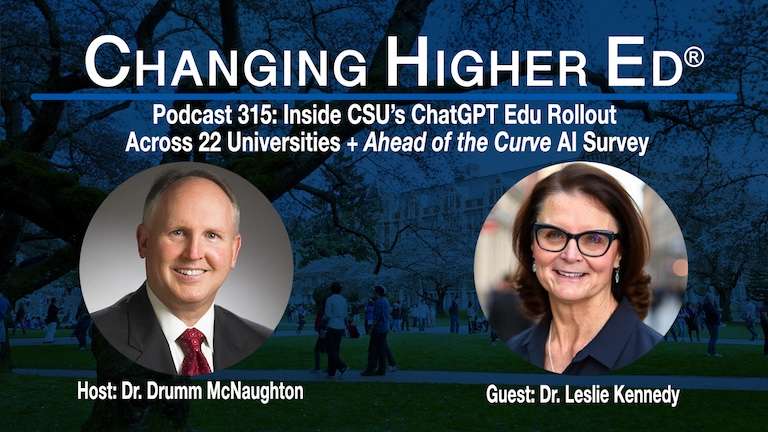
Changing Higher Ed Podcast 315-Dr. Drumm McNaughton and Dr. Leslie Kennedy- Inside CSU’s ChatGPT Edu Rollout Across 22 Universities

What Higher Ed Leaders Can Learn from CSU’s ChatGPT Edu Rollout:

Changing Higher Ed podcast 315 with host Dr. Drumm McNaughton and guest Dr. Leslie Kennedy

California State University expected about 50 faculty applications for its AI Educational Innovations Challenge last spring. It received 417. The system funded 63 projects with $3 million, and the projects will be showcased across disciplines this June. The ratio is what should matter most to other institutional leaders. Faculty appetite for AI is running roughly eight times ahead of what one of the nation’s largest university systems planned to fund. Boards should be asking a different question: whether their institutions have the governance, training, communication, and measurement systems to support responsible AI adoption. That data point sits alongside many more in Ahead of the Curve: What the Nation’s Largest University System Is Learning about AI, the largest AI perception survey ever conducted in higher education, with 94,060 responses from students, faculty,

Changing Higher Ed Podcast 314-Dr. Drumm McNaughton and Dr. Karen Panetta - AI Will Scale Your Institution's Existing Bias: A Procurement and Oversight Framework for Higher Ed

AI Will Scale Your Institution’s Existing Bias: A Procurement and Oversight Framework for Higher Ed:

Changing Higher Ed podcast 314 with host Dr. Drumm McNaughton and guest Dr. Karen Panetta

Most higher ed AI procurement skip the four questions that determine whether the tool will scale institutional bias. A framework for presidents and boards on what to ask before signing. As a high schooler with straight A’s in math and science, Dr. Karen Panetta was told by her school’s career assessment that she could sell makeup or be a cook. A male friend with lower scores got engineer or politician. Dr. Drumm McNaughton, host of the Changing Higher Ed® podcast, was told by his post-Navy assessment to become a forest ranger. No AI was involved in either case. Just rules-based systems applying gender and biographical constraints. That same logic now sits inside AI tools landing in admissions offices and HR systems across higher ed, and McNaughton names the difference that

Changing Higher Ed Podcast 312-Dr. Drumm McNaughton and Nikki Barua-Human-First Transformation: Closing Higher Education’s AI Readiness Gap

Human-First Transformation: Closing Higher Education’s AI Readiness Gap:

Changing Higher Ed podcast 312 with host Dr. Drumm McNaughton and guest Nikki Barua

AI adoption among students is running at 80 to 90 percent. Only 9 percent of CIOs believe their institutions are ready. That gap is not closing on its own. Higher education has a well-practiced response to disruption: study it, pilot it, committee it, and implement it over several budget cycles. That approach worked for the internet. It worked for mobile. It will not work for AI. The difference is speed. The internet took roughly 30 years to reach mass adoption. Mobile took 10 to 15. AI has achieved massive adoption in under three years, and the technology is improving itself week by week without waiting for anyone’s strategic plan to clear shared governance. That timeline changes the nature of the problem. Incremental change, the model higher education knows best, assumes

Changing Higher Ed Podcast 308-Dr. Drumm McNaughton and Mike Toguchi - Higher Ed Technology Change Management and Digital Transformation

Higher Education Change Management for Technology Projects and Digital Transformation:

Changing Higher Ed podcast 308 with host Dr. Drumm McNaughton and guest Mike Toguchi

Higher education’s track record with technology change is uneven for a reason, and the reason is rarely the technology. It is the placement of change management in the project lifecycle. When change management is treated as a rollout activity, handled near the end after vendor selection, contract execution, and configuration, it cannot do the work that determines adoption. By that point, the decisions that govern trust, governance, agility, and stakeholder ownership have already been made, often without the people who will be expected to live with the consequences. The result is a familiar pattern: ambitious initiatives that launch on schedule, generate friction within a semester, and quietly settle into legacy mode without ever delivering the outcomes that justified them. The case for treating change management as a planning discipline rather

Changing Higher Ed Podcast 306-Dr. Drumm McNaughton and Dr. Andy Vaughn- 2026 Title IV Changes and How Higher Education Can Adapt to the OBBBA.jpg

2026 Title IV Changes and How Higher Education Can Adapt to the OBBBA:

Changing Higher Ed podcast 306 with host Dr. Drumm McNaughton and guest Dr. Andy Vaughn

The structural changes now reshaping higher education did not arrive by executive order. They arrived by an act of Congress. That distinction matters enormously, because it means institutions waiting for a policy reversal, a change in the White House, or a shift in chamber control are waiting for something that is not coming. The question is, will adapt in time. That is the central message Dr. Andy Vaughn, President and CEO of Alliant University, and Dr. Drumm McNaughton deliver in part two of his conversation on the Changing Higher Ed® podcast. Having served on the negotiated rulemaking committee that shaped Title IV implementation under the One Big Beautiful Bill (OB3) Act, Vaughn speaks not as an outside observer but as an institutional leader with a front-row seat to what is

Changing Higher Ed Podcast 305-Dr. Drumm McNaughton and Dr. Andy Vaughn- Inside Neg Reg- What Higher Education Leaders Should Do Before July 2026

Inside Neg Reg: What Higher Education Leaders Should Do Before July 2026:

Changing Higher Ed podcast 305 with host Dr. Drumm McNaughton and guest Dr. Andy Vaughn

Title IV loan limits change July 1, 2026. The accreditation Neg Reg begins this May. Both trace back to the One Big Beautiful Bill, (OBBB) an act of Congress that cannot be reversed by a change in administration. Institutions that have not started preparing are already behind. Andy Vaughn, President and CEO of Alliant University and one of three higher education representatives on the 2025 Negotiated Rulemaking RISE Committee, joins Dr. Drumm McNaughton on the Changing Higher Ed podcast to examine what the latest Neg Reg signals about Title IV changes, accreditation reform, delivery costs, and the decisions institutions need to make before July 2026. Higher education has spent years hearing that affordability, student debt, and public skepticism are becoming existential pressures. What is different now is that those pressures

Changing Higher Ed Podcast 303-Dr. Drumm McNaughton and France Hoang - When AI Handles the Task, Higher Education Has to Build Human Judgment

When AI Handles the Task, Higher Education Has to Build Human Judgment:

Changing Higher Ed podcast 303 with host Dr. Drumm McNaughton and guest France Hoang

AI has pushed higher education past the point where policy alone is enough. If students can generate summaries, draft papers, and produce plausible answers in seconds, colleges now have to answer a harder question: what are they teaching that still matters? France Hoang, founder and CEO of BoodleBox, pushes the AI conversation toward the issue that matters most for presidents, provosts, boards, and academic leaders. The central challenge is no longer access to the tool. The challenge is whether colleges and universities will redesign learning, advising, and implementation in ways that strengthen judgment, expertise, and human decision-making rather than weaken them. That is what makes AI a strategic issue for institutional leadership. A campus can publish guidelines, approve a platform, and hold a few workshops without addressing the deeper problem.

Cover Image: Changing Higher Ed Podcast 297 Closing the Change Gap: Agile Change Management for Today’s Higher Education Leaders -Dr. Drumm McNaughton and Dr. Christine Janssen

Closing the Change Gap: Agile Change Management for Today’s Higher Education Leaders:

Changing Higher Ed podcast 297 with host Dr. Drumm McNaughton and guest Dr. Christine Janssen

Higher education is facing a convergence of change unlike anything in its history. Within the past six years alone, institutions have navigated three major transitions: political shifts under the first Trump administration, the COVID-19 pandemic, and now a second Trump administration coupled with the rapid emergence of AI. Demographic decline, funding uncertainty, and shifting student expectations compound these pressures. Change is no longer optional, yet many institutions continue to operate as though incremental adjustments will be sufficient. They will not be. The case for transformational change management draws on the combined perspectives of Dr. Christine Janssen, founder and CEO of Edstutia, an immersive learning platform leveraging virtual reality and AI, and Dr. Drumm McNaughton, a higher education consultant specializing in institutional transformation. Dr. Janssen brings entrepreneurial expertise and a background

Changing Higher Ed podcast episode 261- When DEI Is Off the Table: How Higher Ed Leaders Can Still Drive Institutional Change with host Dr. Drumm McNaughton and guest Susan Sturm of Columbia Law

When DEI Is Off the Table: How Higher Ed Leaders Can Still Drive Institutional Change:

Changing Higher Ed podcast 261 with host Dr. Drumm McNaughton and guest Susan Sturm

  With DEI efforts under political siege and campus trust eroding, higher ed leaders must confront a defining question: How do institutions drive meaningful change when DEI is no longer safe to say out loud? Public skepticism, legislative attacks, and institutional fatigue have exposed the limits of short-term programs and reactive messaging. What’s missing isn’t commitment—it’s a clear strategy for change grounded in institutional trust, leadership alignment, and organizational learning. In this episode, Dr. Drumm McNaughton speaks with Professor Susan Sturm of Columbia Law School, whose decades of work across higher ed, law, and social systems offer a deeper framework for moving from polarization to transformation. Drawing on insights from her recent book, What Might Be: Confronting Racism to Transform Our Institutions, Sturm reframes DEI as an adaptive, systems-level process

Confronting the Storm: Resistance to Change and Current Attacks on Higher Education-Changing Higher Ed podcast 259 with host Dr. Drumm McNaughton and guest Dr. Brian Rosenberg

Confronting the Storm: Resistance to Change and Current Attacks on Higher Education:

Changing Higher Ed podcast 259 with host Dr. Drumm McNaughton and guest Dr. Brian Rosenberg

  Navigating an Era of External Pressures and Internal Resistance to Change in Higher Education Higher education faces unprecedented challenges from declining public trust, external political pressure, and a deeply ingrained resistance to change. In this episode of Changing Higher Ed®, Dr. Brian Rosenberg, former president of Macalister College and author of “Whatever It Is, I’m Against It: Resistance to Change in Higher Education,” shares insights on the current attacks on higher education, how resistance to change has contributed to the sector’s vulnerabilities, and what institutional leaders must do to navigate this turbulent environment. The conversation explores how higher education’s traditional structures and decision-making processes have created barriers to the transformational change needed in today’s volatile higher ed environment, while offering actionable strategies for presidents and boards. Current Attacks on

Illustration showing effective change management in higher education with icons representing holistic thinking, strategic alignment, and stakeholder engagement in front of a university building.

Effective Change Management in Higher Education:

A Holistic Framework for Institutional Transformation — Addressing the Change Management Realities, Barriers, and Breakthroughs

The Reality of Institutional Transformation While change has always been part of academia, the current rate of transformation is undermining the viability of institutions that once seemed unassailable. Between 2016 and 2023, more than 90 colleges closed their doors permanently. This challenge is particularly acute for institutions with long-established cultural and historical foundations. Many colleges face the delicate balance of honoring tradition while embracing the innovation necessary for survival. For faith-based institutions, especially, the challenge is twofold: meeting external demands while staying true to their core missions and values. Through my work with college presidents and governing boards, I’ve seen how technological disruption, financial pressures, post-pandemic student readiness gaps, and the increasingly politicized landscape around DEI have made leadership more complex than ever. These factors are not temporary; they are

Changing Higher Ed podcast 257-Higher Education Strategic Planning That Drives Growth and Faculty Buy-In-Changing Higher Ed podcast 257 with host Dr. Drumm McNaughton and guest Dr. Andrew Hsu

Higher Education Strategic Planning That Drives Growth and Faculty Buy-In:

Changing Higher Ed podcast 257 with host Dr. Drumm McNaughton and Dr. Andrew Hsu

  Effective higher education strategic planning requires more than setting goals—it requires leadership that understands the importance of stakeholder engagement, shared vision, and persistence in driving institutional transformation. In this episode of Changing Higher Ed®, College of Charleston President Dr. Andrew Hsu shares how building consensus and focusing on long-term strategy led to enrollment growth, academic expansion, and the college’s trajectory toward national university status. Leadership-Driven Strategic Planning at College of Charleston Building a Shared Vision Through Holistic Campus Engagement When Dr. Hsu became president of the College of Charleston, he recognized the importance of building institutional change on a foundation of shared vision. Rather than introducing immediate top-down changes, he led a full year of strategic planning that included participation from faculty, staff, students, alumni, and governing boards. This

Change in Higher Education-Changing Higher Ed podcast 254 with host Dr. Drumm McNaughton and guest R. Todd Benson: Using Faculty Satisfaction Data for Strategic

Using Faculty Satisfaction Data for Strategic Change in Higher Education:

Changing Higher Ed podcast 254 with host Dr. Drumm McNaughton and guest Dr. R. Todd Benson

  Faculty surveys are a familiar practice in higher education, but many institutions fall short when it comes to using that data to drive long-term change. Too often, results are seen as evaluations rather than inputs into strategy and leadership development. This episode explores how faculty satisfaction data—along with broader faculty survey data—can be used to inform institutional decision-making, strengthen shared governance, and support leadership effectiveness. This week’s guest is Todd Benson, Executive Director of COACHE—the Collaborative on Academic Careers in Higher Education. He oversees the initiative’s research and institutional collaborations. The discussion highlights how faculty data is being applied on campuses to clarify priorities, improve communication, and guide change management efforts. How Colleges Are Turning Faculty Surveys Into Institutional Strategy COACHE operates on a three-year engagement cycle that begins

Changing Higher Ed podcast 245 - The Glass Cliff in Higher Education: Challenges Faced by Women University Presidents with guest Dr. Lori Varlotta

The Glass Cliff in Higher Education—Challenges Faced by Women University Presidents:

Changing Higher Ed podcast 245 with host Dr. Drumm McNaughton and guest Dr. Lori Varlotta

  According to recent ACE presidential survey data, women now constitute 33% of university presidencies, yet a troubling pattern has emerged: these leaders are often appointed during times of institutional crisis, creating what researchers call “the glass cliff” phenomenon.  In this episode of Changing Higher Ed®, Dr. Lori Varlotta, former president of Hiram College and California Lutheran University and current Distinguished Professor of Higher Education Leadership at Cal Lutheran, shares insights from her research on the glass cliff phenomenon in higher education. Drawing from her first research sabbatical in 40 years, she explores how women presidents are often hired during periods of institutional vulnerability and what can be done to ensure their success. Understanding the Glass Cliff in Higher Education The glass cliff differs significantly from the well-known glass ceiling

Changing Higher Podcast 227- Strategies to Improve Student Retention Rates and Lower Acquisition Costs- with guest Carey Dukes

Strategies to Improve Student Retention Rates and Lower Acquisition Costs:

Changing Higher Education podcast 227 with host Dr. Drumm McNaughton and guests Carey Dukes

  In addition to the enrollment cliff, one challenge continues to loom large in higher education: student retention. Alarming statistics show that 59% of college students don’t graduate within four years, and 30-35% transfer after their freshman year. It’s clear that institutions need to rethink their approach to student success. These numbers not only represent lost potential for students but also significant financial challenges for universities and colleges. Dr. Drumm McNaughton and Carey Dukes, an educational and business leader, discuss a pioneering approach to addressing this critical issue. As an Assistant Professor of Management at North Greenville University, Dukes shares a unique perspective with Dr. McNaughton, combining business experiences with their passion for education. Dukes’ innovative model for improving student readiness and retention offers a beacon of hope for institutions

Changing Higher Podcast 220 - AI Integration in Higher Ed Curriculums-How Kogod Did it in Six Months with host Drumm Mcnaughton and guests David Marchick and Angela Virtu

AI Integration in Higher Ed Curriculums: How Kogod Did it in Six Months:

Changing Higher Ed Podcast 220 with Host Dr. Drumm McNaughton and guests David Marchick and Angela Virtu

  Actionable Insights from American University’s Kogod School of Business on Rapid AI Adoption Throughout Their Curriculum American University’s Kogod School of Business integrated artificial intelligence across its entire curriculum in just six months, revolutionizing its approach to business education. This rapid AI integration strategy offers valuable lessons for higher education institutions seeking to prepare students for an AI-driven future, thereby securing their institution’s relevance and sustainability. In this episode of the Changing Higher Ed podcast, Dean David Marchick and Angela Virtu, Professorial Lecturer in IT & Analytics at Kogod, join Dr. Drumm McNaughton to discuss this ambitious initiative. They share Kogod’s strategy for swiftly developing and implementing AI-integrated courses across the curriculum, including faculty preparation and adaptation of existing programs. Their conversation explores the challenges and opportunities in expeditiously

Changing Higher Ed Podcast 210-Transformative Change Models in Higher Education-Part 2 with guests F. Joseph Merlino and Deborah Pomeroy

Transformative Change Models in Higher Education – Part 2:

Changing Higher Ed podcast 210 with host Dr. Drumm McNaughton and guests F. Joseph Merlino and Deborah Pomeroy

  Transforming Teacher Preparation Programs for the 21st Century In Part 1 of this series, we explored the four primary quandaries that university presidents and higher education leaders must navigate: the tension between mission and revenue, the challenges of interdisciplinary collaboration and integration, the need to address college access and equity, and the balance between admitting in-state and out-of-state students. Part 2 examines the strategies and approaches for tackling teacher preparation challenges and driving transformative change in higher education. Through their research and practical experiences, Joseph Merlino and Deborah Pomeroy share valuable insights on effective change management, the importance of understanding change theory, and the role of service learning in enhancing both pedagogy and research.   Supporting Professors and Processes Through Change Theory  To effectively drive transformative change in higher

Changing Higher Ed 209 - Four Quandaries Facing Higher Ed Presidents - Transforming Teacher Preparation for the 21st Century with host Dr. Drumm McNaughton and guests F. Joseph Merlino and Deborah Pomeroy

Four Quandaries Facing Higher Ed Presidents – Part 1:

Changing Higher Ed podcast 209 with host Dr. Drumm McNaughton and guests F. Joseph Merlino and Deborah Pomeroy

  Transforming Teacher Preparation for the 21st Century This two-part series explores improving teacher preparation for the 21st century, the four quandaries facing higher education presidents, and strategies for addressing change management to facilitate successful transformation.  In Part 1, Joseph Merlino and Deborah Pomeroy join Drumm McNaughton to share their insights as they identify and analyze the dilemmas impacting higher education institutions today. Through their research and experiences, including a project in Egypt focused on transforming teacher preparation programs, they shed light on the four quandaries that higher ed presidents and leaders must navigate to make transformational change in these areas. Part 2 examines the strategies and approaches for tackling teacher preparation challenges and driving transformative change in higher education (and a fifth presidential quandary).   The Four Quandaries Higher

Subscribe To Our Newsletter

Get the Latest News, Posts, and Podcasts in Our Monthly Newsletters