THE CHANGE LEADER

Category: Strategic Planning and Management

Changing Higher Ed podcast 335 with Dr. Drumm McNaughton and Chuck Johnson | Workforce Development in Higher Education: Apprenticeships, Industry Partnerships and Stackable Credentials

Workforce Development in Higher Education: Apprenticeships, Industry Partnerships and Stackable Credentials:

Changing Higher Ed podcast 335 with host Dr. Drumm McNaughton and guest Chuck Johnson

Probably in May 2019, as Chuck Johnson recalls it, Amazon came back to Vincennes University with a bigger request than the training it had first discussed: a four-year registered apprenticeship, to start when a new Indianapolis fulfillment center opened at the end of September. Johnson, the university’s president, was picturing early 2020. Amazon’s answer, he says, was, “You don’t understand. We deliver things overnight.” The program launched that September with 44 associates, and 43 of them eventually completed it. Johnson describes Indiana as facing a “double whammy”: a shrinking high school cohort, and a smaller share of graduates going straight to college, a rate he calls hard to raise given concerns about the ROI of college. His response has been to build programs that need not lead an 18-year-old directly

Washington Update-The Federal Policy Changes Putting Title IV Eligibility at Risk - Changing Higher Ed podcast 330 with host Dr. Drumm McNaughton with guest Tom Netting

Washington Update: The Federal Policy Changes Putting Title IV Eligibility at Risk and What the 2026 Midterms Could Change:

Changing Higher Ed podcast 330 with host Dr. Drumm McNaughton and guest Tom Netting

For many colleges and universities, the most immediate threat to Title IV eligibility over the next two years is a number no one on campus controls. Student loan default and repayment rates have continued to be calculated through years in which collections stopped and borrowers were told they did not have to pay. Those rates drive eligibility decisions for every institution of higher education. They are running considerably higher than normal, and no regulatory accommodation has been made for them. That exposure sits on top of a federal agenda moving on several fronts at once. The One Big Beautiful Bill (OB3) regulatory packages are final, including an earnings accountability metric that reaches every program at every institution. The Accreditation, Innovation, and Modernization (AIM) negotiated rulemaking has produced proposed rules that

Changing Higher Ed Podcast 328 Employer Engagement in Higher Education- Why Available Support Can Still Go Unused with Brad Griffith

Employer Engagement in Higher Education: Why Available Support Can Still Go Unused:

Changing Higher Ed podcast 328 with host Dr. Drumm McNaughton and guest Brad Griffith

A twelve-person software firm in central Ohio ran six paid interns this past summer, put every one of them on real client work, and then filed with the state for reimbursement of a substantial share of those wages. One of those interns arrived from the University of Richmond with his placement funded by his own institution, roughly five hundred miles away. Others have come through Ohio State with donor money attached. That employer engagement in higher education still required the company to identify, assemble, and navigate several separate funding and placement channels. That is the part of the workforce-readiness conversation that tends to get skipped. The usual assumption is that closing the gap between graduation and employment takes new money, new programs, and new staff. In some states and at

Changing Higher Ed podcast 327 with Dr. Drumm McNaughton and Dr. Brooke Barnett | How a Tuition-Dependent College Built Non-Tuition Revenue That Strengthens Its Academic Mission

How a Tuition-Dependent College Built Non-Tuition Revenue That Strengthens Its Academic Mission:

Changing Higher Ed podcast 327 with host Dr. Drumm McNaughton and guest Dr. Brooke Barnett

Private colleges under enrollment pressure get told to diversify revenue. The venture that follows usually either fails to earn or drags the institution away from the academic identity families were paying for, and the college ends up with a side business it has to keep defending to its own faculty.Rollins College spent more than a decade and $200 million building a three-part portfolio it calls the Innovation Triangle, and the three parts run on deliberately different economics. A boutique inn that doubles as a rotating contemporary art collection had sent $10.8 million to student scholarships as of early 2026. An art museum moving off campus into the community charges no admission and is designed to draw no institutional funds. An executive education institute, seeded with a $10 million commitment and

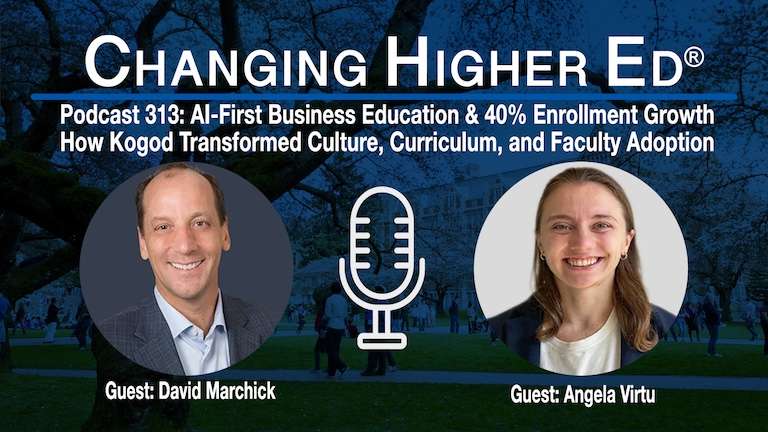
Changing Higher Ed Podcast 313-Dr. Drumm McNaughton, David Marchick, and Angela Virtu-313: AI-First Business Education & 40% Enrollment Growth-How Kogod Transformed Culture, Curriculum, and Faculty Adoption

How Kogod’s AI-First Business School Model Drove 40% Enrollment Growth in Three Years:

Changing Higher Ed podcast 313 with host Dr. Drumm McNaughton with guests David Marchick and Angela Virtu

Most business schools are still forming committees to study AI. Kogod School of Business at American University formed one too, gave it six weeks and a five-page limit, and has since integrated AI into every department, every major, and every minor. The impact: Undergraduate enrollment is up 40% over three years. Applications are up 50%. More than 90% of faculty are using AI in the classroom. Bloomberg Businessweek called Kogod the first AI-first business school, and the program has been named among the top ten to watch two years running. What makes learning about Kogod’s transformation useful to other higher ed leaders isn’t about AI technology itself (for a change). What makes this discussion valuable is how the school moved from a dean’s instinct that AI would matter to a

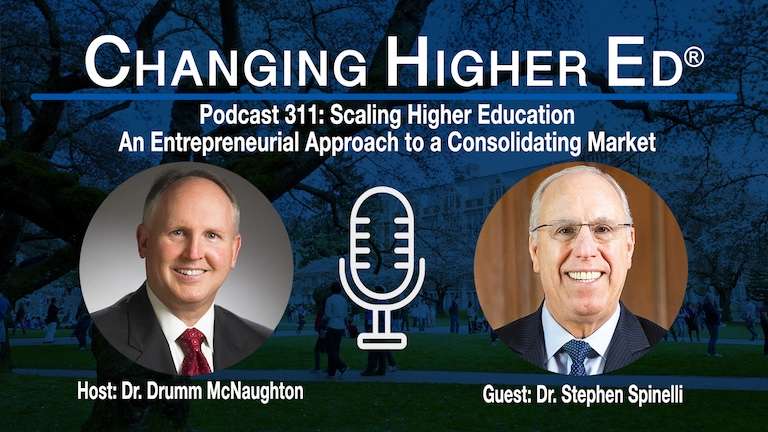
Changing Higher Ed Podcast 311-Dr. Drumm McNaughton and Dr. Stepen Spinelli-Scaling Higher Education: An Entrepreneurial Approach to a Consolidating Market

Scaling Higher Education: An Entrepreneurial Approach to a Consolidating Market:

Changing Higher Ed podcast 311 with host Dr. Drumm McNaughton and guest Dr. Stephen Spinelli

Higher education’s anti-scale culture is a strategic problem the sector has not honestly confronted. Entrepreneurial leadership may help identify which institutions are most likely to survive consolidation. Dr. Stephen Spinelli, president of Babson College, joined Dr. Drumm McNaughton to discuss what scaling and an entrepreneurial mindset mean for higher education right now. His diagnosis is direct. Higher education has every signal of a market in early consolidation, and the sector is openly anti-scale. It treats containment and selectivity as virtues and has not seriously asked what scale would mean for the institutions trying to make it through the next decade. Institutions that read the market correctly and act will be the ones still standing. Institutions that wait for the environment to revert will not. Higher Education Is Consolidating, and the

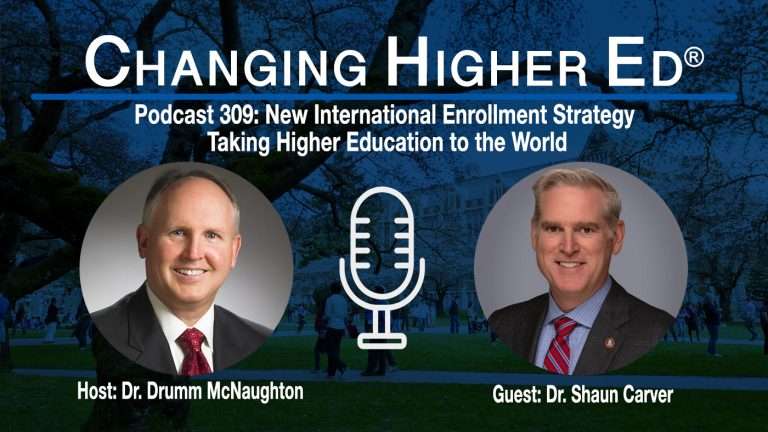
Changing Higher Ed Podcast 309-Dr. Drumm McNaughton and Dr. Shaun Carver- International Enrollment Strategy: Taking Higher Education to the World

Take the University to the World: A New International Enrollment Strategy for Regional and Private Colleges:

Changing Higher Ed podcast 309 with host Dr. Drumm McNaughton and guest Dr. Shaun Carver

International student enrollment in the United States hit record numbers in 2024-2025, then dropped sharply heading into 2025-2026, with effects that will compound through 2026-2027. The headline number conceals what matters most for institutional strategy: the decline is bifurcated. UC Berkeley enrolled more international students this past fall than at any point in its history. Regional privates and tier-two publics are losing them. The same conditions producing record numbers at top-tier brands are accelerating losses at the institutions that have spent the last decade quietly subsidizing operating budgets with international tuition. The stakes extend well beyond a single line in the budget. International students generated more than 55,000 jobs in California between 2022 and 2023. Roughly half of the founders behind Silicon Valley first arrived on a student visa. Travel

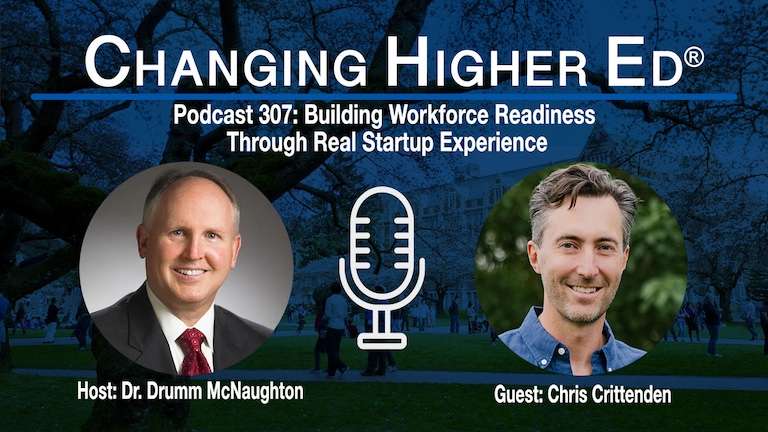
Changing Higher Ed Podcast 307-Dr. Drumm McNaughton and Chris Crittenden - Building Workforce Readiness Through Real Startup Experience

Building Workforce Readiness Through Real Startup Experience:

Changing Higher Ed podcast 307 with host Dr. Drumm McNaughton and guest Chris Crittenden

Experiential learning has become a near-universal claim in higher education, but the claim and the reality are rarely the same thing. Project-based courses, case studies, and capstone assignments are offered as evidence that institutions are preparing students for the workforce. Most of this activity is too shallow to produce the outcomes institutions advertise. Students move through it, complete the deliverable, and emerge with little more capability than they had before. This analysis draws on the work of Chris Crittenden, founder of Sandbox, a for-credit startup incubator now operating at eight universities. Crittenden’s background spans management consulting at McKinsey, founding and selling an AI technology company to Walmart, and leading the entrepreneur center at Brigham Young University before building Sandbox into a cross-institutional program. Sandbox students earn 18 credits over two

Changing Higher Ed Podcast 298 The Data Exists, You're Just Not Using It — Tracking Stop-Outs, Transfers, and ROI Across the Full Student Journey -Dr. Drumm McNaughton and Melba Amissi - National Student Clearinghouse

The Data Exists, You’re Just Not Using It — Tracking Stop-Outs, Transfers, and ROI Across the Full Student Journey:

Changing Higher Ed podcast 298 with host Dr. Drumm McNaughton and guest Melba Amissi

Higher education is sitting on one of the most powerful data assets in the country and most institutions aren’t using it. While colleges and universities debate their purpose, wrestle with declining public confidence, and face mounting pressure to demonstrate value, the National Student Clearinghouse quietly tracks the educational journeys of nearly every postsecondary student in the United States. The question for institutional leaders is not whether this data exists, but whether they are using it to make better decisions. This conversation draws on the perspective of Melba Amissi, Chief Customer and Operations Officer at the National Student Clearinghouse. Amissi brings a career rooted in financial services, fraud analytics, cybersecurity, and operational transformation, entering higher education only three years ago. That outside perspective is the point. Higher education has long been

2026 Strategic Planning for Higher Education | The Change Leader | The outlook for higher education in 2026 and insights for presidents and boards to know before completing their planning for 2026 and beyond

2026 Higher Education Strategic Outlook: Converting 2025 Shocks into Executable Decisions:

Before your 2026 strategic plan is finalized, pressure-test the assumptions that no longer hold

If you are preparing for a 2026 strategic planning cycle, this post is written to be used, not skimmed. It translates 2025 conditions into the board-level decisions, thresholds, and oversight questions that keep a plan executable when conditions shift. This briefing is designed to convert what you already know happened in 2025 into the decisions that protect execution in 2026 and beyond. Most higher education leaders do not need another recap of 2025. You lived it. The practical problem entering 2026 is how to convert a volatile policy environment, cost pressure, enrollment uncertainty, and accountability changes into decisions that protect the institution, preserve mission, and keep options open. This is the shift. 2026 planning cannot be built on stable assumptions. It has to be built on decision gates, credible contingencies,

Changing Higher Ed Podcast Cover Image-Podcast 292: How Stevens Tech Became One of the Strongest Transformation Stories in Higher Education

How Stevens Tech Became One of the Strongest Transformation Stories in Higher Education:

Changing Higher Ed podcast 292 with host Dr. Drumm McNaughton and guest Dr. Nariman Farvardin

Strategic Planning and Academic Realignment at Stevens Institute of Technology Stevens Institute of Technology has become a living example of how disciplined strategic planning, academic realignment, and institutional follow-through can transform a university for long-term relevance and success. This episode of the Changing Higher Ed podcast features Dr. Nariman Farvardin, President of Stevens Institute of Technology. Since assuming the presidency in 2011, Dr. Farvardin has led a remarkable institutional transformation driven by comprehensive planning, academic realignment, and sustained execution. Under his leadership, Stevens moved from incremental change to structural transformation, producing outcomes that place the institution among the strongest performers in the country. The result is not theoretical success. It is measurable, sustained performance across enrollment demand, student outcomes, research activity, and institutional reputation. Under Dr. Farvardin’s presidency: Undergraduate applications

Changing Higher Ed podcast 291 cover image - Higher Education 2026 Planning and Outlook with Lessons from 2025 Predictions with guest host Tom Netting and co-host Dr. Drumm McNaughton

Higher Education 2026 Planning and Outlook with Lessons from 2025 Predictions:

Changing Higher Ed podcast 291 with guest host Tom Netting and co-host Dr. Drumm McNaughton

In this 8th annual end-of-year episode of the Changing Higher Ed® podcast, Dr. Drumm McNaughton joins Tom Netting of TEN Government Strategies to review how 2025 unfolded and explore what institutional leaders must prepare for in 2026. The discussion reveals how higher education navigated a transformative year marked by federal policy shifts, economic pressures, and fundamental questions about the sector’s future—and what these changes mean for strategic planning in the year ahead.   The Accuracy of 2025 Predictions: Key Lessons Dr. McNaughton’s 2025 predictions proved remarkably prescient, with Tom Netting noting he “batted a thousand” on forecasting the year’s major developments. The accuracy of these predictions offers important lessons for institutional planning: Higher Education Act Reform Through Reconciliation  As predicted, comprehensive HEA reauthorization did not occur independently. Instead, reforms came

Changing Higher Ed Podcast Cover Image-290- Strategic Insights from the 2025 AAC&U Employer Survey-What Employers want from higher education-Dr. Drumm McNaughton and Dr. Ashley Finley

Strategic Insights from the 2025 AAC&U Employer Survey: What Employers Really Think About Higher Education:

Changing Higher Ed podcast 290 with host Dr. Drumm McNaughton and guest Dr. Ashley Finley

Employers are far more aligned with higher education than today’s public and political narratives suggest—and the 2025 AAC&U Employer Survey makes that disconnect impossible to ignore. In this episode of Changing Higher Ed, Dr. Drumm McNaughton speaks with Dr. Ashley Finley of the Association of American Colleges and Universities about her AAC&U’s 2025 Employer Survey, The Agility Imperative: How Employers View Preparation for an Uncertain Future, and what it reveals about the real-world employer views of college degrees, civic learning, AI readiness, and the skills that matter most for an uncertain future. This conversation builds on nearly 20 years of longitudinal employer research and offers one of the clearest signals yet that employers continue to value higher education, often in ways that contradict prevailing public narratives. The findings challenge institutions to

Cover image | Changing Higher Ed podcast 289 with host Dr. Drumm McNaughton and guest David Maffei | Higher Education Communication Strategy Under Political Pressure and Crisis Risk

Higher Education Communication Strategy Under Political Pressure and Crisis Risk:

Changing Higher Ed podcast 289 with host Dr. Drumm McNaughton and guest David Maffei

Higher education is operating inside one of the most unforgiving communication environments in modern history. Political pressure, fractured trust, faculty skepticism, board-level risk exposure, and real-time public scrutiny have collapsed the margin for error. In this environment, a coherent higher education communication strategy is no longer a marketing function. It is a strategic planning and leadership discipline. In this episode of Changing Higher Ed®, Dr. Drumm McNaughton is joined by David Maffei, Senior Vice President and General Manager of the Americas at Staffbase, for a grounded, operational conversation about what university presidents and governing boards must understand about communication in 2025 and beyond. David Maffei brings more than two decades of enterprise communications leadership across multiple sectors, including higher education. The discussion moves well beyond platforms and tools to the

Changing Higher Ed podcast 287 | How Leaders Can Reclaim the Narratives About Higher Education and Rebuild Public Trust | With host Dr. Drumm McNaughton and guest Peter Murphy Lewis

How Leaders Can Reclaim the Narrative About Higher Education and Rebuild Public Trust:

Changing Higher Ed Podcast 287 with host Dr. Drumm McNaughton and guest Peter Murphy Lewis

Public narratives about higher education have drifted away from the real work taking place on campuses. Families hear more from pundits, political operatives, and social media personalities than from the people who teach, mentor, and support students every day. As those outside voices grow louder, institutions struggle to communicate the value they deliver. Leaders need a narrative strategy built on authenticity, clarity, and lived experience. Peter Murphy Lewis brings relevant insight to this moment. As a CNN political analyst, filmmaker, and director of People Worth Caring About, he works in environments where public assumptions rarely match reality. His documentary approach shows how human-centered storytelling can bridge gaps in understanding, especially when political noise dominates the conversation.  Lewis’s framework helps leaders understand why perceptions have drifted, how distorted narratives spread, and

Innovation in Higher Education: How Leaders Build the Capacity to Adapt with Insights from AFIT | Changing Higher Ed Podcast 286 with host Dr. Drumm McNaughton and guest Erika Liodice

Innovation in Higher Education: How Leaders Build the Capacity to Adapt with Insights from AFIT:

Changing Higher Ed Podcast 286 with host Dr. Drumm McNaughton and guest Erika Liodice

Innovation in higher education often breaks down long before it reaches implementation. Leaders see where the institution needs to go, but the structures beneath them move at a pace built for a different era. Teams struggle to make sense of unfamiliar challenges. Planning cycles are misaligned with the rate of external change. Initiatives stall because the institution lacks the shared practices, cross-functional coordination, and environmental intelligence necessary for action. These gaps are not caused by a lack of commitment. They are symptoms of organizations that were never designed to operate in today’s conditions. This episode examines how colleges and universities can build the internal capacity required for innovation. The discussion draws on field examples from the Alliance for Innovation and Transformation (AFIT), where leaders from community colleges, technical colleges, and

Aligning Higher Education Strategy and Programs with Workforce Needs by Measuring Value Through Outcomes and Earnings | Changing Higher Ed podcast 282 with host Dr. Drumm McNaughton and guest Dr. Harrison Keller

Aligning Higher Education Strategy and Programs with Workforce Needs by Measuring Value Through Outcomes and Earnings:

Changing Higher Ed podcast 282 with host Dr. Drumm McNaughton and guest Dr. Harrison Keller

This episode of the Changing Higher Ed podcast helps higher education presidents, boards, and senior leaders rethink how to connect institutional mission with workforce readiness. It explores how institutions can better align employer partnerships, faculty innovation, and experiential learning to ensure graduates gain both economic and civic value from their degrees. Dr. Drumm McNaughton speaks with Dr. Harrison Keller, president of the University of North Texas and former Texas commissioner of higher education, whose experience turning statewide workforce policy into institutional strategy offers a practical model for today’s campus leaders. As commissioner, Keller helped launch Building a Talent Strong Texas, the first statewide plan to link educational attainment goals directly to the economic value of degrees. Now, as president of one of the state’s largest universities, he’s applying those ideas to

How to Execute a Debt-Free Higher Education Turnaround Through Real Estate and Risk Planning | Changing Higher Ed podcast 280 with host Dr. Drumm McNaughton and guest Dr. Beth Martin

How to Execute a Debt-Free Higher Education Turnaround Through Real Estate and Risk Planning:

Changing Higher Ed podcast 280 with host Dr. Drumm McNaughton and guest Dr. Beth Martin

When every board meeting is about cuts, deficits, or another “strategic realignment,” leaders start asking what it would take to actually fix the institution instead of managing its collapse. When higher education institutions reach that point, recovery depends on disciplined execution, clear governance, and a business plan rooted in measurable outcomes. We explore how to stabilize and transform a university when real estate is part of the equation—and how systems theory, change management, and risk planning can guide a true debt-free higher education turnaround instead of another temporary fix. In this episode of the Changing Higher Ed podcast, Dr. Beth Martin, President of Notre Dame de Namur University (NDNU), joins Dr. Drumm McNaughton to share how she led NDNU through a financial and operational turnaround. Drawing from her earlier career

Changing Higher Ed podcast 278 Higher Education Fundraising and Strategic Planning Alignment

Higher Education Fundraising and Strategic Planning Alignment—Strengthening Donor Relationships and Institutional Resilience:

Changing Higher Ed podcast 278 with host Dr. Drumm McNaughton and guest Dr. Bill Crouch

Shifts in tax policy and philanthropic behavior are reducing traditional donor activity at the very moment institutional budgets are already strained by declining enrollments, demographic cliffs, and shrinking government support. For presidents and boards, this means fundraising can no longer be treated as a background function. It must become a central lever in strategic planning—one that builds sustainable income pipelines to stabilize the institution’s future. This week’s Changing Higher Ed podcast brings forward practical strategies for presidents and boards to strengthen their fundraising impact. Bill Crouch, CEO of BrightDot and former university president, draws on forty years of experience to explain how institutions can move from transactional giving to cultivating generosity that creates long-lasting ripple effects. Beyond Transactions: Building Donor “Mattership” Donors today are asking a simple but profound question: Does my life

Cover Image- Changing Higher Ed podcast 276 with host Dr. Drumm McNaughton and guest Dr. Emily Chase Coleman | Enrollment Analytics: Using Data Modeling to Improve Student Recruitment, Retention, Budgeting, and Planning

Enrollment Analytics: Using Data Modeling to Improve Student Recruitment, Retention, Budgeting, and Planning:

Changing Higher Ed podcast 276 with host Dr. Drumm McNaughton and guest Dr. Emily Chase Coleman

Many institutions discover too late that the way they collect and manage enrollment data makes it impossible to build reliable forecasts. Institutions can no longer rely solely on tradition, instinct, or anecdotal evidence to guide their recruiting and retention efforts. Data-driven strategies, particularly enrollment analytics, have become a competitive necessity. In this episode of the Changing Higher Ed podcast, Dr. Drumm McNaughton speaks with Dr. Emily Chase Coleman, co-founder and CEO of HAI Analytics, about how predictive and financial aid analytics can transform enrollment management and strategic planning. Together, they examine how institutions can move beyond guesswork to create evidence-based strategies that enhance recruitment, improve retention, and strengthen long-term financial stability. For boards and presidents, the question isn’t just how to recruit and retain more students — it’s how to

Subscribe To Our Newsletter

Get the Latest News, Posts, and Podcasts in Our Monthly Newsletters