
May 19, 2026 · Episode 312
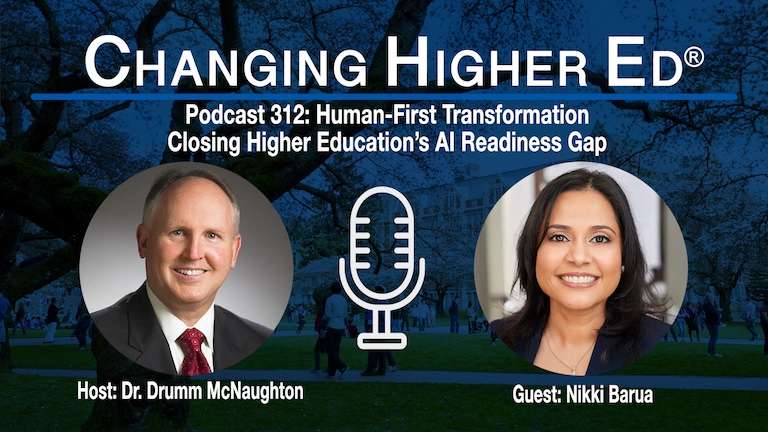
Human-First Transformation: Closing Higher Education’s AI Readiness Gap
39 Min · By Dr. Drumm McNaughton
AI is outpacing higher education’s traditional change models, forcing leaders to rethink readiness, workforce preparation, and institutional strategy.
AI adoption among students is running at 80 to 90 percent. Only 9 percent of CIOs believe their institutions are ready. That gap is not closing on its own.
Higher education has a well-practiced response to disruption: study it, pilot it, committee it, and implement it over several budget cycles. That approach worked for the internet. It worked for mobile. It will not work for AI. The difference is speed. The internet took roughly 30 years to reach mass adoption. Mobile took 10 to 15. AI has achieved massive adoption in under three years, and the technology is improving itself week by week without waiting for anyone’s strategic plan to clear shared governance.
That timeline changes the nature of the problem. Incremental change, the model higher education knows best, assumes the environment holds still long enough for institutions to catch up. AI does not hold still. By the time an institution finishes one round of adaptation, ten other changes have already arrived. The standard change management playbook that has served institutions for decades is, as one expert put it bluntly, dead in the water.
This analysis draws on a conversation between Dr. Drumm McNaughton, founder of The Change Leader, and Nikki Barua, a serial entrepreneur who specializes in AI implementation and organizational change across Fortune 500 companies. Barua founded FlipWork, a firm focused on helping organizations adapt for the AI age through what she calls human-first transformation. Her work centers on closing the gap between how fast AI moves and how slowly organizations change their people, culture, and workflows to keep pace. McNaughton brings the institutional lens, drawing on his background in academic administration and decades of consulting with university leadership, boards, and accrediting bodies.
Their shared conclusion: the AI readiness gap in higher education is structural, and it will not be solved by adding an AI training module to the professional development calendar.
The Exponential Divide Is Real, and Incremental Change Cannot Close It
McNaughton frames the scope of the challenge through a change management lens familiar to institutional leaders. In the standard higher education textbook, there are three categories of change. Incremental change is the natural mode for most institutions, built on the same logic as academic research: you add to the body of knowledge a little at a time. Transformational change describes what the internet required. Revolutionary change is something else entirely, and that is what AI represents.
Barua reinforces that distinction with data from the corporate world. Close to 90 percent of businesses worldwide have adopted AI in some form. That’s the good news. The bad news is that 40 percent of AI pilots and initiatives are failing, and the reason is consistent: organizations are investing in the technology without preparing the people who need to use it. In Barua’s framing, they are putting a Ferrari engine in a lawnmower and wondering why it isn’t going any faster.
The failure pattern is predictable. Organizations buy tools, launch pilots, and expect results. When results don’t materialize, they blame the technology. The actual bottleneck is that no one rewired how people work. AI training alone does not solve this. Institutions have to change behaviors, habits, and workflows, not just add a new competency to the checklist.
Barua’s approach at FlipWork uses 90-day sprints rather than multi-year transformation plans. The logic is practical: if you make the sprints longer, external changes outpace your internal progress before you finish. Shorter cycles allow institutions to incorporate new developments as they emerge rather than building a plan that is outdated before it launches.
AI Is Infrastructure, Not an IT Project
One of the most consequential framing mistakes institutions make is treating AI as a technology initiative housed in the IT department. Both McNaughton and Barua push back on this directly. AI is not a vertical function. It behaves more like electricity. It runs across every part of the institution, and that means every stakeholder has to be part of the conversation.
This has direct implications for institutional governance. If AI sits in IT, the president, provost, and board are not asking the right questions about how it changes competitive positioning, enrollment strategy, academic delivery, and student support. Relegating AI to one department guarantees fragmented adoption and, eventually, the problem Barua identifies as shadow AI: unauthorized and inappropriate use by students and staff who have raced ahead of institutional guidance because no one is leading them.
The stakeholder-based approach Barua advocates aligns naturally with how higher education operates. Shared governance, faculty input, and consensus-building are already in the institutional DNA. The challenge is applying those processes at a speed that matches the technology, not abandoning them, but accelerating them.
The Disappearing Bottom Rung and the Shift to Skills-Based Hiring
The workforce implications of AI create a direct problem for higher education’s core value proposition. Barua cites the prediction from Dario Amodei, CEO of Anthropic, that 50 percent of entry-level jobs could be displaced by AI within one to five years. McNaughton noted the estimate may run high in the near term but acknowledged the trajectory is undeniable and the implications for the talent pipeline are enormous.
The structural issue is not just job loss. It is the disappearance of the bottom rung of the career ladder. Entry-level positions have historically served as the apprenticeship layer where graduates develop professional skills, learn organizational culture, and build the experience that qualifies them for advancement. If that rung contracts or disappears, the entire model of professional development that institutions have prepared graduates for is disrupted.
Employers are responding by shifting from role-based hiring to skills-based hiring. Barua describes the shift as moving from an army of soldiers with defined capabilities to a Navy SEAL team of experts assembled for specific missions. Career paths are becoming nonlinear. Graduates will need a portfolio of skills they continuously rebuild throughout their careers, and that requires what Barua calls a fundamentally entrepreneurial mindset: higher agency, self-direction, and the ability to anticipate what is ahead without waiting for someone else to design the path.
For institutions, this means the four-year degree as a one-time credentialing event is losing ground to modular, competency-based, stackable credentials that support lifelong learning. The institutions that adapt their program design to this reality will be positioned to serve students across entire careers, not just the first four years.
Human Skills Are the Premium Offering, and Faculty Are the Key
Both McNaughton and Barua are emphatic on this point: the skills that matter most in an AI-driven workplace are the ones AI cannot replicate. Creativity, compassion, ethical judgment, complex reasoning, relational skills, and the ability to bring personal perspective into ambiguous situations. These are not soft skills in the dismissive sense. They are the differentiator.
Barua points out that the newest frontier AI models are already demonstrating capabilities that were considered exclusively human just a year ago, including taste, judgment, and complex problem-solving across entire professions. When AI can transfer knowledge infinitely and with unlimited patience, the value of a human instructor delivering content from a textbook diminishes. What does not diminish is the capacity to contextualize, to explain why something matters, to model ethical reasoning, and to build the kind of critical thinking that McNaughton ties to the upper levels of Bloom’s Taxonomy: synthesis, evaluation, and application.
McNaughton connects this directly to the liberal arts debate. For those who want to do away with liberal arts education, he argues, this is exactly why you don’t. Barua agrees, noting that liberal arts graduates may be more valuable than ever because their training emphasizes precisely the competencies employers say they cannot find: critical thinking, self-expression, and the ability to see connections across disciplines. She observed that engineering graduates are entering a market where AI can already do significant portions of their job, while the social sciences and liberal arts are becoming more, not less, relevant.
The role of the professor shifts accordingly. As Barua describes it, the transition moves from transferring knowledge and teaching content to becoming mentors and guides. AI can serve as a 24/7 tutor, an adaptive learning platform, and an infinitely patient teaching assistant. What it cannot do is inspire curiosity, teach ethical reasoning, or help a student find their own voice within a group. Those are faculty functions, and they represent the premium offering institutions can build their value proposition around.
Human-in-the-Loop Operations: Where AI Helps and Where It Hurts
Beyond the classroom, AI has immediate applications across institutional operations. Barua identifies use cases in admissions, enrollment, advising, student mental health support, grant writing, and research. McNaughton estimates that AI could handle roughly 75 percent of the top-of-funnel enrollment process, from initial inquiry through information delivery, before a human needs to step in for the relational work that actually closes the decision.
The danger, both agree, is automating away humanity. Barua describes the common failure: an institution replaces a human-driven process with a chatbot, gains efficiency and scale, but loses the trust and confidence that made the human interaction valuable in the first place. McNaughton illustrates the frustration from the user’s side, describing chatbots so rigidly programmed they can only steer users toward predetermined responses rather than addressing what the person actually needs.
The solution is what Barua calls human-in-the-loop design. Every step of a workflow, whether admissions, advising, or student support, needs to be mapped from the student’s perspective. Some steps benefit from scalable technology. Others should never be handed to a machine because that is where relationships and confidence are built. When a system detects frustration, it should hand off to a human immediately rather than cycling the user through another menu. Designing that handoff point intentionally is what separates thoughtful AI implementation from the kind that drives people away.
The Real AI Risk Is Human, Not Machine
When asked about the doom-and-gloom narratives around AI, Barua’s answer is pointed. The real risk is not robots taking over or turning humans into slaves. That is an imagined doomsday scenario. The immediate and present risk is humans becoming bad actors who leverage this powerful technology to do bad things to other humans. That is the threat institutions should be preparing graduates to recognize and resist.
McNaughton reinforces this by previewing an upcoming episode with American University, where the business school’s first course in their AI-integrated curriculum is Ethics in AI. The sequencing matters. Ethics is not an elective bolted on after students learn the tools. It is the foundation everything else is built on.
This is another argument for treating AI literacy as a core institutional capability rather than a training add-on. Just as students today are expected to know how to use a computer, graduating students who are AI native, who understand both the capability and the ethical boundaries of the technology, should be baseline expectation, not a competitive differentiator.
The Existential Question for Every Institution
Barua poses the question directly: What do you offer that AI cannot replicate? That is not a rhetorical exercise. It is the strategic question every president and board should be asking right now. The answer defines the institution’s value proposition for the next decade.
Institutions that can articulate a clear answer, one grounded in human mentorship, ethical formation, experiential learning, and the capacity to develop professionals who can work across difference, will hold their position. Institutions that cannot answer it, or that delay asking it while waiting for the environment to stabilize, are betting on a strategy that is not defensible. AI is not waiting for higher education to catch up. The cost of waiting grows exponentially every week.
Three Takeaways for University Presidents and Boards
- AI is an opportunity for reinvention, not an IT project. Do not relegate AI to the IT department. This is an inflection point for the leadership team to rethink overall institutional strategy, competitive advantage, and what the institution offers that AI will not replace. Think about how AI changes your agility as an institution and how you prepare people and culture for what is ahead.
- Lead the students or they will lead themselves into shadow AI. Students are already using AI at rates far exceeding institutional readiness. If leaders do not establish governance frameworks, ethical guidelines, and structured guidance, the result is unauthorized and inappropriate use across the institution. The choice is between leading adoption intentionally and managing the consequences of unmanaged adoption.
- The cost of waiting grows exponentially, not linearly. AI technology evolves week by week. The gap between where institutions are and where they need to be is not holding steady. It is widening. The longer leadership delays, the harder and more expensive the catch-up becomes. The time to begin is now.
Quick Overview
- The AI readiness gap in higher education is severe: 80 to 90 percent of students use AI, while only 9 percent of CIOs believe their institutions are prepared
- Incremental and episodic change management approaches cannot keep pace with AI’s revolutionary, week-by-week evolution; continuous reinvention is required
- AI is institutional infrastructure comparable to electricity, requiring cross-departmental stakeholder engagement, not IT-department ownership
- Forty percent of corporate AI pilots fail because organizations invest in technology without preparing people, effectively putting a Ferrari engine in a lawnmower
- Industry leaders predict up to 50 percent of entry-level jobs may be displaced by AI within one to five years, disrupting the traditional career ladder
- Employers are shifting to skills-based hiring, assembling project-specific teams rather than filling fixed roles
- As frontier AI models develop judgment and problem-solving capabilities, faculty roles must shift from knowledge transfer to mentoring, ethical formation, and teaching complex synthesis
- Liberal arts education is becoming more valuable, not less, because it develops the human skills employers say they cannot find
- Operational AI requires human-in-the-loop design to achieve scale without sacrificing the trust that drives student decisions
- The primary near-term AI risk is not autonomous machines but humans leveraging powerful technology as bad actors; ethics education is critical
- AI literacy must become a core institutional capability, as fundamental as computer literacy
- FlipWork is developing a new apprenticeship model for early career professionals and a global AI readiness benchmark relevant to institutional planning
About Our Guest
Serial entrepreneur, keynote speaker, bestselling author, and globally recognized expert on reinvention, Nikki Barua has spent 25 years in the digital space helping top brands transform their culture and capabilities. Her work spans strategy, digital transformation, and organizational change, rooted in the belief that people, not just technology, are the key to future success. As a tech entrepreneur, she has built and scaled high-growth businesses, earning accolades for visionary leadership and impact.
Her personal journey of rising from humble beginnings has made her a sought-after voice on resilience and reinvention, with features in CNBC, Bloomberg, Fortune, and Forbes. She has been named Entrepreneur of the Year by ACE, EY North America Entrepreneurial Winning Woman, one of Entrepreneur Magazine’s 100 Most Influential Women, and LA Woman of Influence by The Business Journals. A lifelong learner, she holds three master’s degrees, is fluent in five languages, and speaks from the heart in all of them.
About the Host
Dr. Drumm McNaughton is the founder, CEO, and Principal Consultant at The Change Leader, Inc. A highly sought-after higher education consultant with 20+ years of experience, Dr. McNaughton works with leadership, management, and boards of both U.S. and international institutions. His expertise spans key areas, including accreditation, governance, strategic planning, presidential onboarding, mergers, acquisitions, and strategic alliances. Dr. McNaughton’s approach combines a holistic methodology with a deep understanding of the contemporary and evolving challenges facing higher education institutions worldwide to ensure his clients succeed in their mission.
Read the Podcast Transcript →
Transcript 312: Changing Higher Ed podcast
Introduction to Changing Higher Ed®
Welcome to Changing Higher Ed®, a podcast dedicated to helping higher education leaders improve their institutions. With your host, Dr. Drumm McNaughton, CEO of The Change Leader, a consultancy that helps higher ed leaders holistically transform their institutions. Learn more at changinghighered.com. And now, here’s your host, Drumm McNaughton.
Welcome and Guest Intro
[00:00:31] Drumm McNaughton: Thank you, David.
Today, I welcome as a guest Nikki Barua. Nikki is not the typical guest. She doesn’t come native from higher education, but she’s a serial entrepreneur who specializes in AI implementation. Her work spans strategy, digital transformation, organization change. These skills are rooted in the belief that people, not just technology, are the key to future success.
Nikki has worked with quite a number of the Fortune 500 companies in implementing AI, and she’s been featured on CNBC, Bloomberg, Fortune, and Forbes. We’re going to have a great conversation about how AI can help change higher ed and what employers need from graduates.
Nikki, welcome to the show.
[00:01:23] Nikki Barua: Thanks for inviting me. I’m so thrilled to be here, Drumm.
[00:01:26] Drumm McNaughton: I am as well, and of course, your expertise is very broad, very deep. You’re an entrepreneur, but you’ve also been working quite a bit in tech and AI. You’ve built this new company called FlipWork. Before we get into what FlipWork does from an AI transition for higher ed, give us a little background about yourself, please.
[00:01:54] Nikki Barua: Yes, absolutely.
Nikki’s Reinvention Story
[00:01:55] Nikki Barua: So the through line of my story is all about reinvention. My entire journey and career over the last 25-plus years has been about not only reinventing myself through every chapter, but helping people and organizations reinvent and adapt to change quickly. So whether it was my career in digital transformation and strategy, working with some of the world’s largest corporations and helping them become more innovative, or as a tech entrepreneur who has built cutting-edge products and solutions at the forefront, really my passion and excitement is all about anticipating change in the future and helping people in organizations adapt to it. That’s what I really love doing, and that’s what I’ve built my expertise and reputation around.
Languages and Global Roots
[00:02:43] Drumm McNaughton: And you’re fluent in five languages.
[00:02:47] Nikki Barua: Used to be a lot more than that, but I’ve actually lost my conversational ability over time, just from not having practice.
[00:02:57] Drumm McNaughton: Well, I can appreciate that. I’ve lived overseas 19 years and, been in 50 countries, and I remember the pleasantries, ohayou gozaimasu, good morning in Japan, things like that. But beyond that, forget it. My mind just doesn’t work that way.
[00:03:15] Nikki Barua: I come from a family where everyone is a linguist and speaks a lot of languages. And so as kids, we were exposed to multiple languages from a very early age. Even before I turned five, I was speaking multiple languages very fluently, and I could read, write, and speak in all of them. I don’t know if it’s exposure? This is where I quite wonder whether it’s nature or nurture, but I was certainly exposed to a lot.
[00:03:40] Drumm McNaughton: I would say probably both in your case.
What FlipWork Does
[00:03:42] Drumm McNaughton: And, with the fluency, you’re also fluent in a lot of different technology, which brings me to FlipWork. You started this new company. You’re taking it in the direction of reinventing, which is what you said your life has been about. Tell us about FlipWork.
Closing the Exponential Divide
[00:04:00] Nikki Barua: Yes, so Flipwork is focused on helping organizations adapt and transform for the AI age. The real challenge that every organization is facing right now is the speed of AI is outpacing the ability for humans to adapt to that kind of change. That’s the exponential divide, right? The technology’s racing ahead, and the humans are getting left behind.
And unless you close that gap, you’re not going to get real transformation. There is, there’s no way to truly adapt to what’s coming unless you bring the people along. And so what Flipwork helps organizations do is create a human-first transformation approach, not only diagnosing exactly where that gap is and how to make people ready, but then helping them go through a 90-day sprint-based approach that helps them quickly transform how people think, how they work, and how they lead, in this new world.
And when you get that foundation in place, that’s when you can truly leverage the investment in AI tools and technology that you’ve made. When you don’t do that, when you don’t kind of prepare that foundation of people and culture, you end up having investment in technology that just sits on a shelf because it remains unused or underused or, frankly, not used the right way.
So what we’re really doing is turning the entire organization inside out and making it AI ready.
Making Change Less Scary
[00:05:28] Drumm McNaughton: Well, that sounds pretty scary, at least from a higher ed perspective.
[00:05:32] Nikki Barua: It is, but the … It’s scary in terms of considering the scope and scale of change, but our approach is what makes it palatable and not scary because, it’s sort of the whole adage of, like, how do you eat an elephant? One bite at a time. And that’s really what we do. So instead of going in for this massive, transformation that introduces risk or frankly people are not ready for, we do it in small chunks.
And so it becomes sort of really building a culture where you become more agile, where you start becoming more comfortable with AI, and it’s the kind of transformation that lasts, and it sticks deep.
Stakeholders and Buy In
[00:06:15] Drumm McNaughton: And in conversations before, your firm and the way you go about these things is very much in line with higher education. People, stakeholder-based approach, people supporting what they help create, et cetera. Tell me more.
[00:06:31] Nikki Barua: Exactly right because, we have to consider the reality of AI not being a vertical focus. It’s not something that sits in one department. You have to think of it like infrastructure, right? It’s like electricity. It goes across the entire organization, and that means you have to bring all stakeholders along.
You have to consider their priorities, their concerns, and you have to create an environment where everybody … Y- you gain the buy-in and the engagement and support of everyone. That’s where you can really deploy it successfully across the organization.
AI in Industry Today
[00:07:12] Drumm McNaughton: Before we get into the details of how this could potentially work in higher ed, what is going on with the AI in industry? Because you’ve worked with a number of the Fortune companies, been recognized by some of the biggest names in, in the Fortune companies.
What’s going on with industry? How are they using it?
Why AI Adoption Is Different
[00:07:35] Nikki Barua: Well, let’s take a step back and really consider what is different about AI compared to previous technological, disruptions. When we think about the Industrial Age, it was 200 years of really kind of, adapting to that change. When you consider the internet, it took 30-some years for true mass adoption.
When we consider mobile, it was 15, 10 to 15 years of that. AI is gaining massive adoption in less than three years. And so that speed and scale of not just adoption but the speed at which the technology is essentially self-propagating, we’ve now built this thing- That is building and making itself better on its own.
And so when you consider that and, the implications of that speed of change and disruption that’s happening, it really shocks the system for any organization, right?
Why AI Pilots Fail
[00:08:45] Nikki Barua: So on one hand, you have close to 90% of businesses that, worldwide, that are leveraging AI in some shape or form.
that means majority of them have already adopted it. That’s the good news. The bad news is 40% of pilots and initiatives are failing, and the reason for that is because they’re focusing on the technology and not on the people that need to get ready and shift their mindset and the behaviors and the habits and the workflows to be able to leverage the technology.
So we’re essentially putting a Ferrari engine in a lawnmower, but it’s not going any faster, right? So, there’s excitement about the technology, but, technology is ultimately for the purpose of the humans leveraging it effectively, and if you don’t prepare them to leverage it effectively, you’re not going to get the full value.
And the answer is not AI training. That’s the other mistake is that AI training does not solve that. You have to actually rewire how people work, and that’s the key.
Entry Level Jobs at Risk
[00:09:42] Nikki Barua: And, when I think about, not just, that speed and scale of change but the implications of what that means on the workforce, AI is now doing a lot of jobs that you needed humans for.
One of the predictions is from, Dario Amodei, who’s the CEO of Anthropic, one of the largest AI labs, and his prediction is that 50% of entry-level jobs will be displaced by AI in less than five years, somewhere between one to five years. 50% of entry-level jobs.
Now consider what that means for graduates. Consider what that means for companies where your, the bottom rung of the career ladder effectively, i- is gone. So those are the kind of trends that we really have to bear in mind and prepare for.
[00:10:33] Drumm McNaughton: Well, that, that’s a huge impact on the talent pipeline, if fifty, fifty percent. And I personally think that’s a little high, but it’s going to get there eventually. We’re going to have to train our graduates differently.
Higher Ed Change Models
[00:10:47] Drumm McNaughton: But let’s back up a little bit to the culture piece.
[00:10:50] Nikki Barua: Mm-hmm.
[00:10:51] Drumm McNaughton: If you take a look at any textbook in higher education on change management, you’ve got three categorizations of change.
You’ve got incremental change, which, little by little by little. That’s very natural for higher education because most research is not huge breakthrough research. It’s we add to the body of knowledge just, a little bit at a time. You have transformational, which in many respects, the internet was a transformational change. AI, the third category, is revolutionary change, and that’s what I’m seeing AI doing, from a technology perspective, but also from a speed of change perspective. Does that make sense?
Shifting from Traditional Change Management to Reinvention
[00:11:42] Nikki Barua: Yes, and that’s literally why Flipwork has the kind of approach that we have, because previous approaches to change just don’t work in the AI age. You certainly cannot have incremental change with exponential technology. So the first option is dead in the water. The second one of transformation historically worked well for a lot of other technologies because, you could, you had more time to adjust to all of that, and that’s why transformation programs used to be episodic. There was a start and an end date to it, and, you could sort of go through that transformation process and enjoy the fruits of it for many years to come. AI doesn’t work that way. By the time you finish one type of change, 10 other changes have already come about.
And so what AI requires with that kind of revolutionary speed and scale, it requires reinvention, which is continuous. It has to be done in short sprints, because if you make them longer, you are unable to incorporate the external factors, that will impact your internal conditions. And it has to be something that is rewiring how work gets done, not just what work gets done.
And that in itself poses a lot of complexity for any organization to solve.
[00:13:03] Drumm McNaughton: Oh, it’s tremendous complexity.
Are Graduates Ready for the Workforce?
[00:13:06] Drumm McNaughton: Let’s take a look at the graduates. You talked about entry-level jobs being displaced. There’s a challenge with that is if you don’t have as many entry-level jobs, how are you going to be able to train those who get to move up to the managerial director and vice president role?
There’s that impact. But right now, there’s very, very few schools that I see out there who have changed their pedagogy to be able to teach AI. Essentially, what they’re being asked to do is teach for a job market or teach for specific jobs that haven’t even been thought of yet.
[00:13:49] Nikki Barua: Yes.
[00:13:50] Drumm McNaughton: So how do we do this type of things?
First off, a basic statement. Graduates prepared right now for the AI world? I would say no.
[00:14:00] Nikki Barua: No, they’re not. And not just for the AI world, but how quickly the nature of jobs and expectations are changing in the workplace. That’s a whole different element where executives are needing to think differently about, , talent in the workplace, and also how they design jobs.
Skills Based Hiring Shift
[00:14:20] Nikki Barua: So one example is there’s a growing movement towards hiring for skills rather than pedigree or degrees or, specific expertise areas.
And what that looks like is it almost promotes more of a gig economy, if you will, where there’s projects to be done, and so traditionally it would’ve been, well, we’ll give this project to this team because this team has this kind of capability. Now it’s moving more from that mindset of an army of soldiers who have these capabilities to a Navy SEAL team of experts that kind of come together, specifically for an objective or a mission to be done.
And companies are more and more open to thinking in context of skills rather than roles. And so that fundamentally changes what a career path actually looks like. It’s not going to be linear anymore. It’s going to be a portfolio of experiences and capabilities that you build and rebuild and keep evolving throughout your career.
And so you have to think it almost brings about more of an entrepreneurial mindset, to be honest, you know? The way you have to have higher agency. You have to be self-directed. You have to, forecast what’s ahead and not wait on someone else to design your career and build your expertise and competency over time.
You have to kind of take over all of that. so what does that mean for students when that is what the future is about? That’s the question.
Soft Skills as Differentiator
[00:15:55] Drumm McNaughton: So with that, you mentioned skills. Obviously, the technical skills are important, but what about the softer skills? working in teams, the critical thinking, the things that AAC&U promotes so strongly.
[00:16:12] Nikki Barua: That becomes the true differentiator, the soft skills. Because we are already seeing the newest frontier AI models being able to do things that we just a year ago said only humans can do. Well, now AI actually has taste and judgment and is able to solve very complex problems and take over many professions, or certainly large portions of that profession.
So the question is, what differentiates one person from another? And what differentiates people are the innately human skills. It’s our, unique taste, it’s our wisdom, it’s our, creativity, compassion, relational abilities, it’s our judgment. It’s all of those skills. And so in, in preparing students for this new reality, it’s really looking at how can the school environment actually harness and strengthen those human skills, not just the core, the core hard skills.
[00:17:14] Drumm McNaughton: And that is a really difficult thing to do. Higher ed has always done it through general education classes, and now it’s starting to integrate many of the GE skills, the AAC&U critical thinking, working in teams. They’re starting to integrate those into technology courses. But what I’m hearing you say, it’s a step or two beyond that.
[00:17:38] Nikki Barua: Yes. It is. Yes.
Professors as Mentors
[00:17:39] Nikki Barua: It also in some ways, shifts the focus of the professors or the teachers, because what historically was about transferring knowledge and teaching content now has to shift into becoming more mentors and guides of seeing that, building the kind of expertise that students can use in real-life scenarios.
Because AI can transfer so much of that knowledge without even human intervention. You can learn all kinds of skills through AI. What you don’t learn, though, is the context of why is that important, the ethical understanding of what is right and wrong, the, ability to, bring your own perspective into it.
That’s where the guidance really needs to go, and what we are going to see a lot of transition towards.
[00:18:33] Drumm McNaughton: Well, a-and I agree with you 100% on that.
’s Taxonomy Revisited
[00:18:39] Drumm McNaughton: When I take a look at it from an academic perspective, and that’s my background, although, I’ve done a lot of entrepreneurial stuff with Fortune companies. There’s something called Bloom’s Taxonomy, and it’s the three levels of learning. At the baseline, it’s knowledge and comprehension, yet not quite so important in an AI environment.
When you’ve got application and analysis, that’s where it starts to get important. And then synthesis and evaluation, being able to bring these things together. It sounds to me that at the bachelor’s level, which has been mostly knowledge and comprehension, it’s starting to get even higher to analysis and application at those undergraduate levels.
[00:19:28] Nikki Barua: Yes, and it needs to move even to the next level of the synthesis and because that is what would bring a differentiation between one person to another. Because how you synthesize, how you express that, how you contextualize, that is the skill that is truly valuable. When I think back to my business school days, and this was in the ’90s, and so a lot of the academic curriculum and management philosophies that I learned and the principles that I learned, so much of that has changed now.
It’s, I don’t focus so much, the value of what I learned in a classroom through those textbooks, frankly, has completely changed because management philosophy and approach and leadership styles have changed, and the nature of organizations are different. But what has stayed with me and strengthened the foundation that I’ve built my career on is the actual experience of how I learn.
because it was team-based, it was pod-based, it was case studies, and dissecting case studies, and presenting to panels, and making a pitch, and learning how to deal with different personalities, on your pod and overcome conflict. Those were the things that are still valuable and still relevant, and finding my own voice within that group, right?
And so that kind of capability building is what we need at all levels, not just at the master’s level.
[00:20:58] Drumm McNaughton: Yep. And for those people who wanna do away with the liberal arts education, this is exactly why you don’t do it.
[00:21:06] Nikki Barua: Yes, exactly. I think liberal arts, majors are more valuable than ever before because the ability to, have critical thinking, to be able to, express yourself, to see the through line, I mean, they’re all just so much more valuable. And you see the effect now on, engineering degrees, where AI can, you’re graduating and AI can do your job. So you certainly need, I think we’re moving towards the softer skills and the social sciences.
[00:21:38] Drumm McNaughton: Mm-hmm.
AI Use Cases in Higher Ed
[00:21:39] Drumm McNaughton: We’ve talked a lot about teaching pedagogy, that type of thing. There’s a lot of other applications for AI in higher ed, aren’t there?
[00:21:50] Nikki Barua: Yes. There are. And, there’s something that really struck me was the disconnect or what I would call the readiness gap in higher ed. The adoption of AI among students is in the 80, 90% range. And yet, one of the stats that struck me was only 9% of CIOs believe their institutions are ready for AI.
Now that’s a huge gap . That’s a really massive gap. So the question is, well, if th- there’s that readiness gap, how do you close it? How do you apply AI, and what are, the best use cases for that? I think of it in a few different areas.
Number one, certainly in teaching and learning. when I think back to my own college days and master’s level where getting access to teaching assistants or tutors was limited by capacity.
You just didn’t have enough of them for the number of students, right? AI can be that 24/7 tutor and a teaching assistant for students, and by the way, AI can be infinitely patient . So while you’re doing that.
[laughter] Trust me,
[00:23:01] Drumm McNaughton: I am not the infinite patient person using AI.
[00:23:07] Nikki Barua: Yes. So, you think about being able to offer that kind of guide to students. You think about AI as a truly a learning platform that adapts in real time to a student’s strengths and weaknesses. That it can almost provide this personalized learning, for students, where it can give feedback on coursework.
It can almost be like an intelligent textbook of sorts to answer the questions that students have. And then of course, some basic use cases in terms of, lecture transcription and things like that. But so that’s in the teaching and learning category. Then I think about beyond teaching and learning, there’s just overall student success, if you will, and retention of students and their ability to thrive through the program.
There’s an example or a story I heard about a chatbot that’s used as, for mental health check-ins and emotional wellbeing support for students. , Or even answering questions during enrollment for students that might, particularly for underrepresented students, that might be reluctant to ask questions to a human but feel more comfortable engaging with AI during the enrollment the programming perspective. I’m trying to think of which one, oh, I think it was Arizona State University that had the emotional support chatbot. And you think about something that we might have never considered, and yet here’s this incredible use case. Right. And then certainly things like grant writing, research uses and all of that.
And all of this beyond the most fundamental thing, which is the operations and administrative part. I think that’s a known use case of, yes, you’re going to use that during admissions process or HR and so forth.
[00:24:50] Drumm McNaughton: Yes. But it’s amazing, there’s a lot of institutions out there they haven’t gotten to the use of AI, and one of the big ones that I see is the enrollment process. You’ve got a certain point where you’re– when you’re trying to enroll a student, you can use AI for, I estimate 75% of the top of the funnel, getting people in, getting them things.
And then when it comes time to, I hate to put it in a sales term, but I will, to close the deal, you have that person to touch out and be there. The biggest mistake I’ve seen, and I see this with major corporations, is they get their AI chatbot so programmed that you can only add certain responses.
I get so frustrated with those type of things, and I know enrolling students would have the same thing. Why can’t you program your AI chatbot to be able to take multiple things rather than just trying to steer them into one or the other? I mean, that to me would be a, not necessarily a simple thing, but it would be a heck of a lot more user-friendly.
What do you think?
[00:26:06] Nikki Barua: Right. Yes and the example you gave is really illustrates where you need a much more thoughtful approach to implementing AI, right? If you just use a tool and replace the work that was done by a human before and, replace it with a chatbot- You may get the efficiency and the scale, but what you’re losing is the human touch that actually inspires trust and confidence in someone making that decision.
So that’s an example of what not to do. A better way to do it is to really break down the workflow of every step of, you talked about the admission process, so if you break down every step of the admission and enrollment process that whether it’s top of the funnel, middle of the funnel, or the closing point, think about every step from a, prospective student’s perspective, and what things require the use of a scalable technology and what things you never wanna trade with a machine.
You want to keep it human because that’s where confidence is built, that’s where the relationship is built. And when you design it thoughtfully between that human and machine collaboration, that’s where you get maximum benefits all around. You get the scale and the automation that is able to provide 24/7 support to prospects, but you also get the human connection that actually makes them make that final decision.
[00:27:34] Drumm McNaughton: For example, and I’m, I’m just speculating at this point, if someone is going down this funnel and you can, you can audibly detect the frustration in their voice, why doesn’t the funnel, why doesn’t the chatbot say, “I’m sorry, I think you’re getting upset with how I’m doing things. Let me steer you over to a human.” Is that unreasonable?
[00:28:03] Nikki Barua: It’s absolutely the right way to do it. And that should become the trigger to bring in, human intervention. And when you design an AI system thoughtfully, that’s exactly what it’s trained to do. And, that’s why it’s called human in the loop. You can have, AI handle a lot of those, but you got to know exactly where you need a human in the loop so that you are not automating away humanity.
[00:28:30] Drumm McNaughton: Yes. So I’ll apologize to the listeners. I just started venting about my challenges with AI bots right now.
The Future of Higher Ed
[00:28:38] Drumm McNaughton: So what does higher ed look like in the future?
And what does it need to do to catch up to where that future is?
[00:28:48] Nikki Barua: Well, to think about what higher ed needs to look like, we have to think about what work looks like in the future, and what the future of work is, and what the talent expectations are, because higher ed is really building the supply, and it has to match the demand. And so where is that demand headed? Well, as I mentioned before, there’s a shift from simply thinking of people in terms of roles and titles to thinking in terms of skills, a portfolio of skills.
So there’s an unbundling that’s happening within the workforce of unbundling skills from titles and roles. And so if that is the case and there’s less focus on just a, four-year degree or credentials and much more focus on continuous learning and continuous skill building, there’s an opportunity for higher ed to, where credentials can become unbundled, right?
How do you move from, the traditional form of lecture-based instruction and fixed curriculum, and instead move towards something that’s competency-based, that’s modular almost, that can be, verified and stacked? That people can decide, what are the skills that I need, and how can I get verified credentials for that and have shorter programs but have more of a lifelong learning model.
That’s what you really need. You don’t just need the one-time degree. You need something for your whole career now. So if that is the case, then… And the shift is more towards the human traits and abilities beyond the hard skills, then it also shifts the professor’s role to be more about, w- if AI can teach so much and answer questions and give feedback, how can teachers shift towards inspiring curiosity and build critical learning skills, critical thinking skills?
How do you help with reasoning and judgment? How do you help people develop a sense of ethics of right from wrong? Those are the things that a machine just cannot teach. But it also, and a reason I mention these traits, is it becomes the most valuable thing in a workplace. So if that is the most valuable thing in a workplace, it becomes the premium offering that institutions can prepare students to have.
And the final thing I’d say is that AI literacy just has to become a core capability. It cannot be just a training add-on. It has to be thought of as a core fundamental capability. It’s like, students today being able to use a computer. You don’t question that they’re using a laptop to do their assignments, and so using AI as a core capability has to be the case.
But ultimately, I think what institutions have to think about is a very existential question: What do you offer that AI cannot replicate? That’s where the real value and the differentiator will be
[00:31:52] Drumm McNaughton: You said two things there that really resonated with me. That, that last one, what are the core skills that they need? Keying that back to what are the core skills that industry needs. But the other piece was about ethics. And next week on the podcast, going to have David Marchick and Angela Vertu from the American University, who have implemented AI across all of their business curriculum.
The first course that they take, Ethics in AI.
[00:32:25] Nikki Barua: Mm, love that.
[00:32:27] Drumm McNaughton: It’s so critical because I hear multiple stories of people using AI for unethical behaviors, et cetera, and stupid stuff is the best way to put it.
[00:32:40] Nikki Barua: Drumm, that actually this may be a bit of a tangent, but I wanna take the opportunity to share something really insightful. One of the questions I get asked a lot is, there’s so much doom and gloom about AI and what it’ll do to the future of work and the future of human society and all of that.
What’s the real risk, and what’s something that’s im- imagined, right? Like, what’s, what should we really be worried about? And my answer to that question is, don’t worry about robots and AI taking over and turning humans into slaves, right? Like, that’s an imagined thing that way too, that, that’s too much of a doomsday prophecy.
That’s not the thing we need to worry about at least not in the near future. What we should be really worried about, even now, is humans becoming bad actors that leverage this powerful technology and the infinite intelligence that it offers to do bad things to other humans. That’s the real risk, and that’s why the importance of ethics cannot be understated.
[00:33:45] Drumm McNaughton: Mm-hmm. Again, another soft skill.
[00:33:49] Nikki Barua: Yes.
Three Takeaways for Higher Education Presidents and Boards
[00:33:50] Drumm McNaughton: So Nikki, three takeaways for presidents and boards. What do they need to be thinking about in this AI age to make sure their institutions are graduating the students that they really need to be graduating?
[00:34:06] Nikki Barua: The three things I would share with presidents and boards.
- Number one, AI is offering a massive opportunity for reinvention. It’s not just a technology trend. And what that means is don’t relegate AI to your IT department. This is an opportunity for the leadership team to really think about your overall strategy and think about how does this change your competitive advantage. traditional moats. what can you offer that AI will not replace?
Number two, how is it changing your agility as an institution? And overall, how do you prepare people And culture? So for president and boards, number one, like think about as an inflection point that gives you a chance to reinvent and do it very Don’t just treat it as an IT project. - The second takeaway is that clearly the data’s showing the students are already racing ahead of where the institutions are, right? If students are already using it and corporations need students to be AI native, that means you’ve got to close that gap and lead them instead of them being ahead of where the institution is. Because what happens in that case is what’s called shadow AI. there’s unauthorized use and inappropriate use in many cases because no one’s leading them. So I think it’s important for institutions to lead the students, give them guidance, set up the governance frameworks, the ethical considerations, and promote the use within that framework.
- And then finally, keep in mind that whether you’re ready to embark on this journey or not, AI is not waiting for you. It’s speeding ahead exponentially week after week. It’s not even happening year after year. It’s happening week after week. I mean, I’m deep in the trenches, and every week I have this mind-blown reaction of, “Oh my God, I can’t believe what the models can do now.”
So the technology isn’t waiting for you to catch up, and so the time is now. Time is of essence, and the longer you wait, that gap is becoming exponential. It’s not linear. That’s a very important thing to keep in mind is the cost of waiting grows exponentially every week. So, get started.
[00:36:27] Drumm McNaughton: Wow. Wow. Those are three great takeaways. Thank you.
What’s next for you.
What’s next for FlipWork?
[00:36:34] Nikki Barua: Well, two things that are relevant, especially in the context of higher ed, one, we are hearing so much from our corporate partners about the bottom rung basically disappearing or transforming in real time because of AI. And the gap is that the apprenticeship model, the way traditionally students build skills, isn’t there anymore.
So we’re introducing a new kind of apprenticeship model for early career professionals that really helps them become AI native. And piloting that as an example and really looking to partner with academic institutions on that. And then the second thing is our global benchmark that measures AI readiness really helps to uncover where you should start, not just where your gaps are, but where to begin. And we’re very excited about publishing the research data that comes out of that and really will provide perspective for institutions everywhere on what to do and how to go about it.
[00:37:31] Drumm McNaughton: Well, that’s great. Nikki, thank you so much for being on the program. If you couldn’t tell, I’ve thoroughly enjoyed this. I love these kind of… I call them esoteric topics, but right now, the esoteric is becoming very, very real, and it’s leaving people in the dust. So thank you for all you’re doing, and I look forward to the next time our paths cross.
[00:37:54] Nikki Barua: Thank you for inviting me on the show, Drumm. This has been absolutely thrilling and I look forward to seeing higher ed become AI ready.
[00:38:02] Drumm McNaughton: Me too. Thank you.
Thanks for listening today, and a special thank you to my guest, Nikki Barua. Nikki, thank you for a wonderful conversation. I thoroughly enjoyed having this time to spend together, and I look forward to the next time our paths cross.
To my listeners, thanks for tuning in. See you next week.