THE CHANGE LEADER

Category: Accreditation

Changing Higher Ed podcast 301 with host Dr. Drumm McNaughton and guest Dr. Stephen Pruitt | SACSCOC Accreditation Substantive Change Updates and Standards Revision Through 2026

SACSCOC Accreditation Substantive Change Updates and Standards Revision Through 2026:

Changing Higher Ed podcast 301 with host Dr. Drumm McNaughton and guest Dr. Stephen L. Pruitt

SACSCOC is updating how it handles institutional change and how it makes expectations easier to navigate. For institutional leaders, the practical work is keeping governance records and documentation clear enough that important changes move efficiently, with quality demonstrated in a way that holds up under peer review and public scrutiny. Dr. Stephen L. Pruitt, President of the Southern Association of Colleges and Schools Commission on Colleges (SACSCOC), is leading this phase of work with an emphasis on clearer pathways and faster turnaround where the institutional case is well-built. Dr. Bell Wheelan’s 20 years as president gave SACSCOC stability and continuity that institutions depended on and helped shape the Commission’s credibility across the region. Dr. Pruitt is building from that base by tightening turnaround times and clarifying pathways so institutions can

Changing Higher Ed Podcast Cover Image-288- How Accreditation Can Strengthen Institutional Strategy and Student Success: Insights from CHEA-Dr. Drumm McNaughton and Dr. Nasser H. Paydar

Using Accreditation to Advance Institutional Strategy and Student Success: Insights from CHEA’s New:

Changing Higher Ed podcast 288 with host Dr. Drumm McNaughton and guest Dr. Nasser Paydar

Accreditation in higher education is entering one of its most consequential periods. Institutions are navigating declining public trust, shifting federal expectations, uneven student success outcomes, and a pace of change that outstrips traditional planning cycles. In this episode of Changing Higher Ed, Dr. Drumm McNaughton speaks with Dr. Nasser Paydar, President and CEO of the Council for Higher Education Accreditation (CHEA), about how accreditation is evolving and how presidents and boards can use accreditation to advance institutional strategy and student success as they steer their institutions through growing pressure, uncertainty, and opportunity. The discussion explores how institutions can maintain autonomy while responding to executive orders, regulatory actions, demographic shifts, uneven graduation outcomes, and increasing demands for transparency. It also examines how accreditation bodies and institutional leaders must work together to

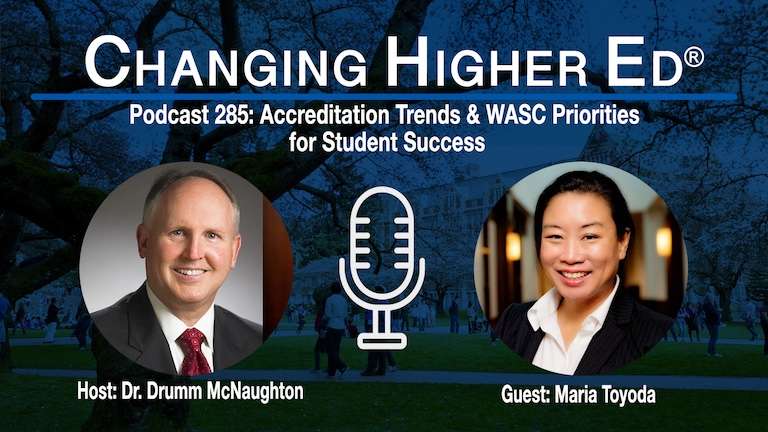
Changing Higher Ed podcast 285-Accreditation Trends and WASC Priorities for Student Success with Dr. Drumm McNaughton and Maria Toyoda

How WASC Is Shaping the Future of Accreditation and Student Success:

Changing Higher Ed podcast 285 with host Dr. Drumm McNaughton and guest Maria Toyoda

Accreditation trends are shifting under new pressures, and institutions are expected to demonstrate learning, progress, financial resilience, and documented value with far greater clarity than in the past. Maria Toyoda, President and CEO of the WASC Senior College and University Commission, joins Dr. Drumm McNaughton to outline how institutional expectations are evolving and how leaders can position their campuses for stronger outcomes and improved student success. The Realities Institutions Face in Today’s Accreditation Environment Accreditation now operates in an environment defined by rising accountability, questions about value, increased scrutiny of student debt, economic uncertainty, and growing expectations for transparency. Institutions must understand these conditions and be prepared to show how programs lead to completion, stability, and long-term benefit. WSCUC standards require evidence that learning outcomes are clear, assessed regularly, and

Changing Higher Podcast 233 Accreditation NECHE Style from prescriptive to nuanced- with host Dr. Drumm McNaughton and guest Larry Schall

Accreditation NECHE Style—From Prescriptive to Nuanced:

Changing Higher Ed podcast 233 with Dr. Drumm McNaughton and guest Dr. Lawrence "Larry" Schall

Innovation in Higher Education Accreditation: How NECHE Leads Change Gone are the days of counting library books and checking boxes. With average presidential tenure plummeting to less than five years and a wave of institutional mergers reshaping American higher education, understanding the evolution from prescriptive to nuanced accreditation has become paramount for institutional survival. In this podcast, Dr. Drumm McNaughton, in discussion with Dr. Lawrence “Larry” Schall, President of the New England Commission on Higher Education (NECHE), shares insights on how accreditation has transformed from a compliance exercise into a partnership that helps institutions navigate contemporary challenges while maintaining academic quality and institutional accountability. Transformative Trends in Institutional Consolidation Demographic challenges are driving unprecedented changes in higher education structure. According to Schall, New England’s unfavorable demographics have accelerated institutional mergers

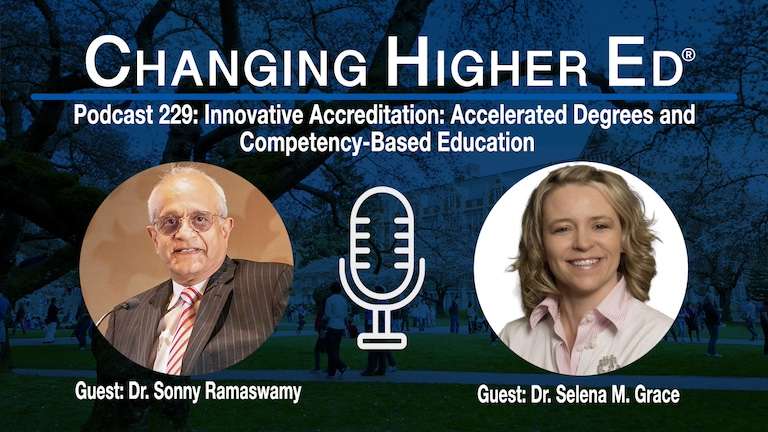
Changing Higher Podcast 229 -innovative accreditation-accelerated degrees-competency-based education with host Dr. Drumm McNaughton and Guests Dr. Sonny Ramaswamy and Dr. Selena Grace

Innovative Accreditation: Accelerated Degrees and Competency-Based Education:

Changing Higher Ed podcast 229 with host Dr. Drumm McNaughton and Guests Dr. Sonny Ramaswamy and Dr. Selena M. Grace

  In this second part of our series, we explore the innovations in accreditation that are reshaping higher education from accelerated degrees to competency-based education and workforce development. Northwest Commission on Colleges and Universities (NWCCU) is at the forefront of these changes, piloting groundbreaking programs and reimagining accreditation processes to address the evolving needs of students and institutions. Accelerated Bachelor’s Degree: A New Paradigm in Higher Education NWCCU has approved a pilot program for an accelerated bachelor’s degree, allowing students to complete their degrees in just three years. This innovative approach, developed in partnership with Brigham Young University, Idaho, and Ensign College, challenges the century-old four-year model in American higher education. Historical Context of the Four-Year Degree The traditional four-year baccalaureate model in America originated from considerations related to professors’

Changing Higher Podcast 228 - NWCCU Advances Higher Ed Accreditation

NWCCU Advances Higher Ed Accreditation with 3-Year Bachelor Degree and Collaboration:

Changing Higher Ed podcast 228 with host Dr. Drumm McNaughton and Guests Dr. Sonny Ramaswamy and Dr. Selena M. Grace

  The Northwest Commission on Colleges and Universities (NWCCU) is revolutionizing higher ed accreditation through a collaborative approach that emphasizes innovation, student success, and institutional partnerships. This shift in strategy, exemplified by initiatives such as a pilot program for a three-year bachelor’s degree, demonstrates NWCCU’s commitment to adapting accreditation practices to meet the evolving needs of students and institutions that will help overcome the challenges facing higher education. In a two-part podcast, NWCCU President Sonny Ramaswamy and Executive Vice President Selena Grace shared insights into the commission’s efforts to transform accreditation through collaboration and innovation. Ramaswamy, with extensive experience in higher education and government service, and Grace, a first-generation college graduate with a strong background in academic strategy, bring valuable perspectives to this collaborative approach to higher ed accreditation.  

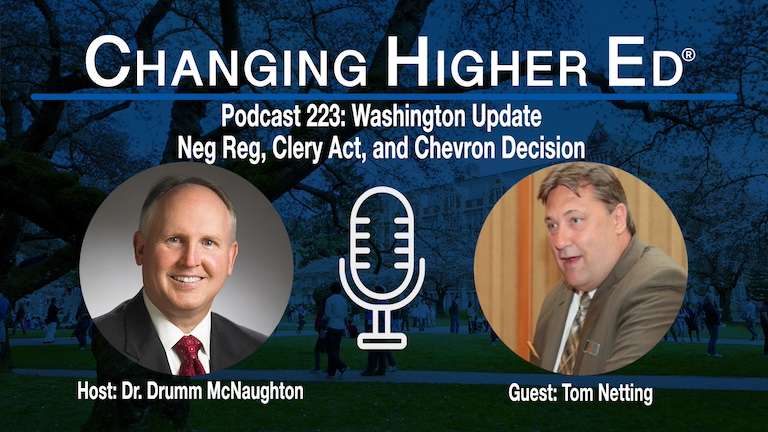
Changing Higher Ed podcast 223 – Washington Update: Neg Reg, Clery Act, and Chevron Decision with Tom Netting

Washington Update: Neg Reg, Clery Act, and Chevron Decision:

Changing Higher Ed podcast 223 with host Dr. Drumm McNaughton and guest Tom Netting

  Covering FAFSA, Title IX, FSA, IDR, SAVE, NC-SARA, NACIQI, PPA, TRIO, Clery Act, Gainful Employment, Title IV, and Chevron Decision Impacts Title IX implementation has created a chaotic regulatory environment, with 26 states under injunction and the rest required to implement new rules as of August 1st, 2023. This state-by-state variation, coupled with potential exemptions for certain student groups, forces institutions to navigate multiple, sometimes conflicting policies simultaneously. The Department of Justice is challenging these injunctions up to the Supreme Court, mirroring legal battles over other higher education policies like the SAVE program for Income-Driven Repayment. This complex situation exemplifies the broader regulatory challenges facing higher education, as detailed in this Washington Update featuring our frequent guest, Tom Netting, President of TEN Government Strategies. This update aims to provide

Florida vs Department of Education: Background and Implications

Florida vs Department of Education: Implications and Background:

Redefining State Control in Higher Education

On June 21, 2023, the State of Florida filed a lawsuit against the Department of Education, Florida vs Department of Education. The implications of this lawsuit can be far-reaching. This lawsuit has the potential to change how much influence state governments can have on both higher education accreditation and their institutions. The US Department of Justice has yet to file a response.   The Background – Leading Up to the Lawsuit The lawsuit has been coming for a while, especially considering we’re in the presidential election cycle with the Governor of Florida vying for the presidency.   Florida’s current and former governor have had issues with their accreditor, the Southern Association of Colleges and Schools (SACS), for what they view as undue meddling in the State’s affairs. Then Florida, at

 Improving Institutional Accreditation Transparency - A Call for Change and the Need for Accountability - The Change Leader circled with links to accreditation components

Improving Institutional Accreditation Transparency:

A Call for Change and the Need for Accountability

Why is accreditation transparency important?  Institutional accreditation is the gold standard for higher education institutions in the US and globally. Indeed, without accreditation, most employers and other universities and colleges will not accept a degree from a graduate, whether for employment or graduate school. Colleges and universities are only eligible for federal financial aid if accredited by a Department of Education-approved accreditor. And most importantly, they will attract quality faculty or students to deliver degrees only if an institution is accredited. Accreditors serve as the gatekeepers for over $150 billion in financial aid, and accreditors are increasingly called upon to demonstrate the “value-added” of these funds at the institutions they accredit. However, higher education needs help from an enrollment and perceptions perspective. Since the pandemic (officially) began in March 2020,

Florida v. Department of Education – Accreditation and Quality Control | Changing Higher Ed Podcast 161 with Dr. Drumm McNaughton and Michael Goldstein

Florida v. Department of Education – Accreditation and Quality Control:

Changing Higher Education Podcast 162 with Host Dr. Drumm McNaughton and Guest Michael Goldstein

  The recently filed and highly publicized Florida v. Department of Education lawsuit could change the face of higher education across the US. At stake is the ability of accreditors to set standards in the accreditation versus how much state governments can be involved in accreditation affairs. Essentially the lawsuit is pushing to allow institutions to change their accreditors without being restricted by the Department of Education and that, as the owner of state schools, the state has control over what these institutions can do. In this podcast, Dr. Drumm McNaughton once again speaks with higher ed legal expert Michael Goldstein of Tyton Partners, who returns to Changing Higher Ed to discuss the background behind the lawsuit, its reasons, and its implications for higher education institutions and accreditation.   Podcast

Navigating Institutional Accreditation: How to Get it and Keep it. Guidance for institutional accreditation in higher education. Stamp of approval.

Navigating Institutional Accreditation—How to Get it and Keep it:

Helping colleges and universities navigate the accreditation process successfully

Institutional accreditation is a quality assurance process that provides colleges and universities access to critical resources once attained: federal financial aid, the ability to transfer and accept student transcripts and credits, and the increased likelihood of degree acceptance from employers and other higher ed institutions. Understandably, most colleges and universities seek accreditation to obtain funds from the Department of Education to provide Title IV federal financial aid funding such as Pell Grants, etc. In this case, the Department serves as a bank and delegates its authority to accreditors to confirm if institutions meet the quality, organization, and financial standards to receive federal financial aid. Since the Negotiated Rulemaking of 2019, accreditation bodies now consist of institutional accreditors and programmatic accreditors; the Neg Reg removed the distinction between the former regional

Institutional Accreditation is in Dire Need of Change - People jumping through hoops

Institutional Accreditation is in Dire Need of Change:

Changing Higher Ed Podcast 144 With Host Dr. Drumm McNaughton And Guest Ralph Wolff

Changing Higher Ed Podcast 144 With Host Dr. Drumm McNaughton And Guest Ralph Wolff: Institutional Accreditation is in Dire Need of Change → Read the podcast transcript → Download the podcast PDF transcript Institutional accreditation is in dire need of change, even though it provides institutions with more external recognition, improves the likelihood of gaining more resources, and boosts the respect of staff and faculty. And with an increasingly high number of professional accrediting bodies now touching and impacting many colleges and universities, now is the time for higher ed leaders to strive to support and understand how accreditation can improve overall to strengthen post-secondary education even more. In the second and final episode of this two-part series, Dr. Drumm McNaughton speaks with Ralph Wolff, the founder and former president

Should Accreditors help Higher Ed Identify What's Good Enough for Them? Different forms of quality check approval

Should Accreditors Help Higher Ed Identify What’s Good Enough for Them?:

Changing Higher Ed Podcast 143 with Host Dr. Drumm McNaughton and Guest Ralph Wolff

Changing Higher Ed Podcast 143 with Host Dr. Drumm McNaughton and Guest Ralph Wolff: Should Accreditors Help Higher Ed Identify What’s Good Enough for Them? → View the podcast transcript  Now more than ever, accreditation is essential in higher education. An increasingly high number of professional accrediting bodies touch and impact colleges and universities to the point where accreditors have the potential to lead or even stifle change in higher ed. This is especially true given that accreditation is the gatekeeper for over $150 billion in federal financial aid. In the first of this two-part series, Dr. Drumm McNaughton speaks with Ralph Wolff, the founder and former president of the Quality Assurance Commons for Higher and Postsecondary Education, and former president of WASC, the Accrediting Commission for Senior Colleges and

An Assessment of Higher Ed Accreditation and SACSCOC - Part 2

An Assessment of Higher Ed Accreditation and SACSCOC – Part 2:

Changing Higher Ed Podcast 133 with Host Dr. Drumm McNaughton and Guest Dr. Belle Wheelan

Changing Higher Ed Podcast 133 with Host Dr. Drumm McNaughton and Guest Dr. Belle Wheelan – An Assessment of Higher Ed Accreditation and SACSCOC – Part 2   In Part 2 of this two-part series, Dr. Drumm McNaughton and Dr. Belle Wheelan conclude their discussion of the challenges facing higher education accreditation. Wheelan shares her assessment of higher ed accreditation,  SACSCOC standards,  response to criticism of accreditation, and where SACSCOC would like to focus in the future. In Part 1, we left off with: Hot Button #3: The Increasing Politicization of Higher Ed Governance at the State Level.    Hot Button #4: The Impact of Federal Student Learning Outcomes on Institutional Operations and on SACSCOC The current focus on accreditation and student learning outcomes originated with the U.S. Department of

President of SACSCOC Talks Higher Ed Accreditation Challenges

President of SACSCOC Talks Higher Ed Accreditation Challenges:

Changing Higher Ed Podcast 132 with Dr. Drumm McNaughton and Guest Dr. Belle Wheelan 

Changing Higher Ed Podcast 132 with Dr. Drumm McNaughton and Guest Dr. Belle Wheelan – President of SACSCOC Talks Higher Ed Accreditation Challenges Dr. Belle Wheelan is no doubt right when she says she’s probably the only person on Earth who will ever begin their career at SAC and end it at SACS. In the 48 years following her first higher ed job as a member of the psychology faculty at San Antonio College (SAC) to serve as president of Central Virginia Community College and Northern Virginia Community College, to her long-term current tenure as president of the Southern Association of Colleges and Schools Commission on Colleges (SACSCOC), Wheelan has seen first-hand the profound changes in the nation’s higher ed landscape. In Part 1 of this two-part series, Wheelan, who

Prepare for Changes in Higher Ed Accreditation

Prepare for Changes in Higher Ed Accreditation:

with host Dr. Drumm McNaughton and guest Dr. Cynthia Jackson-Hammond | Changing Higher Ed Podcast 089

Changing Higher Ed Podcast with Host Dr. Drumm Mc Naughton and Guest Dr. Cynthia Jackson-Hammond – Prepare for Changes in Higher Ed Accreditation     Are you staying informed of the changes in higher ed accreditation and what those changes could mean to your institution and/or your strategic planning? Higher education institutions are increasingly being called to improve the quality of education they provide and to be more innovative. Institutional accreditation serves as quality control to ensure that institutions are remaining true to their mission and providing academic benefits to students. The organization that oversees the accrediting effort is the Council for Higher Education Accreditation (CHEA). This Council, which started in 1996, was founded by college presidents, who felt it was the role of the Academy to monitor, regulate, and

Increase Student Enrollment with Smartphone Delivered Degrees

Increase Student Enrollment with Smartphone Delivered Degrees:

with Dr. Drumm McNaughton and Frank Rojas | Changing Higher Ed Podcast 071

Offering smartphone delivered degrees in higher education is no longer just nice to have; it’s going to increase student enrollment and student success, rendering it a must-have. Higher education online courses are under pressure to meet student needs through increasing online access, inclusion, and engagement. A study by Wiley and Education Dynamics published in June 2020 found that 74% of students in online programs wanted to use their mobile devices to engage in coursework. However, only 13% had done so. To meet this need, Los Angeles Pacific University (LAPU) has created its myLAPU app, a human-centered design effort built in partnership with Ready Education that allows students to complete their full degree on their smartphones. Student-Centered Approach to Smartphone Delivered Degrees LAPU prides itself on creating student access to education.

Washington Update: University Regulations and New Stimulus Package

Washington Update: University Regulations and New Stimulus Package:

with Dr. Drumm McNaughton and Tom Netting | Changing Higher Ed Podcast 051

University regulations and new stimulus package – what it means for higher ed institutions. Federal policymakers are trying to figure out their next steps in relation to higher education in the wake of the pandemic. In addition, these policymakers are continuing in developing and implementing regulations. TEN Government Strategies CEO Tom Netting, a regular guest on this podcast, provides an update on new regulations that are coming online as well as recent and proposed federal legislation, including the CARES Act, which provides short-term financial and policy guidance. Federal University Regulations Even as the nation focuses on the coronavirus pandemic, the regulatory environment remains omnipresent. The U.S. Department of Education is focusing on developing a number of new regulations while also overseeing the implementation of regulations. A number of these rules

NEGOTIATED RULEMAKING 2019

Negotiated Rulemaking 2019 — Washington Update:

with Host Dr. Drumm McNaughton and Guest Russ Poulin | Changing Higher Ed Podcast 029

Negotiated Rulemaking 2019 podcast with Dr. Drumm McNaughton and Dr. Russ Poulin. Dr. Poulin served on the subcommittee on the recent federal Negotiated Rulemaking (Neg Reg) negotiations where he had the opportunity to provide input on recommendations that were voted on by the full committee. He was recently promoted to be the Executive Director of WCET. In this podcast, he discusses some of the decisions that came out of the Neg Reg and were published. Negotiated Rulemaking 2019 – Tying Federal Financial Aid to State Service Negotiated Rulemaking 2019 solidified the state authorization that ties federal financial aid to the institution that has the approval of the state where it is serving students. Some institutions were hesitating in complying with state authorization and were waiting for this tie to federal

Neg Reg 2019 Washington Update Higher Ed

Neg Reg 2019 Washington Update with Tom Netting | Changing Higher Ed 025

Neg Reg 2019 Washington Update Podcast with Dr. Drumm McNaughton and Tom Netting. Federal legislators and policymakers continue to try to work through policy and legislative changes that will have significant impacts on higher education. These include efforts by the U.S. Department of Education to alter rules developed during the Obama Administration. In addition, Congress continues to focus on trying to come up with a workable plan to update the Higher Education Act. Negotiated Rulemaking Regulatory Activity The Department of Education has been attempting to make a number of revisions to rules created during the Obama Administration. Most recently, the Department made a seismic shift on gainful employment on June 28. The department soft-launched a final rule that overturns the 2009-2010 regulations as well as the 2014 regulations, including Subpart Q

Subscribe To Our Newsletter

Get the Latest News, Posts, and Podcasts in Our Monthly Newsletters