THE CHANGE LEADER

Category: Fundraising & Grants

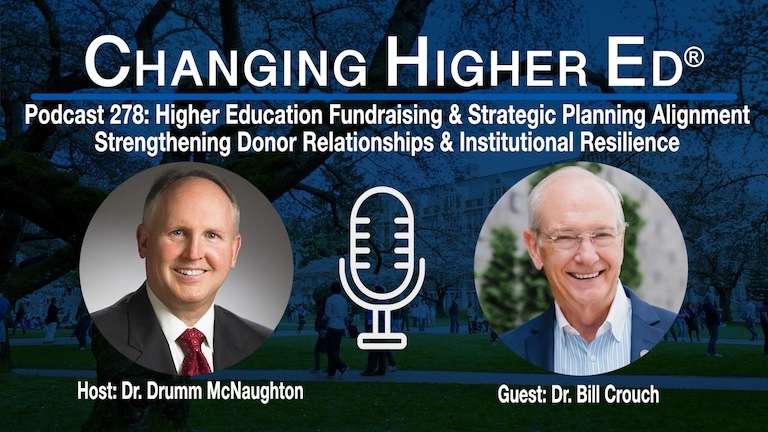
Changing Higher Ed podcast 278 Higher Education Fundraising and Strategic Planning Alignment

Higher Education Fundraising and Strategic Planning Alignment—Strengthening Donor Relationships and Institutional Resilience:

Changing Higher Ed podcast 278 with host Dr. Drumm McNaughton and guest Dr. Bill Crouch

Shifts in tax policy and philanthropic behavior are reducing traditional donor activity at the very moment institutional budgets are already strained by declining enrollments, demographic cliffs, and shrinking government support. For presidents and boards, this means fundraising can no longer be treated as a background function. It must become a central lever in strategic planning—one that builds sustainable income pipelines to stabilize the institution’s future. This week’s Changing Higher Ed podcast brings forward practical strategies for presidents and boards to strengthen their fundraising impact. Bill Crouch, CEO of BrightDot and former university president, draws on forty years of experience to explain how institutions can move from transactional giving to cultivating generosity that creates long-lasting ripple effects. Beyond Transactions: Building Donor “Mattership” Donors today are asking a simple but profound question: Does my life

Capital Funding Strategies in Higher Education: How Universities Are Solving Infrastructure and Student Housing Challenges-Changing Higher Ed podcast 256 with Brent Miller of HED

Capital Funding Strategies in Higher Education: How Universities Are Solving Infrastructure and Student Housing Challenges:

Changing Higher Ed podcast 256 with host Dr. Drumm McNaughton and guest Brent Miller of HED

  As traditional state capital support declines, colleges and universities are turning to new capital funding strategies in higher education to address urgent infrastructure needs and student housing demands. In this episode, Dr. Drumm McNaughton speaks with Brent Miller, Higher Education Market Sector Leader at HED, about how institutional leaders are creatively structuring major projects through P3s, donor partnerships, and local bonds, while managing long-term costs and aligning with campus missions. Capital Funding Strategies in Higher Education—What Institutions Are Doing Now The conversation outlines four core approaches institutions are using to finance major capital projects: Donor and Philanthropic Gifts: Institutions like USC and UC Irvine are securing large, mission-aligned donations that fund both construction and ongoing program support. Corporate Sponsorships: Companies like Ford Motor Company are entering into collaborative research

Advancing Research for Tier Two Institutions with NSF | Changing Higher Ed Podcast 165 with Host Dr. Drumm McNaughton and Guest Dr. Sethuraman Panchanathan

Funding Research for Tier Two Institutions with NSF:

Changing Higher Ed Podcast 165 with Host Dr. Drumm McNaughton and Guest Dr. Sethuraman Panchanathan

Tier two (R2) research and smaller institutions, including two-year, minority-serving, and tribal colleges, can now build solid research infrastructures and perform groundbreaking discoveries through research enterprises on the same scale as larger R1 and flagship universities.   In this episode of Changing Higher Ed®, Drumm speaks with Sethuraman Panchanathan, Director of the National Science Foundation (NSF). They discuss how his organization helps democratize ideas in higher education, enabling all colleges and universities to solve real-world problems and revitalize their communities.   The NSF achieves this through funding and grant programs like the Nationally Transformative Equity and Diversity (GRANTED) and Enabling Partnership to Increase Innovation Capacity (EPIIC).   Dr. Panch also discusses NSF’s mission and vision. He talks about its recent $44 million program that helps fund projects across the US.

Hope Forward: Enabling Free Tuition for College | The Change Leader

Hope Forward: Enabling Free Tuition for College:

with host Dr. Drumm McNaughton and guest Matt Scogin | Changing Higher Ed Podcast 092

Hope College, a Christian college located in Holland, Michigan, is establishing the innovative Hope Forward program, enabling free tuition for college, which will allow students to graduate debt-free. The first pilot cohort of students is enrolling in the school in Fall 2021. The institution is trying to create this business model to free itself from being tied to tuition, build a true learning community, and inculcate the values of giving and generosity in students. A Different Leadership Skillset Matt Scogin, who served on Hope’s board prior to becoming its president in 2019, brings deep finance experience to higher education. He graduated from Hope College in 2002 with a degree in economics and political science. After studying at Harvard’s Kennedy School of Government, he spent the first part of his career

What Grantmakers Want From Higher Ed

What Grantmakers Want From Higher Ed:

with host Dr. Drumm McNaughton and guest Ken Knueven | Changing Higher Ed Podcast 079

Higher education grantmakers are rewarding innovative higher education institutions with grants, and technology innovation, a disruptive force for traditional industries, is now playing a key part of the ongoing and rapid transformation. A growing number of social entrepreneurs within traditional higher education are emerging, which is challenging higher education’s status quo. Higher education leaders are realizing that technology can help institutions better address the concept of lifelong learning, whether that is preparing for what is coming next in the individual’s life or being able to address disruptive changes such as job loss. When done right, the use of technology can instill a passion for lifelong learning that endures throughout an individual’s life. Grantmakers Consider Higher Ed Challenges Higher education is currently facing significant headwinds and grantmakers want to see colleges

Changes to University Scholarship Processes Due to the Pandemic

Changes to University Scholarship Processes Due to the Pandemic:

with Host Dr. Drumm McNaughton and Guests Keith Brown and Alania Cater | Changing Higher Ed Podcast 060

    This podcast focuses on the changes to university scholarship processes due to the pandemic, and features Dr. Drumm McNaughton, Keith Brown and Alania Cater | Changing Higher Ed 060. The coronavirus pandemic’s tumultuous reach continues to upend higher education. This podcast looks at the disruption that has happened in the areas of scholarship, financial aid, and fundraising. The podcast’s guests are Keith Brown and Alania Cater. Brown is the assistant director for special awards part in the University of Wisconsin-Madison’s Office of Student Financial Aid. He manages and maintains the UW-Madison scholarship management system.  Cater is the director of product management at Blackbaud. Supporting Students in the Pandemic COVID has changed the scholarship process in higher education. The biggest change has been a shift to supporting emergency funding

Raising Money for Universities during COVID: with Dr. Drumm McNaughton and Scott Roberts and Tim Hill | Changing Higher Ed Podcast 043

Raising Money for Universities during COVID:

with Dr. Drumm McNaughton and Scott Roberts and Tim Hill | Changing Higher Ed Podcast 043

In this podcast, Raising Money for Universities during COVID with Scott Roberts, Tim Hill, and Dr. Drumm McNaughton you’ll hear why higher education fundraising is even more critical as colleges and universities navigate the unexpected and unpredictable financial situation caused by the current COVID-19 pandemic. During a time marked by physical separation, institutions and their development offices need to find creative ways to stay in touch with donors and potential donors while also having compassion and empathy for what these individuals are facing during the pandemic. Scott Roberts is the president of the UConn Foundation, which serves the University of Connecticut.  Tim Hill works for Blackbaud, an EdTech company that supports advancement and alumni development across the higher education campus. Hill and Roberts are not sure when higher education will

University Fundraising during Crisis Situations | Higher Ed Podcast

University Fundraising During Crisis Situations:

with Martin Leifeld | Changing Higher Ed Podcast 042

This podcast explores university fundraising during crisis situations. At the time of this podcast, COVID-19 was the major crisis for higher ed finances. Contrary to what many would think, the current situation could be an important time to visit with donors. During his 24 years of professional fundraising, Martin Leifeld and his teams raised a staggering $500 million dollars. He served as vice-chancellor of advancement for the University of Missouri-St. Louis for a decade. While there, he led a dramatic increase in fundraising, averaging $26.4 million per year. In 2018 Martin was named Outstanding Fundraising Executive by the Association of Fundraising Professionals St. Louis Regional Chapter. He is now president of Five Minutes with Martin as well as an author and speaker. University Fundraising During Crisis Situations and Turmoil Leifeld

Transforming Higher Ed in Turbulent Times

A Primer for Transforming Higher Ed in Turbulent Times

Transforming Higher Ed in turbulent times may seem impossible, in “normal” times is difficult enough. Preparing for what comes next and strategically managing the transformation will make or break your institution. I am not a “doom and gloom” person – I see the good in (nearly) everyone and prefer to focus on the positive things in life. Having said that, I am concerned that higher ed is in for “Mr. Toad’s Wild Ride” over the next 5-10 years. The higher ed marketplace has become hyper-competitive. Enrollment is down across nearly all segments, driven by a strong business environment and declining birthrates that have resulted in a shrinking number of traditional students (something that will continue to accelerate). Costs are soaring while the discount rate continues to grow. The number of

Financial Growth Strategies For Higher Ed

Financial Growth Strategies For Higher Ed:

with Host Dr. Drumm McNaughton and Guest Rob Hartman | Changing Higher Ed Podcast 005

Changing Higher Ed Podcast with Dr. Drumm McNaughton and Guest Rob Hartman Financial Growth Strategies for Higher Ed  Financial Growth Strategies For Higher Ed podcast with Dr. Drumm McNaughton and Rob Hartman. The CFO of a higher ed institution is a strategic leadership position that requires a mixture of talents.  Not only must they have a strong financial background, but they must also be able to look across the spectrum of the operations at an institution, and sometimes that includes security and financial aid.  The role requires looking at an institution from a 30,000-foot perspective vs. a day-to-day task position which is how a controller should be looking at an organization, e.g., accounts balanced, etc. One of the reasons that it is critical to have a CFO who can look

Higher Ed Fundraising is an Art Form: with Martin Leifeld | Changing Higher Ed Podcast 002

Higher Ed Fundraising is an Art Form:

with Martin Leifeld | Changing Higher Ed Podcast 002

  Higher Ed Fundraising is an Art Form with Martin Leifeld | Changing Higher Ed Podcast 002 Higher Ed fundraising is an art form, and Martin Leifeld has become a master artist.  Not only has he perfected the art form, he has raised it to new levels through old-school methods that include building relationships, understanding the donors’ priorities, and mastering the ask.  Martin has raised over $500 million for educational institutions and nonprofits, and in this podcast, he gives us a tutorial on the lost art of development.  Some of the key areas covered include the psychology of development and how to build lasting relationships, how the best university presidents work with their development officers, and how the world of fundraising has changed and what it will look like going

The Future of Public Funding of Higher Ed

The Future of Public Funding in Higher Education:

The Changing Face of Higher Ed Part 6

Part 6: The Future of Public Funding of Higher Ed The public funding of Higher Ed freefall began four decades ago (e.g., California’s Proposition 13), but it really took root three decades ago, as declining appropriations, soaring tuition, and broken partnerships started to become the norm.  The aftermath has led to ugly financial battles involving policymakers, faculty, staff, students and alumni. Some colleges are running large deficits, especially when deferred maintenance costs are factored in, and there are some which are going bankrupt. To successfully surmount this pressing challenge, we at The Change Leader believe that higher education leaders must develop a new model for funding higher education which requires identifying multiple sources of funding and must be sustainable and transparent. This blog, the sixth in a series, will discuss

An illustration symbolizing venture philanthropy in the context of colleges and universities. The image features a large, modern university campus

Venture Philanthropy for Colleges and Universities:

Funding and Programs with Venture Philanthropy

Venture philanthropy for college and university funding is a new trend in higher education, and the following blog discusses the pros and cons of how this can help your college or university. Writing in 2012 for the American Association of University Professors, Kevin Kumashiro voices a concern that still resonates for many academics, the fear that venture philanthropy is bound to introduce programs “framed by corporate profitability.” This fear that the private sector only becomes involved in higher education for the purpose of self-enrichment originates in an assumption that business objectives necessarily oppose the interests of the academic world; there cannot be a scenario in which both sides gain. Given the current climate of dwindling public funds, declining enrollment, and a stagnant twentieth-century workforce, however, universities need to move past

HIGHER EDUCATION GRANT WRITING 101

Higher Education Grant Writing 101:

Higher Education Grant Writing Challenges

Higher Education grant writing plays a key role in the fundraising plans of higher education institutions. Unfortunately, there’s no magic recipe for guaranteed success in grant writing. Higher Education Grant Writing Challenges For higher education, the biggest issues are that universities are not set up to design and develop grant-funded programs. These programs often require heavy community and agency interactions: attendance at planning meetings, agency workshops, and other important collaboration events. Faculty members often don’t have time to travel to or attend these types of meetings. They have little ability to nurture the necessary connections needed to design compelling and FUNDABLE programs. Someone (and probably not your professors) must be able to help connect the activities of your university to the goals of the funding agency. The critical piece of

Subscribe To Our Newsletter

Get the Latest News, Posts, and Podcasts in Our Monthly Newsletters