THE CHANGE LEADER

Tag: Student Success Models

Changing Higher Ed podcast 337 with Dr. Drumm McNaughton and Dr. Joseph E. Gillespie | How to Increase College Enrollment: Hyper-Local Recruiting, Fast Follow-Up and Retention at Manor College

How to Increase College Enrollment: Hyper-Local Recruiting, Fast Follow-Up and Retention at Manor College:

Changing Higher Ed podcast 337 with host Dr. Drumm McNaughton and guest Dr. Joseph E. Gillespie

Manor College has four admissions counselors. At many colleges, Dr. Joseph E. Gillespie says, admissions counselor is an entry-level job: counselors stay for a while, then leave for colleges where they think they can earn more, advance or both. At Manor, he says, the same admissions staff has been in place for more than two years, something Manor had never had before. That stability sits underneath the number host Dr. Drumm McNaughton opens with: a 47% rise this year in Manor’s first-time, full-time students, at a time when the enrollment cliff and a perceived drop in the value of a degree weigh on many institutions. Manor is small, with about 600 students, but the strategies behind the growth, McNaughton argues, apply at any size. In this episode of the Changing

Changing Higher Ed podcast 336 with Dr. Drumm McNaughton, Elliot Felix and Dr. Katie Johnson | Student Experience in Higher Education: Growth, Belonging, Student Voice and AI

Student Experience in Higher Education: Growth, Belonging, Student Voice and AI:

Changing Higher Ed podcast 336 with host Dr. Drumm McNaughton and guests Elliot Felix and Dr. Katie Johnson

In the Student Experience Snapshot, a national survey of students, 84% said they were satisfied with their college experience. Only 66% said they were getting a high-value experience. For Dr. Katie Johnson, that gap is the point. “If you only look at the satisfaction piece,” she says, “you’re gonna have a very different takeaway than if you look at it from the value perception from the student’s point of view.” Host Dr. Drumm McNaughton notes that public perception of higher education has declined, citing Gallup polls that put it at 57% positive in 2015 and 38% recently. Yet 60% of hiring decision-makers, he says, have a great deal or quite a lot of confidence in higher education. Conversations about the value of higher education, Johnson notes, often center on ROI

Changing Higher Ed podcast 334 with Dr. Drumm McNaughton and Shawn Banzhaf | Veteran Student Success: Culture Training, Community and Military-Supportive Campuses

Veteran Student Success: Culture Training, Community and Military-Supportive Campuses:

Changing Higher Ed podcast 334 with host Dr. Drumm McNaughton and guest Shawn Banzhaf

Most universities, Shawn Banzhaf says, would be happy if 5% of their students were military-connected. At Arizona State University, where he leads the Pat Tillman Veterans Center, he puts the figure at about 13%, or roughly 22,000 military-connected students. More than 10,000 of them, he says, use GI Bill benefits. Banzhaf argues that keeping those students through graduation takes more than a benefits office. Military-connected students arrive with a different culture, different expectations and often a family to support, and in his experience most institutions are not built to recognize that. For presidents and boards, the question is whether their campus is merely friendly to veterans or actually supports them. In this episode of the Changing Higher Ed® podcast, Dr. Drumm McNaughton speaks with Shawn Banzhaf, Executive Director of the

Changing Higher Ed podcast 333 with Dr. Drumm McNaughton and Kavitta Ghai | AI for Student Success: Faculty-Led Adoption, Course-Level Guardrails, and Measured Outcomes

AI for Student Success: Faculty-Led Adoption, Course-Level Guardrails, and Measured Outcomes:

Changing Higher Ed podcast 333 with host Dr. Drumm McNaughton and guest Kavitta Ghai

At UC Santa Barbara, Kavitta Ghai recalls, it took a student two days, on average, to get a question answered. The university called the measure time poverty, and it covered every route to an answer, from office hours and emails to a professor to questions for an academic or FAFSA advisor. For a student whose tuition is due tomorrow, two days is too long. Ghai and her co-founder were undergraduates at UCSB when they started building tools to close that gap, and she argues the problem is sharper at community colleges, where most classrooms have no teaching assistant at all. Her case to presidents and boards is that AI can now provide the round-the-clock support students have never had. In this episode of the Changing Higher Ed® podcast, Dr. Drumm

How to Scale Experiential Learning to Every Student Changing Higher Ed podcast 329 with host Dr. Drumm McNaughton with guest Dr. W. Brooke Elliott

How to Scale Experiential Learning to Every Student:

Changing Higher Ed podcast 329 with host Dr. Drumm McNaughton with guest Dr. W. Brooke Elliott

Most institutions measure access at the door. Admit rate, net price, discount rate, yield. The measurement stops at the moment a student enrolls, which means the parts of a degree that actually change outcomes, the live client project, the consulting engagement, the international immersion, get rationed to whoever finds them. Honors cohorts get them. Well-advised students get them. Cohorts of 30 to 40 get them. Everyone else gets the catalog. At the Gies College of Business at the University of Illinois, accessibility is defined to include what happens after the door. Serving more learners and lowering the price are the first half of the definition. The second half is whether the experiences inside the degree are reachable by a large share of enrolled students rather than a selected few. That

Changing Higher Ed Podcast 311-Dr. Drumm McNaughton and Dr. Stepen Spinelli-Scaling Higher Education: An Entrepreneurial Approach to a Consolidating Market

Scaling Higher Education: An Entrepreneurial Approach to a Consolidating Market:

Changing Higher Ed podcast 311 with host Dr. Drumm McNaughton and guest Dr. Stephen Spinelli

Higher education’s anti-scale culture is a strategic problem the sector has not honestly confronted. Entrepreneurial leadership may help identify which institutions are most likely to survive consolidation. Dr. Stephen Spinelli, president of Babson College, joined Dr. Drumm McNaughton to discuss what scaling and an entrepreneurial mindset mean for higher education right now. His diagnosis is direct. Higher education has every signal of a market in early consolidation, and the sector is openly anti-scale. It treats containment and selectivity as virtues and has not seriously asked what scale would mean for the institutions trying to make it through the next decade. Institutions that read the market correctly and act will be the ones still standing. Institutions that wait for the environment to revert will not. Higher Education Is Consolidating, and the

Changing Higher Ed Podcast 307-Dr. Drumm McNaughton and Chris Crittenden - Building Workforce Readiness Through Real Startup Experience

Building Workforce Readiness Through Real Startup Experience:

Changing Higher Ed podcast 307 with host Dr. Drumm McNaughton and guest Chris Crittenden

Experiential learning has become a near-universal claim in higher education, but the claim and the reality are rarely the same thing. Project-based courses, case studies, and capstone assignments are offered as evidence that institutions are preparing students for the workforce. Most of this activity is too shallow to produce the outcomes institutions advertise. Students move through it, complete the deliverable, and emerge with little more capability than they had before. This analysis draws on the work of Chris Crittenden, founder of Sandbox, a for-credit startup incubator now operating at eight universities. Crittenden’s background spans management consulting at McKinsey, founding and selling an AI technology company to Walmart, and leading the entrepreneur center at Brigham Young University before building Sandbox into a cross-institutional program. Sandbox students earn 18 credits over two

Changing Higher Ed Podcast 302-Dr. Drumm McNaughton and Jeff Dinski - Students Are Acting Like Consumers. Higher Ed Needs to Catch Up

Students Are Acting Like Consumers. Higher Ed Needs to Catch Up:

Changing Higher Ed podcast 302 with host Dr. Drumm McNaughton and guest Jeff Dinski

Jeff Dinski spent six years at NBC and ESPN learning that if you do not give your audience what they want, they change the channel. Higher education has never had to worry about that. Until now.   The case for treating students as consumers, aligning program portfolios with workforce destinations, and rethinking how faculty are qualified to teach draws on perspectives from Dr. Drumm McNaughton, a higher education consultant who works with institutional presidents and boards on strategy, governance, and transformation, and Jeff Dinski, Chief Strategy and Corporate Development Officer at Ellucian, the largest edtech company in the world serving approximately half of all U.S. colleges and universities. Dinski brings more than 20 years of experience across sports media, consumer internet, and edtech, including roles as an operating executive at

Changing Higher Ed Podcast 298 The Data Exists, You're Just Not Using It — Tracking Stop-Outs, Transfers, and ROI Across the Full Student Journey -Dr. Drumm McNaughton and Melba Amissi - National Student Clearinghouse

The Data Exists, You’re Just Not Using It — Tracking Stop-Outs, Transfers, and ROI Across the Full Student Journey:

Changing Higher Ed podcast 298 with host Dr. Drumm McNaughton and guest Melba Amissi

Higher education is sitting on one of the most powerful data assets in the country and most institutions aren’t using it. While colleges and universities debate their purpose, wrestle with declining public confidence, and face mounting pressure to demonstrate value, the National Student Clearinghouse quietly tracks the educational journeys of nearly every postsecondary student in the United States. The question for institutional leaders is not whether this data exists, but whether they are using it to make better decisions. This conversation draws on the perspective of Melba Amissi, Chief Customer and Operations Officer at the National Student Clearinghouse. Amissi brings a career rooted in financial services, fraud analytics, cybersecurity, and operational transformation, entering higher education only three years ago. That outside perspective is the point. Higher education has long been

Changing Higher Ed podcast 296- Dr. Drumm McNaughton and Jeff Meade Using Entrepreneurship to Redesign the College Operating Model

How Paul Quinn College Uses Entrepreneurship to Reduce Costs, Improve Workforce Readiness, and Graduate Students with Little to No Debt:

Changing Higher Ed podcast 296 with host Dr. Drumm McNaughton and guest Jeff Meade

Most colleges treat entrepreneurship as a business school elective. Paul Quinn College treats it as an operating system for the entire institution. Under the leadership of Jeff Meade, Founding Director of Every Quinnite is an Entrepreneur, entrepreneurship is not a program layered onto campus. It is woven into tuition strategy, the federal work college model, freshman onboarding, corporate partnerships, curriculum design, faculty development, and student debt reduction. This episode reveals a model that simultaneously addresses four problems higher education leaders are trying to solve: Workforce readiness Student engagement and retention Institutional cost structure Student debt Paul Quinn’s solution is not theoretical. It is structural. And it starts before the first class begins.   The Federal Work College Model as an Institutional Cost Strategy Paul Quinn is one of only eight

Changing Higher Ed Podcast 295 Reduce Student Debt Risk and Improve Employability with Distributed Practicum -Dr. Drumm McNaughton and Jarred McNeely.jpg

Reduce Student Debt Risk and Improve Employability with Distributed Practicum:

Changing Higher Ed podcast 295 with host Dr. Drumm McNaughton and guest Jarred McNeely

Higher education is no longer being evaluated on aspiration, tradition, or brand alone. It is being evaluated on outcomes. Students, families, employers, and policymakers are making decisions based on whether institutions produce graduates who can perform in real-world environments, adapt as conditions change, and build sustainable careers without accumulating unnecessary debt. This shift is already visible in enrollment behavior, credential choices, and post-graduation pathways. Institutions that continue to frame this moment as a debate about online versus in-person delivery are misreading the problem. The core issue is not modality. It is whether education systems are designed around demonstrable competence, flexibility, and long-term relevance. Some institutions are responding by rethinking where learning happens, how applied skills are developed, and how credentials align with actual career movement. When done well, these changes

Changing Higher Ed podcast 284 with host Dr. Drumm McNaughton and guest David Gooblar | The Real Cost of Overlooking Teaching Quality in Higher Education

The Real Cost of Overlooking Teaching Quality in Higher Education:

Changing Higher Ed podcast 284 with host Dr. Drumm McNaughton and guest David Gooblar

Improving Student Outcomes Through Faculty Pedagogy and Institutional Accountability Improving teaching quality is one of the fastest, most dependable ways to raise retention, stabilize revenue, and strengthen institutional reputation—yet few universities manage it strategically. Most invest heavily in analytics, enrollment, and student support systems to boost outcomes, but apply little oversight to the one factor most directly tied to student persistence: how teaching happens in the classroom. In this episode of Changing Higher Ed, Dr. Drumm McNaughton speaks with David Gooblar, Associate Professor at the University of Iowa and author of The Missing Course, about why teaching quality has slipped below the leadership radar—and what presidents and boards can do to make it a pillar of institutional performance. Gooblar and McNaughton examine a reality every campus faces but few confront

Aligning Higher Education Strategy and Programs with Workforce Needs by Measuring Value Through Outcomes and Earnings | Changing Higher Ed podcast 282 with host Dr. Drumm McNaughton and guest Dr. Harrison Keller

Aligning Higher Education Strategy and Programs with Workforce Needs by Measuring Value Through Outcomes and Earnings:

Changing Higher Ed podcast 282 with host Dr. Drumm McNaughton and guest Dr. Harrison Keller

This episode of the Changing Higher Ed podcast helps higher education presidents, boards, and senior leaders rethink how to connect institutional mission with workforce readiness. It explores how institutions can better align employer partnerships, faculty innovation, and experiential learning to ensure graduates gain both economic and civic value from their degrees. Dr. Drumm McNaughton speaks with Dr. Harrison Keller, president of the University of North Texas and former Texas commissioner of higher education, whose experience turning statewide workforce policy into institutional strategy offers a practical model for today’s campus leaders. As commissioner, Keller helped launch Building a Talent Strong Texas, the first statewide plan to link educational attainment goals directly to the economic value of degrees. Now, as president of one of the state’s largest universities, he’s applying those ideas to

How CUNY’s Holistic Enrollment Strategy and Management Approach Is Filling the Enrollment Pipeline | Changing Higher Ed podcast 281 with host Dr. Drumm McNaughton and guest Dr. Colleen Leigh

How CUNY’s Holistic Enrollment Strategy and Management Approach Is Filling the Enrollment Pipeline:

Changing Higher Ed podcast 281 with host Dr. Drumm McNaughton and guest Dr. Colleen Leigh

At one of the smallest graduate schools in the nation, a model is redefining how higher education can evolve to truly center student success. The Craig Newmark Graduate School of Journalism at CUNY enrolls just over a hundred students each year, yet its outcomes rival those of larger institutions because it aligns everything—admissions, student affairs, career services, and alumni engagement—around one mission: helping students thrive. In this episode of Changing Higher Ed, Dr. Drumm McNaughton and Dr. Colleen Leigh, Assistant Dean of Enrollment Management and Student Success, discuss how CUNY Journalism’s holistic enrollment strategy and management approach connects the entire student lifecycle, from recruitment to alumni engagement. The conversation explores how colleges can use data, empathy, and equity to transform institutional culture, not just improve operations—creating environments where students succeed

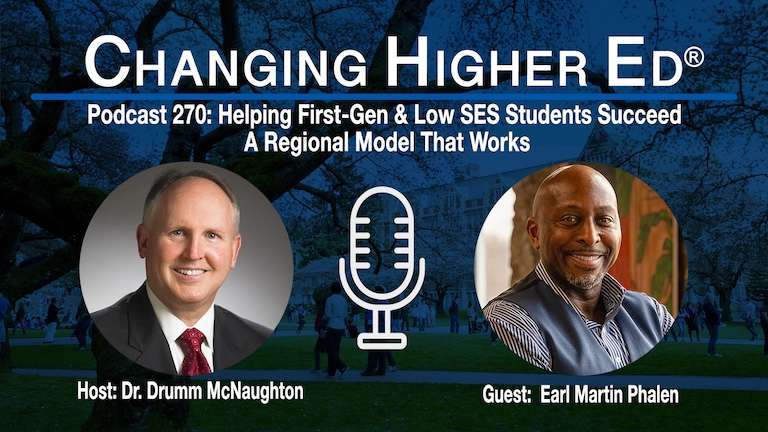
Changing Higher Ed Podcast 270 Cover Image | First-Gen and Low SES Student Success Strategies That Work: A Scalable Regional Model with host Dr. Drumm McNaughton and guest Earl Martin Phalen

First-Gen and Low SES Student Success Strategies That Work: A Scalable Regional Model:

Changing Higher Ed podcast 270 with host Dr. Drumm McNaughton and guest Earl Martin Phalen

  Higher education leaders focused on improving college completion, student retention,  and wraparound support programs for first-generation and low SES students can gain practical strategies from this episode of the Changing Higher Ed podcast, featuring Earl Martin Phalen, President and CEO of Great Jobs Kansas City (KC). Phalen outlines how his organization, funded by the Kauffman Foundation, regional universities, and community partners, has built a scalable model of student success that begins in high school and extends through college graduation and into career placement. With nearly 1,000 scholarships awarded annually at $50,000 each, Great Jobs KC partners with 24 higher education institutions across Kansas and Missouri to provide students with financial support, long-term mentorship, career training, and job placement. The result: a 96% year-over-year college persistence rate, a 73% graduation rate,

Cover Image-Changing Higher Ed podcast 268 with host Dr. Drumm McNaughton and guest Elliot Felix - Building a Connected College by Aligning Strategy and Services

How a Connected College Approach Helps Break Down Silos and Improve Student Success:

Changing Higher Ed podcast 268 with host Dr. Drumm McNaughton and guest Elliot Felix

  Most colleges rely on more than 20 disconnected systems to support students. Studies from Tyton Partners and the Lumina Foundation show that these fragmented systems contribute to student confusion, reduced engagement, and lower graduation rates. In this episode of Changing Higher Ed, student experience strategist Elliot Felix joins Dr. Drumm McNaughton to explain how building a connected college—where strategy, services, and systems work together—can improve student outcomes without increasing institutional complexity or cost. Elliot Felix is the founder of brightspot Strategy (acquired by Buro Happold in 2020) and the author of The Connected College: Leadership Strategies for Student Success. He has worked with more than 100 institutions including MIT, NYU, and the University of Virginia. His approach centers on aligning strategy, services, space, and technology using principles from design

Changing Higher Ed podcast 266 - How Utah State Is Using a Connected Campus to Boost Student Engagement and Persistence with host Dr. Drumm McNaughton and guest Rene Eborn

How Utah State Built a Connected Campus That Boosts Retention, Equity, and Student Support at Scale:

Changing Higher Ed podcast 266 with host Dr. Drumm McNaughton and guest Rene Eborn

  Connected Campus strategies are transforming how universities deliver services, and Utah State University is a clear example of how this can be done with focus and intention. Redesigning the Student Experience Around a Connected Campus Model When Utah State University set out to improve student engagement and outcomes, they didn’t start with new software—they started with a vision. As Rene Eborn, Associate VP of Strategic Initiatives and Deputy of Digital Transformation, explains, digital transformation at USU is rooted in student equity, operational efficiency, and a campuswide strategy to connect students with the tools and relationships that fuel persistence. This meant building a digital environment where students don’t have to hunt for help—and where help can find them. That environment needed to work for traditional and nontraditional learners alike. Whether

Adult Learner Enrollment to Completion via Partnerships Changing Higher Ed podcast episode 265 Strategies to Help Adult Learners Re-Enroll and Graduate - featuring Drumm McNaughton and Malik Brown

How Cross-Sector Partnerships Help Adult Learners Return, Persist, and Complete Their Degrees:

Changing Higher Ed podcast 265 with host Dr. Drumm McNaughton and guest Malik Brown

Why Adult Learner Enrollment Requires a Systemwide Strategy With over 41 million adults in the U.S. holding some college credit but no degree, institutions are under increasing pressure to implement effective strategies for adult learner enrollment and retention that facilitate degree completion. But re-engaging this population takes more than outreach—it requires coordinated partnerships that support learners from enrollment through graduation. In this episode, Dr. Drumm McNaughton and Malik Brown, President and CEO of Graduate Philadelphia, explore how cross-sector partnerships—among colleges, nonprofits, employers, and funders—are helping adult learners return, persist, and complete their degrees. Drawing on real-world experience, they share practical, scalable models that address the complexity of this population’s reasons for stopping out, not returning to complete their degrees, and outline what institutional leaders must do to reduce friction and

High Structure Course Design for Student Engagement, Retention, and Success | Changing Higher Ed podcast episode 264 featuring Drumm McNaughton and Justin Shaffer

High Structure Course Design for Student Engagement, Retention, and Success:

Changing Higher Ed podcast 264 with host Dr. Drumm McNaughton and guest Dr. Justin Shaffer

  Many institutions lose students not because learners are incapable, but because the courses in which they’re placed weren’t designed to help them succeed. Gateway courses, especially in the first year, continue to be a bottleneck in higher education, resulting in high failure rates, lower retention rates, and widening equity gaps. But it doesn’t have to be that way. Our guest on the Changing Higher Ed® podcast is Dr. Justin Shaffer, Associate Dean for Undergraduate Studies and Teaching Professor in Chemical and Biological Engineering at the Colorado School of Mines. He’s the author of the book High Structure Course Design, which gives faculty practical, evidence-based strategies for designing and delivering courses that increase student engagement, close performance gaps, and improve learning across disciplines. While the model was developed with large

Changing Higher Ed podcast 262 with Dr. Drumm McNaughton and Dr. Scott Cowen - Adding Leadership Development to Academic Curriculum Design

Adding Leadership Development to Academic Curriculum Design in Higher Ed:

Changing Higher Ed® podcast 262 with host Dr. Drumm McNaughton and guest Dr. Scott Cowen

How Institutions Can Systematize Leadership Development for Students and Early-Career Professionals: Leadership Development as an Institutional Imperative Institutions routinely cite leadership development as a goal, yet few treat it as a strategic priority embedded in academic curriculum design or operational frameworks. Leadership is often assumed to be an innate quality or left to emerge through informal mentoring and experience. As a result, graduates may leave college with technical competence but lack the ability to lead, collaborate, or adapt to real-world leadership challenges. Dr. Scott Cowen, President Emeritus of Tulane University, believes this is a missed opportunity—and a solvable problem. Drawing on his decades of leadership experience, including overseeing Tulane’s post-Hurricane Katrina recovery and teaching leadership at Tulane and Case Western, Cowen outlines how institutions can take responsibility for cultivating leadership

Subscribe To Our Newsletter

Get the Latest News, Posts, and Podcasts in Our Monthly Newsletters