THE CHANGE LEADER

Category: Mergers and Alliances

A diverse team sitting at a conference table discussing University Mergers as a Strategic Option for Struggling Institutions | The Change Leader Consulting

University Mergers as a Strategic Option for Struggling Institutions:

The business reality of applying M&A rigor to higher education in a buyer's market

University Mergers: When Partnership Language Meets Business Reality University mergers are no longer rare events—they’re becoming one of the only remaining strategies for leaders trying to preserve mission, protect students, and avoid closure. As the growing number of higher education institutions struggle financially and the number of institutions closing increases, institutional partnerships —events referred to in the corporate world as “mergers and acquisitions” (or simply “M&A”) —are becoming more commonplace. And like the corporate world, the expertise needed to successfully consummate such a transaction is highly specialized. Will Higher Education Come Back from the Current Decline? Higher education is in what is known in business-speak as a mature-to-declining market, i.e., there is more capacity (seats in classrooms) than demand (students).  As such, traditional post-secondary institutions are facing significant headwinds that
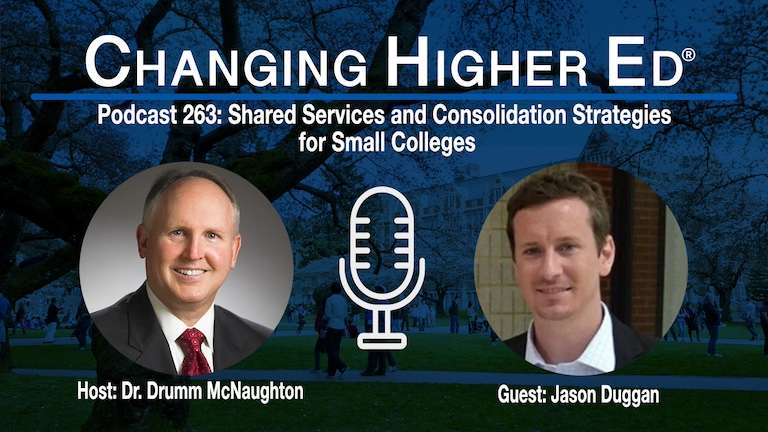
Shared Services and Consolidation Strategies for Small Colleges - Changing Higher Ed podcast 263 featuring Drumm McNaughton and Jason Duggan

Shared Services and Consolidation Strategies for Small Colleges:

Changing Higher Ed podcast 263 with host Dr. Drumm McNaughton and guest Jason Duggan

  Shared services and consolidation strategies are helping many small to medium-sized colleges stabilize operations, reduce costs, and pursue sustainable growth—without compromising institutional identity or student outcomes. In this episode of Changing Higher Ed, Dr. Drumm McNaughton speaks with Jason Duggan, CEO of Thesis Elements, about how these approaches are being utilized to help small to medium-sized colleges enhance their efficiency and financial sustainability. College presidents and boards may want to consider how resource sharing, academic partnerships, and digital transformation could fit into their own institutional strategies. Why Small Colleges Are Exploring Shared Services and Consolidation Strategies Small colleges are navigating a complex set of challenges: Declining enrollment driven by demographic shifts and changing student expectations Rising operational costs that strain limited resources Outdated administrative systems and manual processes that

The Growing Trend of Higher Ed Mergers-upward trendline showing higher education institution puzzle pieces that represent mergers

The Growing Trend of Higher Ed Mergers—Lessons from the Field:

Lessons and strategies from successful mergers to help leaders plan, align, and lead through change

As demographic shifts, financial pressures, and changing student preferences reshape higher education, we’re seeing an upward trend of higher ed mergers and consolidations as viable strategies for sustaining their missions and remaining competitive. Mergers present opportunities to streamline operations, share resources, and maintain accessibility, but they are also complex undertakings requiring thorough planning and engagement across all stakeholder groups. Insights from recent successful mergers reveal critical action steps institutions should consider, offering a roadmap for those contemplating similar strategies. The Growing Need for Strategic Restructuring Public higher education faces unprecedented challenges. Declining college-age populations in many regions, shrinking state funding, rising operational costs, and shifts in student preferences have forced many institutions, particularly regional and rural universities, to reassess their structures. These pressures often lead to a difficult cycle where

Strategic Affiliation in Higher Education: What Colleges Can Learn from the Colleges of Law and TCS Education System-Changing Higher Ed podcast 258 with host Dr. Drumm McNaughton and guest Dr. Matt Nehmer

Strategic Affiliation in Higher Education: What Colleges Can Learn from The Colleges of Law and TCS Education System:

Changing Higher Ed podcast 258 with host Dr. Drumm McNaughton and guest Dr. Matt Nehmer

  Affiliating with a System: A Strategic Move for Institutional Stability Strategic affiliation in higher education is becoming a viable path for independent institutions facing increasing pressure from declining enrollments, heightened regulatory complexity, and infrastructure challenges that disproportionately affect smaller colleges and universities. While some institutions resist systemic change until a crisis forces their hand, others pursue proactive strategies to secure their futures while preserving their missions. The Colleges of Law in California is one such example. It affiliated with The Community Solution Education System—a nonprofit system of mission-driven higher education institutions—well before system partnerships became a common topic in sector-wide discussions. In this episode of Changing Higher Ed®, Dr. Matt Nehmer, president of the Colleges of Law, shares what the affiliation has meant for the institution, how governance and

Are University Mergers the future of institutional sustainability?

Are University Mergers the Future of Institutional Sustainability?:

Examining the Benefits, Challenges, and Alternative Strategies in an Era of Higher Education Transformation

Higher education institutions are facing significant challenges to their existence. Not only are they facing the demographic cliff which begins within the next year, changing funding patterns (especially due to the political landscape in Washington), inflation, and greater competition for a shrinking pool of students, institutions must cope with overcapacity and aging buildings and plant equipment. Any institution with less than 2,500 students, an endowment of less than $10 million, or a discount rate of greater than 50% is at risk of closing. In response, some institutions have turned to mergers, consolidations, or strategic partnerships as a solution. But are mergers truly the future of institutional sustainability in higher education? This article explores the forces driving university mergers, the benefits and challenges they present, and whether they represent a sustainable

Changing Higher Ed Podcast 239 - Consolidation in Higher Ed with Drumm McNaughton and guest Michael Horowitz | New Models for Consolidation in Higher Education

New Models for Consolidation in Higher Education:

Changing Higher Ed® podcast 239 with host Dr. Drumm McNaughton and guest Dr. Michael Horowitz

  Consolidating Higher Education: The Community Solution Model This episode of the Changing Higher Ed® podcast features Dr. Michael Horowitz, Chancellor of The Community Solution Education System (formerly TCS Education System), who discusses using innovative models for higher education consolidation as an additional category in or alternative to traditional mergers or acquisitions. Horowitz highlights the system’s unique approach, a collaborative model prioritizing resource optimization and expertise sharing among member institutions while maintaining individual identities. The conversation addresses challenges facing higher education, including increasing closure rates and the importance of proactive strategies like mergers, acquisitions, and consolidations. Both McNaughton and Horowitz emphasize the necessity of early planning and shared vision, particularly involving faculty, for successful integration. They also touch on broader trends and challenges in higher education, such as increasing closures

higher education board room with board members panicing over their institution's climbing debt and shrinking merger options

College Merger Strategy: The High Cost of Waiting Too Long:

When Timing a Higher Ed Merger, Procrastination and Hope Put Your Future at Risk

“We’ll explore merger options when we absolutely have to.” These words, echoing through board rooms and presidential offices across American higher education, may well become epitaphs for institutions that waited too long to begin a merger strategy. In today’s higher education environment, by the time a college “absolutely has to” merge, its options have already become severely limited—if they exist at all. Higher education is on the precipice of one of its most significant enrollment crises in decades. The challenges, spurred by demographic shifts and the upcoming demographic cliff, economic factors including the FASFA debacle, and changes in student behavior, have caused many institutions to scramble for solutions. Some colleges and universities, particularly those that have traditionally relied on steady enrollment, find themselves in a precarious financial position. For institutions

post-merger integration planning for successful university mergers The Change Leader | connecting two universities by bridge

Post-Merger Integration: Planning for Successful University Mergers:

Strategic Framework for Successful Integration: Aligning Vision, Operations, and Culture in Higher Education Mergers

Higher education institutions are facing mounting pressures driven by decreasing enrollment and many other factors. As a result, mergers have become an increasingly common strategy for achieving financial stability, expanding academic offerings, and pursuing strategic growth. Merging two universities is a complex, high-stakes exercise – and involves much more than simply combining assets. Post-merger integration requires a thoughtful alignment of visions, cultures, governance, and operations to ensure long-term success. The stakes couldn’t be higher: failed integrations waste millions in resources, damage institutional reputations, and leave students and faculty in limbo.   The State of Higher Education: Why Mergers Matter Higher education in the United States is currently navigating what in business is called a “mature-to-declining market.” This term, borrowed from business, describes a situation in which there is more capacity

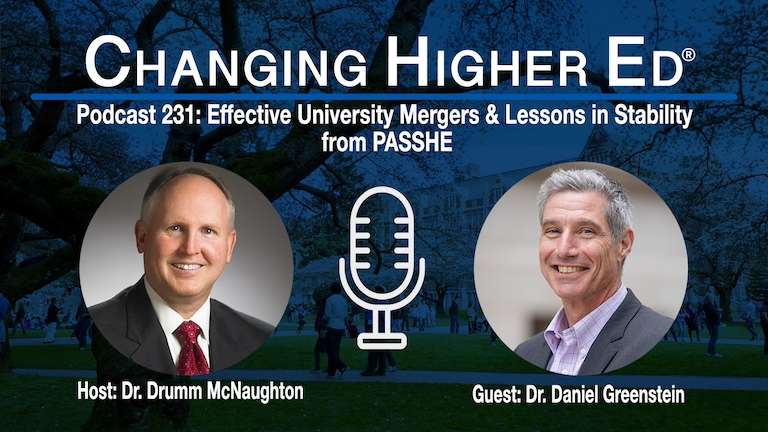
Changing Higher Ed Podcast 231 - Effective University Mergers & Lessons in Stability from PASSHE with Drumm McNaughton and Dan Greenstein

Effective University Mergers & Lessons in Stability from PASSHE:

Changing Higher Ed Podcast 231 with host Dr. Drumm McNaughton and guest Dr. Daniel Greenstein

  This podcast features host Dr. Drumm McNaughton and guest Dr. Daniel Greenstein, former Chancellor of the Pennsylvania State System of Higher Education (PASSHE). Dan discusses his six-year tenure leading PASSHE, focusing on the system’s redesign and the controversial integration of six smaller universities into two larger universities. Greenstein explains the complex process, including legislative approval, stakeholder engagement, and collaboration with regulatory bodies. He details the rationale for the integration, which aimed to address financial challenges, increase program breadth, and improve student outcomes, all while maintaining local brand identities and athletic programs.   Here are some of the valuable insights Higher Education Leaders will gain from this podcast   Understanding the “Why” Behind Mergers: Effective mergers are driven by a commitment to student success and serving community needs, not solely

Changing Higher Ed Podcast 190 - Regulatory Changes and Their Implications for Higher Education Mergers with Drumm McNaughton and Mike Goldstein

Regulatory Changes and Their Implications for Higher Education Mergers:

Changing Higher Ed Podcast 190 with Host Dr. Drumm McNaughton and Guest Mike Goldstein

  In the ever-evolving landscape of higher education, recent regulatory changes by the Department of Education, effective July 1st, have significantly redefined the processes for institutional mergers and acquisitions. These changes, emphasizing ownership and control, extend across all types of educational institutions – for-profit, nonprofit, and public. The new regulations introduce more comprehensive steps and extended timelines, adding complexity and burden to the merger process.   Implementation and Impact of July 1st Regulations The primary intent behind these regulations is to enhance accountability within higher education institutions, especially in managing federal student loan and grant programs. The goal is to safeguard students from the weight of unaffordable college debt, shifting the focus from targeting primarily for-profit higher education to a broader scope that includes all educational institutions.   Department’s Focus

Changing Higher Podcast 187- 2023 Higher Education Year in Review & 2024 Predictions

2023 Higher Education Year in Review and 2024 Predictions:

Changing Higher Ed Podcast 187 with Host Deborah Maue and Guest Dr. Drumm McNaughton

  Join us in our 2023 Higher Education Year in Review and Predictions for 2024. In this sixth annual year-end podcast, Deborah Maue, Aurora University Senior Vice President for Enrollment and Marketing, takes the mic as our special host of the Changing Higher Ed podcast to interview Dr. Drumm McNaughton as they review (and grade) last year’s 2023 higher ed prognostications. The duo share their insights on 2023, discuss the unexpected developments, and what to prepare for with the higher education predictions for 2024.   Reviewing Dr. Drumm McNaughton’s Predictions for 2023 Continuing Decline in College Enrollment: A Closer Look at 2023’s Trends 2022 Prediction for 2023: College enrollment will continue to decline. Grade given by Deb Maue: A. In 2023, college enrollment continued its downward trajectory. Despite a contrasting

Success Strategies for Struggling Small to Medium Sized Colleges and Universities  – Changing Higher Ed Podcast 120 with Guest Rick Beyer

Success Strategies for Struggling Small to Medium-Sized Colleges and Universities:

Changing Higher Ed Podcast with Host Dr. Drumm McNaughton 120 with Guest Rick Beyer

Success Strategies for Struggling Small to Medium Sized Colleges and Universities  – Changing Higher Ed Podcast 120 with Guest Rick Beyer In this episode of Changing Higher Ed podcast, Dr. Drumm McNaughton and Rick Beyer discuss innovative approaches and success strategies for struggling small to medium-sized colleges and universities.  Rick Beyer, Executive Chairman Core Education, PBC and has had a very unique career in higher ed – one that has positioned him to make Core very successful. He has sat on higher ed boards for over 20 years, was president of Wheeling Jesuit University, and has participated in more than 15 higher ed mergers. Rick shares his perspective on the use of shared services in Higher Education and how it can drive innovation and efficiency, both strategically and tactically, to

New Opportunities for Higher Ed Partnerships and Mergers - Changing Higher Ed Podcast 117 with Host Dr. Drumm McNaughton and Guest Mike Goldstein

New Opportunities for Higher Ed Partnerships and Mergers:

Changing Higher Ed Podcast 117 with Host Dr. Drumm McNaughton and Guest Mike Goldstein

New Opportunities for Higher Ed Partnerships and Mergers – Changing Higher Ed Podcast 117 with Host Dr. Drumm McNaughton and Guest Mike Goldstein In this episode, Drumm McNaughton and Mike Goldstein, Managing Director at Tyton Partners, discuss emerging opportunities for colleges and universities to engage in creative partnerships and mergers “outside the box” of conventional thinking. The economics of maintaining campuses and serving student bodies are increasingly outstripping the capacity of institutions to generate sufficient revenue. This is especially true for smaller colleges and universities, many of whom may be on the precipice of financial viability. As schools look for alternatives to closing, seeking a savior-type of partnership is a common tendency – but that tendency is evolving. When considering potential partnerships, schools that take a broader and more creative

TCS Education System's Secret Sauce for Growth and Sustainability

TCS Education System’s Secret Sauce for Growth and Sustainability:

Changing Higher Ed Podcast 102 with Guest Dr. Michael Horowitz

In this podcast, Dr. Drumm McNaughton and Dr. Michael Horowitz discuss how TCS Education System’s forward-thinking approach to growth and sustainability has made a big impact on students, the community, and the medical education system. With the recent addition of the Kansas Health Science Center (KHSC) and the related Kansas College of Osteopathic Medicine, TCS Education System now has five colleges and universities across the United States. These schools serve students across the United States who can participate in TCS’s offerings, many of which are online because of the system’s investment early on into technology. Additionally, TCS’s institutions do offer some options for in-person classes. This also meant that as these new additions come online, TCS already has serves some students in Kansas. TCS Education System is an integrated non-profit

Stakeholders Are Shaping a New M&A Model for Higher Education

Stakeholders Are Shaping a New M&A Model for Higher Education at PASSHE:

Changing Higher Ed Podcast 100 with host Dr. Drumm McNaughton and Guest Dr. Dan Greenstein

A new M&A model for Higher Education has taken shape with Pennsylvania’s State System of Higher Education (PASSHE) merger. PASSHE has 14 public universities, and most of its institutions teach to the undergrad and master’s level and are regional institutions. The system has one research institution. These institutions primarily serve rural areas, which is an area that is changing, especially due to the growing inequality in the United States. As a result, the system has seen a 27% decline in enrollment over the past 11-12 years. It currently enrolls 89,000 degree-seeking students, which is a large drop from its previous high of 120,000 students. Because of declining enrollment, the system is “merging” six universities into two institutions, one in eastern Pennsylvania and one in western Pennsylvania. Background of Institutional Integration

Innovation in Mergers and Acquisitions With 3 Universities

Innovation in Mergers and Acquisitions With 3 Universities:

with host Dr. Drumm McNaughton and guest Dr. Danielle Wilken | Changing Higher Ed Podcast 086

Innovations in mergers and acquisitions took place when three universities’ plans took a scenic route through the process.  The 2020 plan to merge the University of Bridgeport with three institutions – Goodwin University, Sacred Heart University and Paier College of Art – was considered an innovative model. However, as the effort began to unfold, one of the partners had a change of heart, which caused this effort to go in an unexpected direction. Now, the University of Bridgeport, which was founded in 1927, has new life and is working closely with Goodwin University to create innovative programs that leverage both institutions’ strengths. Changing Course – Innovation in Mergers and Acquisitions In 2020, an announcement was made that Goodwin University and Sacred Heart University would acquire the majority of the University

Strategic Transformation for Colleges and Universities Post COVID:

Strategic Transformation for Colleges and Universities Post COVID:

with Dr. Drumm McNaughton and Guest Dr. Paul Friga | Changing Higher Ed Podcast 075

This podcast focuses on how the pandemic has forced strategic transformation for colleges and universities. Now as the end of the pandemic is in sight, institutional leaders find themselves at a critical crossroads as the change leaders in higher education create the new normal. But will this new normal result in institutions falling back into the old—and comfortable—ways of being? Or will leaders create a higher education model that is more effective, efficient, and forward-thinking?   The Pandemic’s Financial Impact on Higher Education The implications of the COVID-19 pandemic on higher education have been huge, and could ultimately cost the industry more than $180 billion. Colleges and universities, on average, lost 14% of their revenue while also incurring additional expenses due to implementing COVID-19 mitigation responses. State institutions also have

Universities: 7 Reasons to be Thankful in 2020

Universities: 7 Reasons to be Thankful in 2020

Universities: 7 Reasons to be Thankful in 2020 will give you a different perspective of gratitude, although the year 2020 has been one for the books. Between the pandemic, the economic rollercoaster, racial and social unrest, natural disasters and extreme weather situations, conspiracy theories, and the election cycle, it’s easy to get swept up in negativity. However, we’ve reached Thanksgiving—and that means it is the perfect time to flip the paradigm and focus on the good that is part of our colleges and universities. This experiment that is known as the United States of America is not perfect; however, our nation is growing and every citizen shares the common goal of seeing our nation prosper (even though we may not agree on how to achieve that mark). So in honor

Creative Alliances Help Universities Thrive with Mark Scheinberg | Changing Higher Ed 055

Creative Alliances Help Universities Thrive:

with Dr. Drumm McNaughton and Mark Scheinberg | Changing Higher Ed Podcast 055

Creative alliances and mergers and acquisitions are helping colleges and universities get out of financial crises while also serving students’ needs. One example of this type of alliance involves three higher education institutions — Goodwin University, Sacred Heart, and Paier College of Art—that are working with the University of Bridgeport to create an alliance.  The University of Bridgeport, which has experienced financial difficulties, decided to pursue alternative ways of operating. Making a Difficult Decision Frequently, universities are so deeply committed and enthusiastic that they often are too optimistic when experiencing financial difficulties. This leads to unrealistic projections. Board members will try to figure out how to raise more money or find ways to make up for a shortfall, but, having the best of intentions, these trustees run the institution off

How to Merge Two Universities | with Dr. Tony Allen | Changing Higher Ed Podcast 053

How to Merge Two Universities:

with Dr. Tony Allen | Changing Higher Ed Podcast 053

How to Merge Two Universities. Many higher ed institutions are struggling with finances due to COVID and other reasons, but few higher ed leaders are seriously contemplating a merger with or acquisition of or by another institution. These processes can be a win-win proposition, allowing for increased capacity, services, and efficiencies for students. One example of this process is Delaware State University, which is in the process of merging with Wesley College. This merger began earlier this year and is spearheaded by Dr. Tony Allen, who became Delaware State’s 12th president in January. He previously served as the institution’s provost. But that isn’t the two-story with Dr. Allen – his career spans both higher education and corporate. This broad career has benefited him significantly, as he brings his experience from

Subscribe To Our Newsletter

Get the Latest News, Posts, and Podcasts in Our Monthly Newsletters