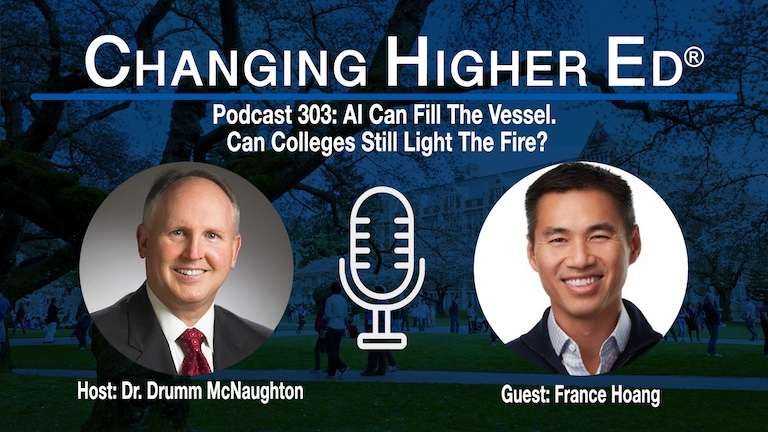

March 17, 2026 · Episode 303
When AI Handles the Task, Higher Education Has to Build Human Judgment
37 Min · By Dr. Drumm McNaughton
When AI can do traditional assignments and apprentice jobs, colleges need learning that develops judgment, critical thinking, and real decision-making.
AI has pushed higher education past the point where policy alone is enough. If students can generate summaries, draft papers, and produce plausible answers in seconds, colleges now have to answer a harder question: what are they teaching that still matters?
France Hoang, founder and CEO of BoodleBox, pushes the AI conversation toward the issue that matters most for presidents, provosts, boards, and academic leaders. The central challenge is no longer access to the tool. The challenge is whether colleges and universities will redesign learning, advising, and implementation in ways that strengthen judgment, expertise, and human decision-making rather than weaken them.
That is what makes AI a strategic issue for institutional leadership. A campus can publish guidelines, approve a platform, and hold a few workshops without addressing the deeper problem. If the academic model still relies on assignments that can be completed through summary, drafting, and imitation, the institution is defending a structure AI has already exposed as fragile.
Why AI Is Pressuring Higher Education to Clarify Its Purpose
A useful way to frame this moment comes from Plutarch: a mind is not a vessel to be filled, but a fire to be lit. Higher education has long depended on a sequence that looked stable enough to trust. Students completed the reading, absorbed the information, wrote the paper, took the exam, and demonstrated learning through the finished product.
That sequence weakens once students can outsource summary, drafting, and explanation without doing much of the underlying intellectual work. A student may still turn in a competent-looking assignment. The finished product no longer proves that the student actually wrestled with the material, made sense of competing ideas, or arrived at an informed conclusion.
That is why AI cannot be treated as a narrow issue of policy enforcement or classroom rulemaking. It reaches into the institution’s purpose. Colleges need to be much clearer about whether they are organized around information delivery or around the development of judgment. Information is now easier to generate than ever. Judgment is not.
For higher education leaders, that shift matters because it changes the basis on which academic value is defended. The argument for college cannot rest on access to content. It has to rest on how well the institution helps students interpret, question, apply, and use knowledge responsibly.
Why Human Judgment Has Become More Important, Not Less
One of the strongest insights here is Hoang’s point that AI often gets a person to a B-minus answer. That framing is useful because it captures both the appeal and the limit of these tools. The answer may look polished. It may arrive quickly. It may even sound authoritative. None of that guarantees the answer is complete, nuanced, or safe to rely on.
The people most likely to spot those weaknesses are the ones with real domain expertise. In a field they know well, they can see where the answer oversimplifies, omits, or misreads the issue. In a field they do not know well, the same response can sound far more impressive than it deserves.
That has direct implications for higher education. Colleges still need to produce graduates who can tell the difference between plausible output and sound reasoning. Faculty still matter because they help students move beyond the first answer into the harder work of interpretation, verification, and judgment. The institutional value proposition is not disappearing. It is becoming easier to define. Students need more than content delivery. They need the ability to assess the quality of what they are reading, hearing, and generating.
That point matters well beyond the classroom. Leaders making decisions about policy, regulation, operations, finance, or public communication face the same risk. A superficially convincing answer can create real problems when no one with expertise tests it carefully.
Why The Old Apprenticeship Model Is Becoming Less Reliable
There is also a workforce issue here that higher education should not ignore. Employers continue to say they want graduates who can think critically, analyze information, collaborate well, and exercise sound judgment. Those qualities do not usually appear all at once on the first day of a new job. In many professions, people developed them through early-stage work that was repetitive, routine, and closely supervised. Over time, the junior employee learned patterns, built confidence, and took on more complex decisions.
That developmental path weakens when routine entry-level work goes to AI instead of junior staff who would have learned through doing it. If the first layer of apprenticeship begins to disappear, the workplace becomes less dependable as the place where emerging professionals mature into capable analysts, managers, and leaders.
Once the workplace stops providing as much early-stage developmental work, colleges have to decide how much of that growth must happen before graduation. That creates pressure for institutions to build more applied learning into the student experience. It also changes what readiness should mean. Completing coursework is no longer enough if graduates have had too little practice making judgments, defending decisions, and working through ambiguity before they enter the workforce.
This is where internships, externships, project-based learning, capstones, simulations, and work-integrated models become more valuable. They are no longer helpful additions on the margins. In many cases, they may become part of the institution’s answer to the shrinking apprenticeship ladder.
Why Colleges Need To Redesign Assignments, Not Just Regulate Tools
The clearest institutional response is not a ban, a warning, or a detection strategy. It is assignment redesign.
The old model assumed that reading the material and writing the paper created enough friction to support learning. That assumption no longer holds. If a student can shortcut the process through AI, the institution has to rethink what the assignment is designed to measure.
A stronger assignment requires students to use knowledge in context, make decisions, justify their reasoning, compare outputs, and reflect on the quality of their conclusions. The educational value has to move away from repetition and toward interpretation. It has to move away from proving that a student can produce a finished answer and toward showing how that student arrived there.
A historical essay based on assigned reading is easier to outsource than a simulation that places students inside a decision point and asks them to defend choices under realistic constraints. A generic response paper is easier to outsource than a case analysis that requires students to compare their own reasoning with AI-generated alternatives and explain why one is stronger. Once the structure of the work changes, AI becomes harder to use as a substitute for thinking and easier to use as a tool within thinking.
Institutions that redesign learning around application, analysis, synthesis, and evaluation will be in a stronger position than those still relying on assignment structures built for a pre-AI academic environment.
What Strong AI-Integrated Teaching Looks Like
The most useful examples are the ones that show what redesign can look like in practice.
In one case, students use their own class notes to build an AI assistant and then apply that assistant to case studies and simulations. That approach asks students to organize information, turn it into a working resource, and then use it to solve realistic problems. The learning does not stop at content exposure. Students have to structure knowledge, work with it, test it, and collaborate around it.
In another case, AI is integrated directly into writing instruction. Students write their own drafts, generate AI versions, compare the outputs, and reflect on the differences. That process makes the role of AI visible instead of treating it as something hidden at the edges of the classroom. It also turns comparison and reflection into part of the instruction rather than leaving them to chance.
These models are useful because they point toward a pattern academic leaders can recognize:
- make AI part of the instructional design rather than treating it only as a threat
- require students to explain their reasoning
- build reflection and comparison into the work
- use simulations, cases, and projects to create more applied learning
- teach students how to work with AI without surrendering judgment to it
That kind of design is harder to fake and more closely aligned with the environments students will enter after graduation.
Why Bloom’s Taxonomy Matters Even More Now
Bloom’s Taxonomy becomes more relevant in this environment because AI can now handle more of the lower-order work that assignments have often emphasized. Basic retrieval, summary, and routine explanation can be generated quickly. That does not remove the need for foundational knowledge, but it does change what leaders should expect from course design and assessment.
If institutions continue to rely on work built around recall and routine production, they should expect recurring problems. Students will use AI in predictable ways because the assignment invites it. Faculty frustration will rise, and leaders will keep hearing the same complaints without changing the conditions that produce them.
A better response is to push more intentionally toward application, analysis, synthesis, and evaluation. That shift belongs in more than individual classrooms. It should shape faculty development, assessment strategy, program review, and general education reform. Colleges that move in that direction will have a much easier time explaining academic rigor in an AI environment because the work itself will demand more than surface-level production.
Why AI Works Better as a Thought Partner Than an Answer Engine
The weakest way to use AI is to treat it as a machine for finished answers. The stronger use is to make it part of the thinking process.
Students, faculty, and staff can get more from these tools when they ask questions such as: what am I missing, what assumption is driving this answer, where is the reasoning weak, what alternative interpretation should I test, or what needs independent verification before I rely on it? Those questions turn AI from a shortcut into a partner in inquiry.
That is a much better fit for higher education because it reinforces habits institutions claim to value. Inquiry, reflection, disciplined skepticism, and better question-asking are all strengthened when AI is used to extend thought rather than replace it.
This is also the version of AI literacy that will travel better across disciplines and professions. Prompting alone is not enough. Students need to know how to interrogate output, evaluate quality, and decide when human expertise has to take the lead.
Where AI Can Strengthen Advising, Career Services, And Student Support
The case for AI extends beyond the classroom when it is used carefully. Advisors, counselors, and career services teams on many campuses are already stretched thin. Used well, AI can reduce repetitive questions and free advisors to spend more time on the students and decisions that require human judgment.
It can also give students a starting point when no human support is available. Some questions arise late at night. Others feel embarrassing enough that students hesitate to ask them in person. In those moments, an accessible tool can help students take a first step, get oriented, and show up better prepared for a later conversation with a professional.
AI is not a substitute for an advisor, but it can offer a starting point when live support is unavailable. For institutional leaders, that is a far more practical frame than generic promises of efficiency. The useful question is where AI can expand access, improve preparedness, and make human support more valuable.
Why AI Implementation Depends on Change Management and Culture
Many campuses still approach AI as a procurement issue. Which tool should we buy? Which vendor is secure? Which platform fits our environment best? Those questions matter, but they do not reach the harder part of implementation.
AI adoption is at least as much a training, change-management, and human-resource issue as it is a technology issue. A campus can choose a solid platform and still make little progress if faculty, staff, and students are not involved early, supported properly, and given room to learn what works in their own contexts.
A collaborative model fits higher education better because institutions, departments, and student populations will not adopt AI in the same way. A chemistry department will not use it like a writing program. A community college will not move in the same way as an R1. Leaders need to provide infrastructure, guardrails, and visible support while allowing units to experiment, compare notes, and learn from one another.
That kind of culture matters. When campuses create environments where people can share what worked, what failed, and what they learned, better practices spread faster, and fear loses some of its grip. AI adoption becomes less about compliance theater and more about institutional learning.
Three Takeaways for Higher Education Presidents and Boards
- Know Where Your Institution Sits on The AI Continuum
Leaders need to understand whether their institution is still AI independent, merely AI enabled, or beginning to move toward AI-native learning and operations. That distinction should shape planning, investment, and expectations. - Invest In People as Much as Platforms
AI adoption is as much a training and workforce issue as it is a technology issue. Without support for faculty, staff, and students, even a well-chosen platform will underperform. - Create A Culture of Innovation and Visible Experimentation
Institutions make better progress when leaders model experimentation, allow units to test ideas, and create environments where people can share both successes and failures.
Bonus Takeaway
The strongest implementation approach is not purely top-down. Institutions tend to move farther and faster when leadership direction is matched by bottom-up participation and experimentation.
Quick Overview
- AI has weakened the old assumption that completed assignments prove learning.
- Higher education now has to clarify what students should learn that AI cannot do for them.
- Human judgment is becoming the clearest institutional value proposition.
- AI often produces plausible answers that still require expertise to evaluate well.
- The old apprenticeship path from junior work to stronger professional judgment is becoming less reliable.
- Colleges may need to build more applied development into the student experience before graduation.
- Assignment redesign is a stronger response than trying to regulate AI out of existence.
- Simulations, case studies, projects, and reflection-heavy work are better suited to this environment.
- Bloom’s Taxonomy becomes more useful when lower-order tasks can be automated.
- AI should be taught as a thought partner rather than treated only as an answer engine.
- Advising and career services can use AI to improve access and preparedness.
- Strong implementation depends on people, culture, and change management as much as technology.
About Our Podcast Guest
France Hoang is the Founder and CEO of BoodleBox, bringing over 25 years of experience in national security, law, technology, and entrepreneurship. Prior to BoodleBox, France was on the founding teams of companies that generated over $600 million in combined sales and employed over 1,200 professionals across law, aerospace, defense, government services, and technology. His distinguished career includes service as Associate White House Counsel and Special Assistant to President George W. Bush, combat deployment as Executive Officer of a U.S. Army Special Forces Company in Afghanistan, and roles as a federal law clerk and Assistant United States Attorney. France holds a J.D. magna cum laude from Georgetown University Law Center, a Masters in Criminal Justice from Washburn University, and graduated in the academic top 1% of his West Point class. He is passionate about democratizing AI access for education and mission-driven organizations, serving as a Distinguished Visiting Lecturer at the U.S. Military Academy, a former trustee of Marymount University, and Senior Fellow with the National Security Institute at George Mason University.
Connect with France Hoang on LinkedIn →
About the Host
Dr. Drumm McNaughton is the founder, CEO, and Principal Consultant at The Change Leader, Inc. A highly sought-after higher education consultant with 20+ years of experience, Dr. McNaughton works with leadership, management, and boards of both U.S. and international institutions. His expertise spans key areas, including accreditation, governance, strategic planning, presidential onboarding, mergers, acquisitions, and strategic alliances. Dr. McNaughton’s approach combines a holistic methodology with a deep understanding of the contemporary and evolving challenges facing higher education institutions worldwide to ensure his clients succeed in their mission.
Read the Podcast Transcript →
Transcript 303: Changing Higher Ed podcast – with host Dr. Drumm McNaughton and guest France Hoang
Introduction to Changing Higher Ed®
Welcome to Changing Higher Ed®, a podcast dedicated to helping higher education leaders improve their institutions. With your host, Dr. Drumm McNaughton, CEO of The Change Leader, a consultancy that helps higher ed leaders holistically transform their institutions. Learn more at changinghighered.com. And now, here’s your host, Drumm McNaughton.
[00:00:31] Welcome and Guest Intro
Drumm McNaughton: Thank you, David. My guest today is France Hoang, founder and CEO of BoodleBox. BoodleBox is a secure, collaborative AI platform for education and work, and gives students and users access to multiple AI models to enhance learning productivity and AI literacy. France brings over 25 years of experience in national security, law, technology, and entrepreneurship. You might have guessed that he’s a serial entrepreneur. Prior to BoodleBox, he was on the founding teams of multiple companies that generated over 600 million in combined sales and employed over 1200 professionals in multiple areas. He served as associate White House counsel and special assistant to President George W. Bush. He was deployed as a special forces to Afghanistan and unfortunately he also graduated from West Point, which as my listeners know, is our rival, but sister school. France is passionate about democratizing AI access for education and mission-driven organizations, and he joins me today to talk about how AI is getting applied in higher education and different ways you can use it.
France, welcome to the program.
France Hoang: Thank you. It’s a pleasure to be here with you this morning, Drumm.
Drumm McNaughton: Likewise, I am so looking forward to our conversation.
[00:02:04] France Hoang’s Background
Drumm McNaughton: You are the founder and CEO of BoodleBox, but you have an incredible background which is actually very much aligned you with AI, which is what BoodleBox is all about. Before we get into AI and what’s going on with that in higher ed, please give us a little background.
France Hoang: Oh, thanks, Drumm. I like to joke I’ve got professional ADHD. I’ve done, I’ve done, I’ve done more than a couple things.
[00:02:31] West Point and Military Roots
France Hoang: I’m a refugee from Vietnam. I grew up in Washington State. I wanted to give back to this great country. So I ended up going to West Point, served in the US military. Yeah.
Drumm McNaughton: Go Navy. Beat Army.
France Hoang: Yes, yes. We are friends 364 days of the year, Drumm. That one day…
Drumm McNaughton: Yep.
France Hoang: But you had a leg up on us.
Drumm McNaughton: Oh yeah, we have for a while. Although your quarterback, the one that left last year was incredible. He was one of the best I’ve seen.
France Hoang: Yeah. Yeah. By the way, one of the reasons I went to West Point, besides the fact that it’s the superior Service Academy. One, I didn’t know how to swim coming outta high school, so that eliminated me from the Naval Academy and two, I’ve terrible eyesight that eliminated me from the Air Force Academy.
But yeah, I served as an Army officer for five years. I was peacekeeper in Bosnia.
[00:03:21] Law, White House, Afghanistan
France Hoang: Then I had my first career pivot. I became a lawyer. Frankly not a very good lawyer, I think. But still ended up working in the White House and for some terrific law firms and in DC. Then I actually commissioned again as an army officer, served in Afghanistan with US Army Special Forces in combat. Came back and became an entrepreneur and started a couple different companies. I have done well with my fellow founders at these companies.
[00:03:48]
France Hoang: After I exited my most successful company, I wanted to continue serving and I’ve always had a love of education. So among other things, I became a trustee of university. I became and remain a distinguished visiting lecturerat West Point. So I’ve had lots of classroom and academic time, done everything from who should we pick as the next Vice Chancellor to open your textbooks to page 43.
I’ve been involved with AI before AI was cool. Was involved in building and deploying AI tools for almost 10 years now. And BoodleBox, as you mentioned, is the culmination of all those things. It’s the intersection of my love of education, my strong interest in AI, and my desire to solve hard problems that need solving.
Drumm McNaughton: Well, it sounds to me you have a very broad experience. Does that experience help you in working with higher ed institutions to bring things, best practices from the outside to help make institutions more efficient.
France Hoang: Yeah.
[00:04:46] Rethinking Education’s North Star
France Hoang: I think one of the things that’s challenging about education is what’s our north star, What are we trying to accomplish? And I think you ask different people, you get different answers. I think that has been strongly challenged by AI. one of my favorite quotes, Drumm, is from Plutarch, “A mind isn’t a vessel to be filled. It’s a fire to be lit.”
Drumm McNaughton: Oh, I like that.
France Hoang: I think there’s this always been this question, what are we doing in education, Are we filling minds? Are we lighting fires? And AI has caused us to really think hard about that question. I think one of the, among many other things that education needs to do, it needs to prepare our graduates for this AI enabled future, which is really our AI enabled present.
And because of my workforce experience, I’ve seen that. I’ve seen how organizations prosper and grow. And so I can bring that when I look at education and if part of education is preparing students for that world, I’ve been in that world. And having used AI and built AI, I see both the promise and the perils of AI in the real world, and thus I can look from that point backwards and say, gosh, how should AI be in the classroom?
Drumm McNaughton: Well, it’s interesting because there’s all sorts of applications for AI in higher education, classroom being one of them. The challenge I’m seeing in higher ed, but even more so when I think, I flew airplanes in the Navy and when I see people saying, “oh yes, we’ll just turn over the air control aircraft control system, the FAA functions to AI.” I’m thinking to myself, I don’t wanna fly anymore. it’s not that it isn’t good, but it still requires human intervention. It still requires monitoring because it doesn’t always make the right decision. An example of that would be autonomous cars. It doesn’t always see everything it’s supposed to. And what happens when it malfunctions, somebody dies?
[00:06:49] Humans Plus AI
France Hoang: One of the driving reasons I built BoodleBox was because I felt there was too much AI in AI. There’s this belief that it’s humans versus AI, And it’s a zero sum game. There’s this thing called the fallacy of the cognitive offloading, That what we do is human beings, if you outsource something, then there’s less left.
I don’t think it’s humans versus AI. I think it should be humans plus AI. In fact, it should be humans plus other humans plus AI plus AI. And so I believe the future of work and thus the future of learning is human AI collaboration. And I hear this term a lot, AI first. Actually really dislike that term. I don’t think organizations should be AI first. I don’t think society should be AI first. I think we should be human first. However, AI allows us, if we use it responsibly and collaboratively, to be the best versions of ourselves. It gives us more time and space for human connection, for critical thinking.
Drumm McNaughton: Interesting because when I think about the great inventions that have happened over the years, iPhone, the light bulb, all these things, they were humans who were doing it. Could AI develop the idea to do something like this? Could it actually, could it build the plans? Yeah, very possibly. But would it be backwards looking because of the technology, or would it be forward looking, as someone’s intuition, as someone’s experience can make that leap of faith?
France Hoang: Yeah.
[00:08:21] AI Limits and Expertise
France Hoang: One of the concerns I hear is that AI is going to replace us because it basically commoditizes expertise.
Drumm McNaughton: Yeah.
France Hoang: If I build a partner level AI, I don’t need law firm partners anymore. We can get rid of all the lawyers,
Drumm McNaughton: Well, I’m sorry, we’re not gonna go there on that one.
France Hoang: But here’s the truth, because of the limitations of large language models, anybody who’s used AI at length knows if I use AI in an area where I don’t have expertise, say refrigerator repair for me, I think AI is amazing. ‘Cause I don’t know anything about refrigerator repair. But if I use it in an area where I do have expertise, let’s say the law, I instantly see the limitations of it. It gives me about a B minus answer, It does about an 80% job. Well, that’s always true. So if you build a partner level AI, you have a partner level AI that is right 80% of the time and wrong 20% of the time. Well, who’s that useful to? The everyday person doesn’t wanna have 80% of their legal answers right. It’s actually most useful to somebody who already has domain expertise. It’s most useful to the existing law firm partner who can see the 80%, that’s right, the 20% that wrong, and actually makes them faster, better, more efficient. And now they can use that AI and maybe automate some of the things that were wrote for them and spend more time on the things that are value add, The critical thinking and what we all want more of, human connection.
Drumm McNaughton: You bring up a very interesting point, and I hadn’t thought of it that way about, the AI and the human interaction and having the partner. It really takes someone with that partner level expertise or department chair swapping it over to faculty or your researcher. Yes. Will it speed up things? Absolutely. But you still need that human there to say, no, this is garbage. Or, oh, this is a good point, hadn’t thought of it that way. You need that human expertise to double check.
[00:10:26] Why Educators Matter to Develop Domain Expertise
France Hoang: And where are students gonna develop that human expertise. If AI gets you to B minus, it’ll never get you past the B minus by itself. So in other words, if I’m a student and I’m just using AI, I get to the B minus. Well, guess what? This is why educators are more, not less important now as well, because the classroom is the place where you can develop that domain expertise. It takes somebody with academic credentials, with real life experience, and who knows how to educate to create those domain experts in our students today. And so that’s why I don’t think we have to worry as educators about being replaced anytime soon.
Drumm McNaughton: No. And in fact, if business was thinking about it smartly, they wouldn’t be trying to replace so many people. Yes, from a bottom line dollar perspective, great. But do we want, six Sigma? Do we want things outside of the limits that AI can do or do we want things that are gonna be better?
France Hoang: Yeah.
[00:11:27] Jobs Are More Than a Collection of Tasks
France Hoang: There’s this, I think there’s this misnomer and technologists often fall in this trap, That we view a job as a collection of tasks and completely remove the human element from it, I am more than just somebody who does five different tasks throughout the day. That’s not what I do. I think about those things, I prioritize, I interact with other people, I exercise judgment. And what AI could actually do is give me more time to do those uniquely human value add activities. And so that’s the way we should think about AI. In terms of augmenting and increasing human potential, not replacing it.
[00:12:05] Employers Want Human Intelligence and Skills
Drumm McNaughton: My listeners often hear me refer to AAC&U, the American Association of Colleges and Universities, and every two years they come out with a study of what employers want from graduates. And we hear AI as starting to creep up there, but not on itself, but the how to use it, it’s always the human traits that you’re talking about. The critical thinking, the ability to analyze data, draw conclusions, working in teams, these are all critical things that a human can do, but a machine can’t.
France Hoang: Yeah. I love that you brought up AAC&U. I was literally there at their annual conference two nights ago. I saw Eddie Watson. I saw Jose Bowen. We talked about their most recent study. What you said is absolutely true. Let me point out something that’s also true that is a little troubling.
[00:12:56] Bridging the Apprenticeship to Executive Level Gap
France Hoang: As it turns out, many of us know that when a recent college graduate, the jobs they take generally actually don’t involve critical thinking and creativity. They involve relatively routine work to give them one or two or three years of opportunities to develop that judgment, that critical thinking, that creativity. And so they have to serve an apprenticeship.
One of the issues now is AI can do those rote tasks. And it’s to that extent, senior level people, instead of turning to a junior level person, are turning to AI. The problem is, if I’ve never been a first or second or third year analyst, how do I develop the expertise and judgment and experience to be a fourth year analyst?
And so this is a conundrum. And Jose Bowen has talked about this a lot in his keynotes. I think the answer again is education. I think as educators we need to step up our game. We need to not just fill vessels, but light fires. And light fires that burn bright and give the graduates of our programs, not just the knowledge, but also develop that expertise, develop those critical thinking skills, as if they were already fourth year analysts, and that should happen in the classroom.
Drumm McNaughton: I agree.
[00:14:13] Work-Integrated Learning Models
Drumm McNaughton: Whether it be in the classroom, whether it be externs, interns, work. I had the president of Paul Quinn College on not so long ago. And they have an incredible model. Their tuition is much lower than many institutions. The way they are able to do this is they have freshmen and sophomore working for the college, learning different skills, their pay goes to pay for the tuition, et cetera. It’s not indentured servitude. They’re getting a good education out of it. Years three and four, they’re working for Paul Quinn partners like Southwest Airlines and others. They’re getting a salary. They’re tuition goes down. They’re getting great skills. They’re learning these first, second, third level analyst skills before they leave college. To me, this is a wonderful model.
France Hoang: Yeah, you and I attended institutions that valued not just academic achievement, but athletic prowess and then leadership in character building, They, we were very much, as much as the service academies are wonderful academic institutions, they’re also vocational institutions, They’re teaching us for a vocation.
Now, I can hear listeners always saying, but look, I’m a professor, I can’t change the DNA of my entire college, another great example of a school like this is Deep Springs, You run a ranch, which is awesome, But here’s the thing.
[00:15:32] AI Projects in Marketing Class
France Hoang: This is the promise of AI, now you can in your classroom. So I’ll give you a quick example. At Point Loma, there’s a marketing professor, Christina Kalberg, and she does traditional lecture and she’s the sage on the stage. But then the students have to take their class notes and they have to build an AI assistant and they do it doing BoodleBox And they filled that AI systems knowledge bank with all of the notes they took from class. Then the way she assesses the students isn’t through a quiz, isn’t through an essay, she gives them real world case studies, real world simulations where the students have to collaborate with the AI assistant they created to generate real world solutions. And at first they do that individually and eventually they do that in groups. And so she’s essentially right now asking students to learn how to process the information she gives them, build AI systems, and collaborate human AI teams to solve real world problems. She’s given an experiential learning, A project-based learning experience inside our classrooms with AI in a way that is possible without having to change the whole DNA of the institution.
Drumm McNaughton: And this is a, she’s a marketing professor? So not tech, not something else marketing. So this is a good applied AI.
[00:16:48] AI Independent to Native
Drumm McNaughton: I know when we spoke before, we were talking about different models for AI independent, AI enabled, and AI native. This sounds to me like it comes under the AI enabled.
France Hoang: Yeah. And moving into AI enabled to AI native type of structure. Yeah. So Jose Bowen talks about how right now a lot of AI use is like taking a horse and buggy and replacing the horse with a steam engine. So if you think of AI independence, the horse and buggy, it’s the era before AI.
AI enabled is where we take existing organizations and processes and procedures and without changing them, we just insert AI. We take something out and we put AI in instead. That’s removing the horse in the horse and buggy and putting a steam engine in its place. Eventually we wanna reimagine processes, procedures, workflows, organizations in the ground up in an era where human AI collaboration is possible and taking advantage of those things. That’s the That’s being AI enabled. Now obviously that’s a lot of work. Obviously that’s scary. Obviously that is not something that’s gonna happen overnight. But it’s clear that the difference between a horse and buggy, a buggy of a steam engine of running in a car. The car is where we’re gonna go, and I’ll add in a world of cars, right, there’s still horse and buggies and there’s still bicycles and some people still walk and there’s different types of cars. So it doesn’t mean this should be one size fits all.
Drumm McNaughton: And I like that analogy very much. We seem to be talking about the classroom with this going to the AI native. I remember Gordon Gee, many years ago, back during COVID, he said COVID is forcing changes on higher ed and accelerating them by more than a decade. Well, I think AI becomes the tool to do this enabling.
What other instances have you seen in the classroom that would give listeners an idea of possibilities, how it could be used better?
[00:18:59] AI in Writing Instruction
France Hoang: Yeah, so Pikes Peak State College, they’re another one of our partners, They used AI in their writing program. And I use writing because for many people, writing is ground zero of the things that have been challenged by AI. Like, how am I gonna teach students to write in an era where they can ask AI to write anything from them, What’s the value of writing? How do I avoid academic integrity issues? So, this very, very, innovative community college writing instructor, again using BoodleBox, built a series of exercises, built a series of bots, made using AI the point. Enabled learning, not just with AI but about AI.
Example, here’s a piece, try this piece of writing yourself, now generate it in AI, compare and contrast the two. What do you notice? Reflections. So at the end of this class which deeply involved AI both as an examination of writing with and about AI and the limitations of AI and AI helping to scaffold the student’s writing, the students said that 90% of them felt that the use of AI this way was more ethical. 83% said they felt more prepared to use AI in their lives and in their work. 87% preferred the use of this AI tool or the other AI tools they hadthat were free because it was collaborative and transparent.
And I think AI, if we’re open to rethinking our pedagogy, looking to the future, I think there are ways to incorporate AI that amplify what we wanna do in the classroom.
[00:20:29] AI and Bloom’s Taxonomy Revisited
Drumm McNaughton: It’s interesting because when I go back to my academic hat, when I think about Bloom’s Taxonomy, lower levels are knowledge and comprehension. Okay, you’ve got an AI tool that can do that. So it gives you the opportunity to move up to those next levels, application and analysis, and even at the doctoral level, synthesis and evaluation. You don’t have to know all these things. You don’t have to fill your brain up with useless trivia. You need a baseline information in many respects, it’s like accreditation. There’s baseline standards, but how are you gonna innovate beyond those? How are you gonna create better student learning outcomes, et cetera.
France Hoang: Yeah, going back to the Plutarch quote. Before the process of filling the vessel, ignited the fire. So I’ll give you an example. If I was giving a reading assignment of 50 pages on the Conference of Yalta and then write an essay analyzing it. The process of me reading and digesting and breaking that down and then reconfiguring that knowledge in my brain to come up with assumptions and then putting on a paper that lit the fire. Because I was doing both at the same time.
The challenge is now we live in a world where AI can make filling the vessels so easy, I can just ask AI to gimme a summary. I can ask AI to write the essay. That no longer lights the fire. So we have to figure out a different way to do that, And so imagine instead,I know exactly what happened if I gave a 50 page reading on the Conference of Yalta to any student in America right now. They’re gonna put in AI. They’re gonna say, what there are five things I should know about this. They’re not gonna do the reading. But imagine, instead the assignment was, here’s an AI simulation of Yalta. You have to take on the role of Churchill or Stalin or Roosevelt, and you’re gonna make decisions, and you’re gonna get feedback on those decisions, and you’re gonna live all those days of Yalta. And at the end of it you’re gonna get feedback on the choices you made versus the frameworks we talked about in class. And you’re gonna be assessed on the decisions you made and then your explanation of why you made them. A, that’s more compelling, it’s something I want to do. But B, we’re now lighting fires in a way that doesn’t require you to assume that students are gonna fill their vessels the way they used to.
[00:22:48] AI as a Thought Partner Not a Replacement
Drumm McNaughton: I’ll give you an example. It happened to me just yesterday, talking with a client and an accreditor. And the accreditor was saying that you don’t need to go through state licensure because you’re part of an exception, or actually I said that. And so I looked up on Google and Google said, “yeah, if you’re charging less than $2,500 for a tuition and all the expenses, you meet BPPE exception criteria”. I thought, “oh, that’s great”. But I always go back and check the regulation. It’s like, yeah, except that it’s a very limited scope of industry. It has to do actually with pilot training and not with regular degree awarding institutions. Oh, well, if I’d just gone by the Google, then I would’ve given this client bad advice. It’s again, the knowledge. The knowledge, being able to look at things critically like the attorney question you gave.
France Hoang: And as much as, and even if we were in a place right, where AI was a hundred percent reliable, we still want different viewpoints, And we still want the human component. Wikipedia, right, and let’s say an encyclopedia, that is 99% right, but no one says that encyclopedia replaces anybody, Somebody’s gotta know how to use it. Somebody has to know how to answer the question, ask the right question, and take those answers and apply them. And in today’s era, you probably want to check it against other sources, multiple sources. That’s what any good academic does.
And then the role of expertise, Even if you get the answer, what am I missing? My first step in researching something isn’t to look it up necessarily. If I know a subject matter expert, I’m gonna ask, hey, this is the answer I’m trying get, what are the things I should think about, or even better, how should I think about this answer? And so that, that goes into one of the points I like to make about the use of AI. We tend to use AI as a tool, as an answer engine, when it’s far more powerful as a thought partner. Not give me this answer, but how should I find this answer? Or even better, here’s the answer I found. What’s wrong with it?
Drumm McNaughton: Exactly, and that helps people develop their ability to analyze, critical thinking, all of those things. If you’re working in a team and you give it to somebody else, there’s the teamwork aspect, all that.
[00:25:21] Institutional Uses and Risks
Drumm McNaughton: I wanna touch base a little bit on what, we’ve talked a lot about classroom stuff here. What are some of the applications an institution can use overall with AI and what are some of the gotchas with each of those? For example, the enrollment funnel.
France Hoang: Yeah, so I tend to focus on teaching and learning ’cause that’s where my passion is. the platform we built can certainly be used for other components of AI in an institution, operations, administration, research, and obviously AI can be applied to all those areas. I think that when you think about administration operations, now you’ve got heightened security concerns. You’re dealing with a lot more FERPA data, You’re dealing with AI at scale. I think, this is where CIOs get very nervous about the systems and security. This is where something like Microsoft Copilot frankly makes a lot of sense because of the close ties totheir security architecture. It’s a workforce application. And again, I think the same way we need to reimagine classrooms to be AI native, we probably need to reimagine the administration of educational institutions to be AI native. I’m not an administrator, that’s not my particular area of expertise. I’m just talking in general terms.
Same thing with research, What does research look like in an era of AI? And again, I think there are specialized AI tools that focus on on academic research at the undergrad, graduate, and postgrad level. Again, I’m not a researcher by profession, but again, what does research look like in an AI native world?
I think in all these cases, Drumm, we need to let a thousand flowers bloom. Give people infrastructure, give them tools, give them left and right limits, let them experiment and make failure okay and then let them learn from that and share those learnings across your organization. And whether it’s in teaching and learning, or administration, operations, or research, the organizations that have done that, that’s where we’re seeing the best, fastest, and greatest adoption of AI.
Drumm McNaughton: Some of the things I’m seeing counselors, obviously counselors are overworked student advisors, overworked. Being able to use an AI tool to bring up different options, and then having your counselors speak to the students saying, this is your options based on my experience and my knowing your situation. This is the direction that I would advise you to go. Career services would be another option. How could you use it? What are the jobs? What are the degree, what’s your degree? What are the jobs you’d be eligible? How do you position yourself better? These are all things that AI can help with, but it’s not AI native, it’s AI enabled.
France Hoang: Yeah. But it’s still extremely valuable. We’ve talked to several institutions, career counselors are, or academic counselors, career advisors are overworked. They have, too many people that want help and not enough time. And so the use of AI to be a supplement, not to replace, but to supplement that, a couple things happen, which is interesting. One is they can help more people because some people can self-serve. Second, the people that are coming for academic counseling or career advice will have already done some of the work on their own. which means they come more prepared. That means in a 30 minute window of time, instead of, maybe 20 minutes of questions have been answered that are, that they could have self-help, now their time with the counselor is more valuable. The other thing we’re seeing, which is interesting, is that students will ask questions of AI. They won’t ask a human being because they’re embarrassed. Or inconvenient. A community college, The most likely time for a community college student to have an academic or career question is 10 to 12:00 PM at night. Not a lot of academic advisors and career counselors working at that moment in time so they just don’t ask. So either they have to. Go out way and remember that, Or they just simply don’t, just don’t bother, And so
Drumm McNaughton: Yeah.
France Hoang: something that’s available to answer the question then, and doesn’t judge, and is convenient, is that better than a human counselor? Well, something’s better than nothing,
Drumm McNaughton: But at the same time, it gets them an answer, gets them thinking about it, and they can go to their actual advisor and say, hey, this is what I’m thinking. AI said this. What do you think?
France Hoang: Right.
Drumm McNaughton: So it gives that.
[00:29:52] AI Implementation and Shared Governance
Drumm McNaughton: We haven’t touched on implementation and obviously when we talk about faculty, their shared governance—
France Hoang: Mm-hmm.
Drumm McNaughton: Collaborative approach with this is incredibly important. I had one client I worked with doing an academic strategic plan, and the group was frankly stuck in developing the strategies. They had all the tactics, but how do you label these in, which do you first, et cetera. So I put it in a, an AI platform. And the faculty, the administrators, which were all faculty members were horrified. Saying that this was plagiarism. So obviously there’s academic freedom that comes into this. There’s shared governance. What have you seen over your, your time doing this?
France Hoang: Yeah, we’re very blessed. We have over 70,000, 80,000 users across over 1300 different academic institutions. We’ve been adopted as the AI infrastructure for 90 colleges and universities and more every day. So we have this privilege of working alongside educators and administrators every day. And seeing a wide variety of practices. So I’ll say first there’s no one size fits all The needs of a community college are different than the needs of an R1. The needs of a school that serves an urban population is different than needs a school that serves the needs of a rural population. But I will say, generally speaking, what has been most successful, our collaborative approaches that are ground up,
In other words, institutions that try to take a centralized approach where the administration picks a tool, picks a methodology and says, hey, this is how we’re using AI and doesn’t involve faculty and students, that generally gets a lot of blow back. Just being very honest for all the reasons. Yeah. For all the reasons that would be apparent to anybody listening to this podcast, where it’s been most successful is where there’s an AI task force, an AI committee, they’re involved from day one in picking out the tools and picking out the platforms in developing the implementations. Realizing that from day one, this is not a technology problem,
Drumm McNaughton: Right.
France Hoang: AI in a college is not a technology problem. It’s a training and change management problem. It is a human resource problem first and foremost, Yes, it involves technology, and technology can be part of the solution, but you’re really investing in your people, And they need to be invested as well.
And also, as I mentioned before a thousand flowers need to bloom. The needs of the chemistry department are gonna be different than the needs of the writing department. The needs of the career officer are gonna be different than the needs of of your adjunct professors. And so, enabling lots of experimentation, setting the example by the administrators of experimenting themselves and then sharing the learnings that come from it. There’s another partner of ours, Pueblo Community College, they have a wonderful AI task force. When they first implemented BoodleBox, they had monthly luncheons where anybody from across the campus could come and just share what they’re doing with AI and what they learn. And sometimes it’s success stories, but as often than not, it was also, Hey, this is what I did and it failed, or it didn’t have the expected results. But it created this en environment of shared learning, which is so important right now.
Drumm McNaughton: Yeah, it’s so critical. And actually if you’re smart, you learn more from your failures than you do from your successes.
France Hoang: Yes. That’s why I consider myself a very smart person. ‘Cause I’ve had a lot of failures.
Drumm McNaughton: Well, you’re an entrepreneur and that’s what it takes.
France Hoang: Yeah. Most of what we do fails.
[00:33:14] Three Takeaways for Higher Education Presidents and Boards
Drumm McNaughton: France, this has been wonderful. I really appreciate your time today. I’ve thoroughly enjoyed the conversation. As we always do, wrap up with two questions. First, three takeaways for higher ed presidents and boards, what do they need to know about this AI revolution and how can they use it to help their institutions?
France Hoang: I would say first think about where you’re at, AI independent to AI enabled to AI native and think about where you wanna be and understand that framework. Second, understand, as we just talked about, this is as much a training and human resource problem as it is a technology problem. Invest appropriately, invest in people as much as platforms. And third,create a culture of innovation. This is about experimentation, it’s about learning. Set the example yourself. There are some deans of presidents that are very public about how they’re using AI, how they’re experimenting, how they use in the classroom.
As we often said in the army, what you do is so loud I can’t hear what you’re saying. So set the example as a leader.
Drumm McNaughton: Those are great takeaways. I’m gonna throw one more in there. And you touched on it with the innovation. Innovation is critical, but even more critical is the collaborative approach, because you’re not gonna do this top down, it’s gotta be a top down, bottom up.
France Hoang: Yes, a hundred percent.
Drumm McNaughton: So what’s next for you?
France Hoang: We are excited for 2026. We have some great partnerships that are in the works with a number of institutions that are right there on the cutting edge. We also have some really great partners. We’ve just announced a partnership with Microsoft. We’re about to announce a collaboration, Nvidia. We’re excited to continue to partner and build this AI native classroom. The one request I have from the listeners is there are folks out there who are BoodleBox users, you know, I love feedback. For those of you who are about to check out BoodleBox, I would love feedback from you too. And particularly if it’s things you don’t like, gosh, I don’t get this, here’s something that’s broken, here’s something that’s missing. We very much view what we do as a partnership with higher education to build this platform for the AI native classroom, for lifelong learning and work with AI and we can’t do that without feedback.
Drumm McNaughton: Very good. France, thank you so much for being on the program. It’s been a wonderful conversation. I look forward to hearing more about what you and BoodleBox are doing going forward.
France Hoang: Thanks, Ron. Great to be on.
Drumm McNaughton: Thanks for listening today and a special thank you to my guest, France Hoang, France, thoroughly enjoyed exploring AI with you. Thanks for some great learnings and I’ll look forward to the next time our path cross.
To my listeners, thanks for listening. Thanks for tuning in, look forward to seeing you next week.