
June 23, 2026 · Episode 317
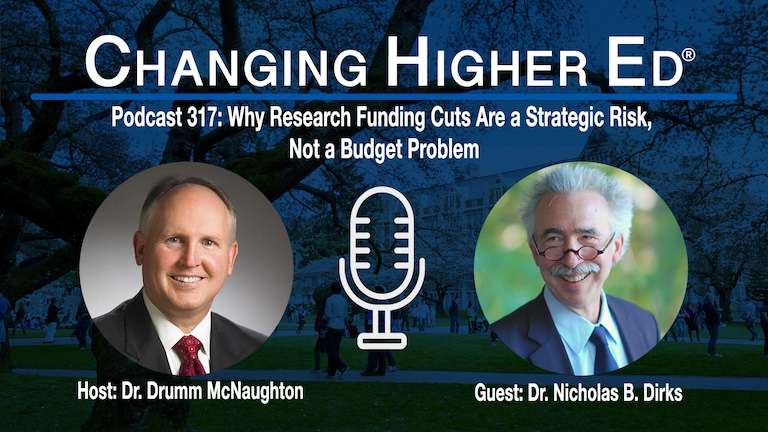
Why Research Funding Cuts Are a Strategic Risk, Not a Budget Problem
40 Min · By Dr. Drumm McNaughton
Research funding cuts threaten university research pipelines, biomedical studies, postdoc talent, and strategic planning for presidents and boards.
When the federal government pulls research funding from universities, the damage does not land first on the institutions that make headlines or the senior faculty who can wait out a bad year. It lands on the early-career scientists, the graduate students, postdoctoral fellows, and research associates who do the daily work of keeping long studies alive. They hold the least security, and when the money stops, they are the ones who leave. The grants can, in theory, be restored. The people who walk away cannot simply be called back.
In this episode of the Changing Higher Ed® podcast, Dr. Drumm McNaughton speaks with Dr. Nick Dirks, President and CEO of the New York Academy of Sciences. Dirks first joined the show in 2018, as the podcast’s third guest, as the former chancellor of UC Berkeley, reflecting on the protests that had put the university at the center of national attention over controversial speakers on campus. He returns to talk about what the current research funding cuts are doing to science, where AI fits in higher education, and the choices facing presidents and boards.
Research Funding Cuts Hit the Early-Career Science Pipeline First
The damage that worries Dirks most is not to marquee labs or tenured stars who can absorb a bad year. It is to the early-career researchers: the advanced graduate students, postdoctoral fellows, and research associates who hold no tenure-track security and who do the day-to-day work of keeping long studies alive. When their pay disappears or they are told to find work elsewhere, they leave, and the studies they were tracking stall behind them. As he put it, “You cannot turn the lights off and expect to walk back into the same room when you turn them on again. The room has changed, and so have the people who were standing in it.”
The scale is what turns this from a personnel problem into a strategic one. On the podcast, Dirks pointed to a National Postdoctoral Association survey he had worked on, in which roughly 75 percent of postdocs reported their work had been affected and 30 to 35 percent were weighing an exit from the country or the field. The picture has sharpened since the original survey.
A January 2026 issue brief from the Association of American Universities cites a Nature poll of roughly 1,600 researchers in which 80 percent of postdocs said they were considering leaving the United States, and a separate National Postdoctoral Association survey in which more than half of respondents had lost federal research funding. These early-career researchers represent the talent supply for the entire scientific enterprise. Disrupt it at that scale and the consequences run for years, well past any single administration or budget cycle.
Dirks connected this directly to national standing. American universities have been where the world wants to study and where the level of science has been the highest anywhere. Whether that holds is now, in his words, an open question, with implications for the country’s strategic position, not just its campuses.
Why Frozen Research Funding Cannot Simply Restart
The cuts that began in the first year of the second Trump administration targeted research dollars as leverage, an attempt to pull institutions away from what the administration views as ideological excess. Columbia, UCLA, Berkeley, and others lost substantial sums. McNaughton’s framing was direct: you can take the dollars away, but research already underway is not so easily paused and resumed.
Dirks agreed, and explained why the biomedical sciences make the problem acute. Trial therapies and long-term population studies cannot simply be halted. Stop following the cohort, and you forfeit the conclusions the original investment of time and money was meant to produce. He pointed to animal research as a concrete example.
Much of the funding for certain biology studies maintained populations of mice and other animals essential to advanced biomedical work. When the money stopped, universities could not afford to keep those populations going, and in the most extreme cases shut the labs down entirely. He also cited drug trials at Columbia that had to stop outright, ending years of work toward a potential cancer treatment in a matter of days. Even after the money was restored, that work could not be picked back up.
The legal record complicates the optimistic version of events. Courts have ruled in several cases that the government cannot withhold funds already promised to an institution. But Dirks noted that not all of the money has come back, and where it has, it has often returned over timelines too long to preserve continuity in the experiments that depended on it. That irreversibility is what makes federal funding volatility a matter for institutional risk management and planning, something to map and prepare for before a freeze hits rather than after.
What COVID Showed About the Research System Now at Risk
McNaughton drew the line back to COVID. The virus hit hard in March 2020, and an effective vaccine arrived in under a year. Weaken the pipeline that produced that result, he argued, and the country is more exposed the next time something like it appears.
Dirks agreed and added a dimension boards rarely hear. The speed of the mRNA vaccine should have been a high point for public trust in science. It was not, and he attributed much of that not to the science itself but to the public-health recommendations layered on top of it, where the move from evidence to policy under the banner of “follow the science” introduced slippages the science alone did not dictate.
He also emphasized how international the achievement was. Foundational mRNA work came out of the University of Pennsylvania with Drew Weissman and Katalin Karikó. Other critical work came from BioNTech in Germany, later acquired by Pfizer, led by two scientists originally from Turkey. The accomplishment ran across academia and industry and across the United States, Germany, England, and beyond.
That international character is precisely what current policy threatens. Many postdocs come from outside the United States, and even where their funding is intact, Dirks noted, their visa status and their sense of whether they can build a life here have been thrown into doubt. Funding disruption and immigration uncertainty arriving together produce what he called a perfect storm.
AI Requires Source Literacy and Human Judgment, Not Blind Adoption
The conversation turned to AI, which Dirks observed has become impossible to avoid. When he and McNaughton last spoke in 2018, the term barely registered. Now, he wagered, no higher education podcast gets through an episode without it.
His position is neither alarm nor cheerleading. AI is not going away, so the answer cannot be to ban it. He compared the moment to the introduction of the calculator in the early 1970s, when faculty worried students would never learn math again. Math skills may or may not have slipped since 1972, he allowed, but a great deal of good math has been done since, and no one now frets about a calculator sitting next to them.
AI, in his framing, is a tool in that lineage, and educators have to accept it as one even while taking the real concerns seriously: plagiarism, derivative work, and whether students still learn to research, think, argue, and write for themselves.
McNaughton brought in a recent guest, Karen Panetta, Dean of Graduate Engineering Studies at Tufts, who told him newcomers to AI need to understand three things: how the data was collected and whether it was ethically sourced, how that data is validated, and that a human has to make the final decision because critical thinking and ethics cannot be automated. Dirks endorsed all three and sharpened the point about sources. Students should be taught to treat what AI returns as a question rather than an answer, to interrogate where information comes from and what point of view it carries. A government source, for instance, carries a government’s perspective. The issue is less bias than provenance, knowing what you are looking at and being able to check it.
He drew a distinction worth holding onto: the human belongs not only at the end of the process but alongside it. He framed AI as augmentation rather than substitution, an unusually powerful tool that still depends on a person who understands the material well enough to know when it is wrong. McNaughton offered a case in point. Researching whether a startup college needed California state licensure, he got a fast answer from an AI tool, then dug into the actual statutes rather than take it at face value, and found a nuance the tool had glossed over. Knowing the subject, and knowing the tool’s limits, is what let him catch it.
Dirks closed the thread on a broader note. Large language models are already reshaping conversations about work across consulting, law, finance, science, engineering, and computer science, with some of those jobs beginning to disappear, though he was careful to separate AI’s effect from broader macroeconomic forces. The throughline he kept returning to was keeping the technology centered on human judgment and human ends, so that AI serves people’s purposes rather than developing its own.
How the University President’s Job Has Changed
Asked what presidents can actually do, Dirks started with empathy. The job is harder than it has ever been, and he respects anyone still doing it. But he located the deeper shift in something structural. A president answers to many constituencies, each with its own priorities, and the traditional path to success was saying yes to as many of them as possible. That no longer works. Increasingly, saying yes to one constituency means saying no to another, which is part of why some presidents have turned to institutional neutrality as a way out of an impossible balancing act.
The harder problem is that the entire sector is under attack and distrusted by a growing share of the public, and Dirks does not think higher education can answer that purely by defending itself. Some of the criticism, he said, has to be taken seriously, including the criticism leaders have been least eager to examine. For years institutions raised revenue so they could do more for everyone, for faculty, students, alumni, the surrounding community, even the football fans, and sustaining all of it drove price relentlessly upward. He grouped higher education with healthcare as sectors widely seen as unconstrained on cost.
McNaughton agreed that cost is the core problem, citing Jack Welch’s discipline at GE about living within a finite budget, and named ending the reflex of raising tuition every year as the obvious place to start. But both men spent more time on why this is so hard to do than on the diagnosis itself. Bringing cost down, Dirks said, means stopping programs an institution built up and displeasing the people attached to them. That is where votes of no confidence come from, and he was candid that those votes are sometimes grounded in something real and sometimes simply in faculty unwilling to see a beloved program touched.
Getting through it requires two things higher education has been bad at: institutions cooperating more across the sector, and faculty and administrators learning to work together rather than treating each other as adversaries. The antipathy many faculty hold toward administration, he said, makes the hard decisions harder, and those decisions are ultimately in everyone’s interest if the goal is to protect what makes American universities, in Clark Kerr’s phrasing, the producers of the best research in the world.
Three Takeaways for Presidents and Boards
For presidents:
- Don’t think of the presidency as a lifetime. Terms are coming down in length, and you have to be ready to leave if something doesn’t work out.
- Keep loving the job. With all the slings and arrows, it is still a magnificent position.
- Don’t be afraid to make some people less happy with you than you’d like. The need now is to raise serious questions.
For boards:
- Take the commitment seriously. When boards recruit a president, they are committing to work with that person, and Dirks has seen cases where they didn’t honor that.
- Back leadership on the hard financial calls. Boards have to understand the institution’s financial realities and support leaders not just in the abstract but when they have to make difficult financial decisions.
- Build a real relationship with faculty. Boards do this with students, but board-faculty relationships are often not as robust as they need to be when everyone has to work together rather than against each other. McNaughton added that he constantly hears presidents and boards ask why they’d want faculty on the board, and his answer is that they absolutely should, because trust has to go both ways.
Quick Overview
- Funding freezes and sudden disruptions hit the early-career pipeline hardest; a January 2026 AAU brief cites polling in which 80% of postdocs said they were considering leaving the United States
- Frozen research funding is not reversible the way a budget line is. Halted biomedical studies and drug trials often cannot be restarted even after the money returns
- Animal research populations were discontinued at some institutions when funds were cut, in some cases shutting labs entirely
- Courts have ordered withheld funds released, but not all of it has come back, and what has often returned too late to preserve continuity
- Funding cuts combined with visa uncertainty for foreign-born postdocs create compounding risk
- Sound AI use depends on understanding how data was sourced and validated and keeping a knowledgeable human in the loop, alongside the process rather than only at the end
- The president’s role has shifted from saying yes to every constituency to making choices that will disappoint some of them
- Bringing higher ed’s cost down requires cutting programs and absorbing the resulting no-confidence pressure, which makes faculty-administration trust essential
- Boards should build stronger relationships with faculty, not just students
About Our Guest
Nicholas B. Dirks is President and CEO of The New York Academy of Sciences, one of the oldest scientific organizations in the United States. Previously, Nick served as Chancellor of the University of California, Berkeley, and Executive VP and Dean of the Faculty for Arts and Sciences at Columbia University, where he was the Franz Boas Professor of Anthropology and History. A leading scholar of South Asia who has taught at Caltech and the University of Michigan in addition to Columbia and Berkeley, he is the author of eight books on subjects ranging from the caste system and the British empire to the university. His last book is entitled City of Intellect: The Uses and Abuses of the University.
About the Host
Dr. Drumm McNaughton is the founder, CEO, and Principal Consultant at The Change Leader, Inc. A highly sought-after higher education consultant with 20+ years of experience, Dr. McNaughton works with leadership, management, and boards of both U.S. and international institutions. His expertise spans key areas, including accreditation, governance, strategic planning, presidential onboarding, mergers, acquisitions, and strategic alliances. Dr. McNaughton’s approach combines a holistic methodology with a deep understanding of the contemporary and evolving challenges facing higher education institutions worldwide to ensure his clients succeed in their mission.
Read the Podcast Transcript →
Transcript: Changing Higher Ed podcast 317 – with host Dr. Drumm McNaughton and guest Dr. Nick Dirks
Introduction to Changing Higher Ed®
Welcome to Changing Higher Ed®, a podcast dedicated to helping higher education leaders improve their institutions. With your host, Dr. Drumm McNaughton, CEO of The Change Leader, a consultancy that helps higher ed leaders holistically transform their institutions. Learn more at changinghighered.com. And now, here’s your host, Drumm McNaughton.
[00:00:31] Welcome Back Nick Dirks
Drumm McNaughton: Thank you, David.
My guest today, or I should say my repeat guest today, is Dr. Nick Dirks, President and CEO of the New York Academy of Sciences. When I had Nick on the show, he was my third guest ever, would’ve been back in September of 2018. That’s how long we’ve been coming to you as a podcast.
Before joining the New York Academy of Sciences, Nick served as chancellor of UC Berkeley and Executive VP and Dean of Faculty for arts and sciences at Columbia University, where he was the Frank Boas professor of anthropology and history. Nick’s been at the forefront of higher ed at the top-tier research institutions in the country for multiple decades, and he joins me today to talk about the impact of budget cuts on research, AI, and what presidents and boards can and should be doing in today’s age of disruption.
Nick, welcome back to the program.
Nick Dirks: Great to be here, Drumm.
Drumm McNaughton: It is great to have you back.
[00:01:32] Remembering 2018 Berkeley
Drumm McNaughton: Listeners probably don’t remember this, but you were my third podcast guest ever. That was probably coming up on eight years ago? I started the podcast in, I want to say August, so we probably did a recording in September.
Nick Dirks: Well, that sounds right and I remember having a riveting conversation with you, Drumm, so I’m looking forward to what you would like to talk about today.
Drumm McNaughton: I appreciate that. It was an interesting conversation because you had just stepped down from being the Chancellor at UC Berkeley, and you’d had the riots that had gone on, et cetera. It was a crazy time for Berkeley back then.
Nick Dirks: It was a crazy time for Berkeley.
[00:02:16] Campus Riots And Speakers
Nick Dirks: We’d had, in fact, that set of riots that took place in 2017, starting in February, and they actually went on through even after I had stepped down from being chancellor and was succeeded by Carol Christ, who had to deal with, more of it in the fall of 2017.
But we talked about it in part because it seemed to me to be something that was happening at Berkeley, but like many things, at Berkeley, they happened there first and then they spread out to other universities. There’s been a lot of spreading and even some exponential since, since then.
But I think we’ve all, across almost every campus in, in, in America, seen the controversies that can attend, having speakers of a particular kind come to campus and, watch the dissension and the disagreement that often goes along with that. They don’t always have riots that are broadcast on CNN and MSNBC as we did, but at Berkeley, we like to be special.
Drumm McNaughton: Of course.
[00:03:15] Berkeley Legacy And Pride
Drumm McNaughton: And you can, that dates back to the ’60s, and actually it dates back to the founding of the university and how cutting edge you are on so many social issues.
Nick Dirks: Well, I like to be cutting edge when it comes to Nobel Prizes and cyclotrons and other great discoveries, as well as making available, a Harvard education at the price of a public university. But we also have our, our interest in, in, in keeping, stories around social issues alive and well.
So, try to bring the full package.
Drumm McNaughton: Well, we certainly appreciate your doing that.
[00:03:53] Leaving Berkeley For New York
Drumm McNaughton: You left Berkeley in 2000 s- Yes, 2017?
Nick Dirks: Yes, I did. And I taught for a while and, and I, I took a little bit of leave. But then I started in the early months of 2020, a new role which took me back to New York. Before I’d gone to Berkeley, I was at Columbia. I was the executive vice president and dean of the faculty for the arts and sciences.
And I’d been at Columbia, not just in administration, but also teaching for the longest stretch of my career. I mean, I’ve taught elsewhere before I came to New York, but New York is where I spent the bulk of my academic life.
[00:04:33] Joining NY Academy Sciences
Nick Dirks: And when I was approached, and I was actually approached by John Sexton, who had just recently stepped down from the presidency at NYU, who was previously the board chair of this organization.
I was approached by him to be interested in the New York Academy of Sciences, which I knew something about. Part of my disciplinary background is anthropology, so I knew that Margaret Mead, for example, was, associated with this organization.
[00:04:59] What The Academy Does
Nick Dirks: But it’s an academy of sciences that’s been around since 1817, and it’s gone through lots of different phases, lots of different iterations.
But it focuses a lot of its work on science education, on awards for scientists, often early career scientists, on publications, on conferences, on fellowships of different kinds. And it struck me as a wonderful opportunity to stay connected to some of the kinds of things I’d done in my administrative career.
We have, again, conferences and events that are done in association with universities, university presidents, many distinguished faculty and researchers.
[00:05:40] No Students No Faculty
Nick Dirks: Allowed me to stay connected with them, but I was given also an opportunity to stay in the university administrative world without any students, without any faculty, without any alumni.
So my colleagues out there still in the trenches will understand why that seemed attractive.
Drumm McNaughton: I, well, I can, Yes, I’m laughing because it’s one of those things I go, “Oh, that’s a dream job. Got to love it.”
Nick Dirks: Except that there is fundraising, so I have to still do that.
Drumm McNaughton: Well, Yes, there’s got to be at least a little bit of work that you have to do without all the enjoyment that you get to have.
Nick Dirks: That’s true. I got to pay my dues. But, believe me, it’s a wonderful organization and I’ve been delighted to be here.
[00:06:23] Starting Right Before COVID
Nick Dirks: Of course, I started in February of 2020, so everybody remembers what happened in March of 2020.
Drumm McNaughton: Sorry. I… No. You mean that was a year of hibernation? Was that what that was?
Nick Dirks: That was a year when a lot of people were doing podcasts, Drumm.
Drumm McNaughton: Really?
Nick Dirks: Yes.
Drumm McNaughton: I didn’t know that.
Nick Dirks: They could– that’s when we all learned basically that every conversation we’d have is like the podcast we’re having. It looks like a Zoom call.
[00:06:51] Going Virtual Overnight
Nick Dirks: But it was an eventful time but also a time when I had to, deal with what you do with a conference organization when you can’t have a conference.
And so we actually took everything virtual. We were able to have some of the most important up-to-the-minute kind of briefings about some of what we were learning about COVID and, and the pandemic. But of course, we did everything online. And so it was a time of real transformation, I think, for, for organizations of all kinds, but certainly for the New York Academy.
But, like everybody else, we’ve gotten through the pandemic.
[00:07:25] New Tempests For Universities
Nick Dirks: We’re now dealing, of course, with all kinds of other tempests, not least those affecting my beloved universities in particular Columbia and Berkeley. And I’ve been watching from the sidelines, but nevertheless watching closely over the last couple of years and deeply worried about the current situation and future of some of our great institutions of higher learning.
Drumm McNaughton: Yes.
[00:07:50] Research Funds Under Attack
Drumm McNaughton: Well, let’s jump into that because you bring up a really interesting point. We’ve seen over the first year of T2, Trump 2.0, going after the research dollars as a way to bend the will of institutions to what many people think is away from woke, away from liberalism. In cutting down…
And I’ve read, millions and millions of dollars being taken away from Columbia, from UCLA, Berkeley, other institutions. I can’t help but think, yes, you can take the dollars away, but it’s not so simple when there’s research going on to stop it by taking the dollars away and then restart it when the dollars return. Am I right?
[00:08:49] Why Research Cant Pause
Nick Dirks: Oh, absolutely. And one of the things that I think has been so devastating from within the university context is precisely that a lot of this research was being done in the biomedical sciences. And in many of those fields, whether it’s doing trial therapies or long-term studies about how particular populations either are affected by, certain kinds of diseases or perhaps being tested for certain kinds of therapies, you can’t just stop them.
And if you do, you’re basically ending the study and frequently not able to get the kinds of conclusions that you need in order for the investment that has been made already, both of time and also money, to be realized. So it’s not one of these things where you turn the lights off and then when you turn the lights back on whenever, it’s the same room.
It’s changed.
Drumm McNaughton: Give me an example, tangible example of research that you’re aware of that this has happened and the potential impact of it being shut off.
[00:09:52] Labs Animals Trials Disrupted
Nick Dirks: Well, this is a controversial area because, of course, there are lots of people have different views about the use of animals for research. But, much of the research money for certain kinds of studies in biology in particular, were used to maintain populations of mice and other, other animals that are critical for all kinds of advanced biomedical research.
And universities were finding they didn’t have the money when those funds were cut off to continue to maintain those populations. In extreme cases, they actually had to discontinue having those labs and resources on campus. But there were other cases, and again, there were some drug trials that were being done at Columbia I know about that had to stop.
And it was, it just meant that, years of work on a particular potential cancer cure just was, was just over in a flash. And so even when the money has been restored, it couldn’t restart those studies. And by the way, even though there, there’s been a lot of back and forth in terms of legal challenge and legal redress and in many cases where judges have said, “No, you can’t shut off money that’s already been promised to an institution,” all the money hasn’t come back.
And even when it has come back, it’s come back, in longer time periods than necessary to really keep continuity in many of the experiments that were being done.
Drumm McNaughton: Agreed.
[00:11:09] Restarting Studies And Staffing
Drumm McNaughton: So help me to understand because you’re a researcher, I am not. My research really is in qualitative type things. If you’re doing cancer research and you have to shut down an experiment that’s been going on, let’s say for a year or two years, how is it that you can’t go back and restart that?
Or can you? And if so, what are the time implications?
Nick Dirks: Yes. There’s some things that you can start up again. But when you have a study, for example, that is a long-term study, and you have, personnel within a lab, for example, who are devoted to following up with a certain population that has been going through the sample study, and all of a sudden they get either fired or told they’re not going to get paid and they should find jobs elsewhere, they’re just not tracking what’s going on.
So, you have all the staff behind any number of studies, were actually just not getting paid and a number of them left. And that for whether it’s cancer research or any number of other biomedical issues, just is really devastating for the research. It’s also devastating for the individuals.
[00:12:19] Postdoc Pipeline In Crisis
Nick Dirks: And one thing I want to point out, because I think it’s really critical, is that the folks who have been most damaged by the cuts are the younger researchers, the advanced graduate students, the postdoctoral fellows, and the research associates who often don’t have, a tenure track position in a university.
I was talking to the National Postdoctoral Association last year, and I was working with them when they were doing a survey in which they discovered that 75% of postdocs in the US had their work affected in one way or another, and about 30% to 35% were thinking either of leaving the country or leaving science altogether.
Now, this is huge, and it’s huge not just because of the number, not just because of the immediate effects, but it’s huge because that is the pipeline of talented scientists, of researchers in the field, and all of a sudden that pipeline has been massively disrupted, and it’s going to have, I think, repercussions over many years in terms of our capacity to maintain the full scientific enterprise that has been so successful in this country, that has been so remarkable a part of the story of our great research universities, and that, to go to the point of, political implications of this, and that has made America the place where everybody wants to go to our universities and where, in terms of the level of our science, it’s been the highest anywhere in the world.
And the question is going to be whether we’re going to be able to maintain that position, both for our universities, but also for our country and even our strategic needs and, and position.
[00:14:06] COVID Vaccines And Global Science
Drumm McNaughton: Well, when you take a look at the research that was done, and let’s just refer back to COVID. COVID hit is a, in a major way in March of 2020. It was less than a year later that there was a vaccine which was very effective. It was fast-tracked forward. If you’re hurting the pipeline of the scientists who can deliver these kind of things, it would seem to me that makes us far more vulnerable for this type of thing.
Am I right?
Nick Dirks: Oh, absolutely, Drumm. I mean, I think, many of us in the field of science, generally speaking, I’m not a scientific researcher myself, but I have been working very closely with many scientists, and especially at Columbia and Berkeley. But when you look at, at the kind of remarkable capacity of our scientific establishment to take mRNA research and use that to develop, for the first time, an mRNA base-based vaccine that was as effective as it was in as short a time as we saw, you would have thought that this would have been a great feather in the cap for science and a source of great not only admiration and, and, and just general approbation, but also of, increasing the level of public support for and trust in science.
Now, we all know that didn’t happen, and we all know that some of the reasons it didn’t happen have to do not so much with the science as with the public health kinds of recommendations that surrounded the science and that had often the legit- legitimation of science and that were often recommended on the basis of, follow the science.
And we can talk about, the kind of slippages that take place when you go from the actual science to a set of policy recommendations that are, part of that, but not directly out of the science itself. But the role of, of our university community in this was huge. It was also, and I hasten to say this ’cause it’s really important in the pr- in the present moment, it was also a very international effort.
I mean, in the case of Pfizer, for example, and then their MR- mRNA va- vaccine, some of the work came out of the University of Pennsylvania originally with Drew Weissman and, Katalin Karikó and, and work that was being done right there in a university lab. Some of it came out of Germany, out of BioNTech, which had been acquired by Pfizer, and the two scientists who were at the lead of that were originally from Turkey.
So you have this international community with the university, of course, being a critical place either to train these scientists or to, to host the research, and you have it being done across industry, academia, US, Germany, England in the case of, of another vaccine or, or Turkey, and you disrupt that.
And of course, one of the reasons why postdocs are especially vulnerable in universities is because many of them are from outside the US, and their visa status, even if their funding hasn’t been disrupted, their visa status and their sense of their permanence in this country, at this point, has been massively disrupted.
So you put all that together, and you have a kind of perfect storm.
Drumm McNaughton: Yes, definitely. And it certainly hurts the trust in universities, the science, scientists, the sciences, the public attitudes.
[00:17:33] AI Enters Higher Ed
Drumm McNaughton: Higher ed’s not perfect. It needs to change, and we’ll get into some of those improvements that are needed, but one of the changes we’re seeing is AI and how it’s starting to impact higher education.
Nick Dirks: Yes, indeed. Well, AI is now everywhere. Now, in 20–
Drumm McNaughton: How’d you like that segue? Not bad huh?
Nick Dirks: That was pretty good. But, it’s interesting because, of course, in 2018 when we spoke last time, we didn’t say AI. And I bet in your first couple of years of your podcast, AI wasn’t mentioned very often.
I bet there’s not a single podcast about higher education in 20, 26, leave alone 2025, in which AI didn’t– doesn’t come up at some point.
It’s ubiquitous. And indeed, I think, universities and I agree with you, by the way, there’s lots of things that universities, have, have had to accept as being legitimate criticisms, and I myself have written about this and made my own suggestions even before Trump too.
[00:18:32] Teaching With AI Tools
Nick Dirks: But, but one of the areas in which, you know, the likelihood that universities are going to be the first to change has to, I think, be at least questioned, is in the fact that AI is not going to go away anytime soon. It’s here to stay. And everybody who’s in the classroom, every teacher, professor, member of faculty who is listening to your podcast knows that students are using AI.
Drumm McNaughton: Agreed.
Nick Dirks: And increasingly, of course, so are we as faculty.
And they’re using it in ways that concern us. We’re worried about plagiarism or we’re worried about derivative work. We’re worried about how you assess it if it’s not being written by the student. And we’re worried not just about the grade, we’re actually worried about the work. Are students going to learn how to do their own research, how to do their own thinking, how to do their own arguing and writing and…
Nick Dirks: …the preparation of a coherent, research, proposal or paper?
These are all legitimate questions, but you’re not going to answer the questions by saying, “Let’s just get rid of AI.” Because as I say, it’s here to stay. So, that is why I think we as educators have to really not so much embrace, but accept the fact that AI is a tool, and it’s a tool like, the internet has been a tool, like even earlier forms of computation have been tools that we worried about at the time.
We worried when the calculator was introduced and replaced the slide rule.
Drumm McNaughton: Agreed.
Nick Dirks: Right? And we thought, “Oh, students are never going to learn how to do math anymore.” Well, that was the early 1970s, and maybe it’s true that our math skills have declined since 1972. But on the other hand, a lot of good math has been done.
And, and people now, of course, don’t spend their time worrying about the fact that you have a calculator to– at your side when you’re, when you’re doing some c- some basic comp- addition, subtraction, and even basic functions.
Drumm McNaughton: Yes. I just had a guest on the podcast a couple of weeks ago, a woman named Karen Panetta, who is the Dean of Graduate Engineering Studies at Tufts, and she works with AI frequently in multiple areas. She said three things that really struck me. Says things that newcomers to AI must know. They’ve got to know how the data is collected.
Nick Dirks: Agreed.
Drumm McNaughton: For that, is it ethically sourced?
Where are you getting it from? How that data is validated. And lastly, and probably the most important thing is there needs to be a human at the end to make the decision, because AI, you can program it all the ways you want to, but ultimately, it requires the critical thinking and the ethics that a human can put into the whole process.
Does that make sense?
Nick Dirks: Yes, I think those are great points, all three of them. And I would say that, all of us who are engaged in research in one way or another, it can be in the sciences, it can be in engineering, it can be in the social sciences, it can even be in the humanities, understand that it’s important to really come to terms with, what is the, what are the sources for this data?
And we all know, from, our own research experience that, you put garbage in, you’re going to get garbage out. The sources have to be both reliable and known, and you have to be able to go back to them and check them. And I think, that’s a really important point.
And I think all students have to be taught in a way to, not so much distrust the sources, but to take them as a question, not as just an answer. Look at them critically, try to understand where they’re from, what are the biases, what happens when you collect information from a particular source?
If it’s a government source, it’s going to have the point of view of government. It’s not even a question of bias so much as a question of understanding the provenance of different kinds of information. And, by the same token, as you, as you see miraculous capacity on the part of AI to do everything from quickly read and scan, far more literature than you’d be able to in, a month or a year even, let alone an evening when you’re doing a research project, and pull it all together and summarize it, you’re still going to have to figure out, what are the decisions being made about how that data’s being used.
And ultimately, you have to be held accountable for if you’re going to put your name to it. How you decide to use that which has already been, as it were, processed by some set of AI functions or another. And each one of those steps are familiar steps. They’ve been there long before the computer. Now we’re using the computer, but we can’t abandon the steps that go along with their use.
It’s more complex, but it’s also, in some ways, both more interesting and certainly more urgent.
Drumm McNaughton: Yes. There needs to be a fundamental knowledge of the subject matter so that you can determine if it’s valid, the critical thinking pieces of it. I’ll give you a good example of that. I was doing some research for a client and startup college, they needed to know whether they had to go through California state licensure program, BPPE.
And I did a quick scan, Google AI said no, they didn’t. Well, the challenge was, I’m not somebody who just believes it, carte blanche. So I went in and dug through the actual statutes, and there was one exception there that says, “Yes, in fact, you do not have to go through if you are a pilot training program.”
And I was like, “Okay.” Obviously, the AI tool didn’t dig down deeply enough. I’m glad I looked at the thing. So I ended up calling the BPPE folks, and we got it worked through. But that was just one example of you’ve got to understand the material well enough and understand some of the limitations of AI to have that make decisions, and ultimately having that human in the loop to make the final decision
Nick Dirks: No, absolutely. And I think, it’s not just that the human has to be there at the end, the human has to be there alongside.
Drumm McNaughton: Agreed.
Nick Dirks: I think, a lot of people have been writing about this as, the augmentation function of AI as opposed to the, substitution effects of AI. But however you phrase it, I think that in the best of all possible worlds, AI is this incredibly powerful, unprecedentedly powerful tool that we can use.
That being said, it does have a power of a kind, especially now that we see in the whole, development of LLMs. I mean, for the first time now, two years ago, for example, I don’t think there was nearly as much discussion about, jobs in just about every field from consulting to law to finance, t- just to mention a few of basic areas, leave alone, perhaps science and engineering.
But, and by the way, computer science too, that we’re seeing discussion now that these jobs are beginning to disappear. Now, there are macroeconomic effects that are not completely related to AI that, have to be disaggregated in terms of their influence on this.
But at the same time, I think, we, we have to acknowledge that this is going to impact just about every aspect of our world. We know it’s going to impact the world of work. We’ve seen already ways in which it’s begun to help, at least in some areas, scientific research and discovery.
We have seen so far not altogether encouraging evidence that it’s going to change our social and cultural lives and possibly our personal lives as well if we start trusting a chatbot therapist or interlocutor more than we do a friend or a real therapist. Yes, it’s just kind of pervasive as to the kinds of different domains in which this is going to have some kind of impact.
But, I think what we have to always keep in mind is, how do we keep this centered on the humanity both that would govern our ethical perspective on this, but also because, ultimately we want this to serve our purposes and our needs, and not begin to create a sense of what, what purpose the AI wants to, pursue.
So it’s an important moment for us to reassert our human, position in the great s- great race for more intelligence.
Drumm McNaughton: And I was thinking human dominance, but that’s a different story.
Nick Dirks: Well, there you are. That’s a,
Drumm McNaughton: another way of putting it.
[00:27:37] Leaders Boards And Closing Thoughts
Drumm McNaughton: What can presidents do? Higher ed is obviously needing improvement. The business model is how many years old? I’m saying how many centuries old? What do we need-
Nick Dirks: Cambridge, Oxford, Paris, Bologna. Yes
Drumm McNaughton: There we go. The big four. So what do we need to do as leaders in higher ed?
How can we improve what we’re doing and raise that public perception and make it better outcomes for what our product is, graduates.
Nick Dirks: Yes. Oh, such an important question. Look, I want to begin just by saying that. Hats off to everybody who’s actually still in the role of a college or university president. In some ways, it’s gotten harder than ever before. I thought it was pretty hard when I was at Berkeley, and I talked about some of the reasons for that.
And there were good reasons, and, and Berkeley was a challenging environment in the immediate years after the Great Recession, to be sure. But, it’s not e– by any means alone in that respect, and things have just gotten more difficult. First, w- of course, with the pandemic, and now with the cutting of many research funds.
But, but all of that being said, the, the position of the president of the college or university has always been hard because you have so many different constituencies, each of which have different perspectives, different needs, different interests, different priorities. And, the tendency on the part of a university president has been you succeed by being able to say, as many times as possible, yes to every one of those constituents.
And now, of course, increasingly you find you have to say no to one, or if you say yes to one, you’re by implication saying no to another. And, that’s I think why some university presidents have notably s- embraced this idea of institutional neutrality because they’ve seen that it’s a kind of really almost, contradictory impossibility to, to be able to please all the people all the time.
Although I think the issues there are actually more complex than just who you please and how you talk about neutrality and what it means to, to decide what you want to talk about and what you don’t want to talk about. But the position of university president, nevertheless, is one in which you’re basically trying to support your own institution.
Now, what happens when the whole sector increasingly is under attack, and when the whole sector is increasingly distrusted by larger and larger, portions of the, of the population? And to deal with this adequately, we’re almost all of us, I think, called upon to say, “Okay, look, we haven’t done everything right.”
We’re at a point we really do have to take seriously some of these kinds of criticisms and, and even at some points question, some of the ways in which we’ve operated in the past. Now, in the past, we’ve just wanted to increase our revenues so we could, do more in the university, and we would do more both, for the faculty, for the students, do more for the alumni, do more for the football fans, do more for, for the community around us.
But, to sustain that, we’ve ended up driving up price. The cost of higher education has gone up and up. Everybody talks about how, education, higher education and healthcare, are, completely unconstrained in terms of, the, the cost issues that attend them.
And, and, we have to ask ourselves at what point we’re doing too much, and how do we then perhaps make decisions about what we prioritize? And we’ll have to make some people very unhappy and not always be terribly popular, when we say, “We’re going to do this and we’re not going to be able to do all of these other things.”
So it’s a moment I think that calls for and even requires collective, real collective, interrogation of the fundamental premises of what’s been driving much of our expansion. But certainly, the cost of higher education and many of the things that we’ve decided over the years have been critical for the success of our own college, because put it all together and you have a crisis.
Drumm McNaughton: And we do have one certainly right now. I think you hit on it very much correct in its cost. That is the primary thing that’s driving it, and it’s very difficult for presidents or anyone to say no. But we’re at the point where, it’s like Jack Welsh said at Strategic Planning at GE.
He said, “If we could do everything we needed to do, great.” We have a finite budget, so we need to stay within that budget.” Part of that, at least for higher ed, is stop charging large tuition and raising the tuition every year. We need to figure out how to do it smarter. I certainly hope that accreditation becomes less costly than it does.
Agreed. And I know that’s one of the things that the Trump administration is wanting to do with their next Neg Reg. But I think we’ll see changes need to be made, and we’ve got to make them. We could probably develop a laundry list of 15 or 20 things to do, but the biggest thing is this: bring the cost down.
Nick Dirks: Agreed. But to bring the cost down, you have to actually sometimes stop a few programs that you built up. You have to displease some members of the larger community. You’re not going to get any popularity contest– win any popularity contest, sorry. And it’s very hard because, of course, we know that for university presidents, to go back again to your original question, there are more and more votes of no confidence.
Drumm McNaughton: Yes.
Nick Dirks: And those votes of no confidence sometimes are based on something real, but sometimes they’re based simply on the fact that faculty don’t want to have some program they love or are connected to in any way cut or affected by financial realities. And for this, in fact, to be successful is going to require, not just that universities work a little bit more collectively, but it’s also going to require that faculty and administrators figure out how to work together better.
Because the antipathy that’s often there for, for many faculty a-a-against the administration just is not helpful for making hard decisions that we have to make, that in the end of the day are in our collective best interest, in order to protect what is so fabulous about our sector and indeed about our American universities, both our small colleges, and also our large multiversities that, as Clark Kerr put it, that, produce still, even with all these kinds of cuts, the best research in the world.
Drumm McNaughton: Absolutely. Well, Nick, it has been a real pleasure having you back on the podcast. I wish I could say it hadn’t been so long, but it has been so long, but it was worth the wait for me. Thank you.
Nick Dirks: Well, it was worth the wait for me too. Thank you so much, Drumm. Great talking with you.
Three Takeaways for Higher Education Presidents and Boards
Drumm McNaughton: My pleasure. As we do, we wrap up with our two questions. Three takeaways for higher ed presidents and boards in today’s day and age.
Nick Dirks: First, if you’re going to be a higher ed president, think about what you’ll do after you’ll be– after you’re president. Don’t think of it as a lifetime anymore. That’s, I think, not only are terms coming down in terms of number of years, but just, you have to be ready to leave if something doesn’t work out.
Second is, to continue to love the job because, it, it– with all of the slings and arrows, it’s still a magnificent position. And the third one is, don’t be afraid to start, as we were just saying now, make some people less happy and pleased with you than you would like because the need is, is now to really raise serious questions.
I think for boards, I think it’s important for them to both understand that when they’re hiring somebody, bringing somebody in, recruiting a president, they’re really committing to working with them. And, and it’s, it’s important that they take that commitment very seriously. We’ve seen some examples where they haven’t.
Additionally, though, I think they have to understand what the, what the financial realities are, and, and be willing to not only support the university leadership in the abstract, but support them when they have to make hard financial decisions.
And third, and I think it’s often the case, and it’s been raised as a critical question a lot recently, what and how can the board get to a place where they can interact more fruitfully with members of faculty?
They do that with students, but the relationships, again, between boards and faculty are not always as, as robust as they need to be at a time when we have to have everybody working together and not against each other.
Drumm McNaughton: I think those are great takeaways, especially that last one about faculty on the board. I will tell you, I have so many presidents and boards even say, “Why do I want faculty on my board?” And it’s like, yes, you absolutely do want them on there.
Nick Dirks: Yes. You want to have them there and you want to listen to them, and you want them to listen to you. I mean, it’s– it, it goes both ways.
Drumm McNaughton: It certainly does. If you want to have trust, you have to give trust.
Nick Dirks: Yes. So true.
Drumm McNaughton: What’s next for you?
Nick Dirks: Well, I’m going to be here at the New York Academy for a little while longer, so, but, I guess in terms of things that I’m preoccupied by here, two I’ll say. One is that I’m talking a lot about AI these days, and I am exploring with a number of people what an AI university might look like.
So, that’s something I’m working on the side, but it’s extremely interesting, and I think it’s a… It could be a thought experiment. It could be an actual experiment. We’ll see. Second one is, I can’t get the academic out of me, so, I’m, I’m writing a book on, on the whole controversy around relativism in the fields that I’ve spent my life in, fields like anthropology and history and philosophy.
So, I try to stay out of trouble.
Drumm McNaughton: Very good, sir. Well, it has been a real joy and pleasure to be with you again, and let’s not make it quite so long this next time.
Nick Dirks: Indeed. Thank you so much, Drumm.
Drumm McNaughton: Thank you.
Thanks for listening today, and a special thank you to my guest, Dr. Nick Dirks. Nick, it was great catching up with you again. Best of luck to you with the New York Academy of Sciences, and I look forward to the next time our paths cross.
To my listeners, thanks again for tuning in. See you next week.