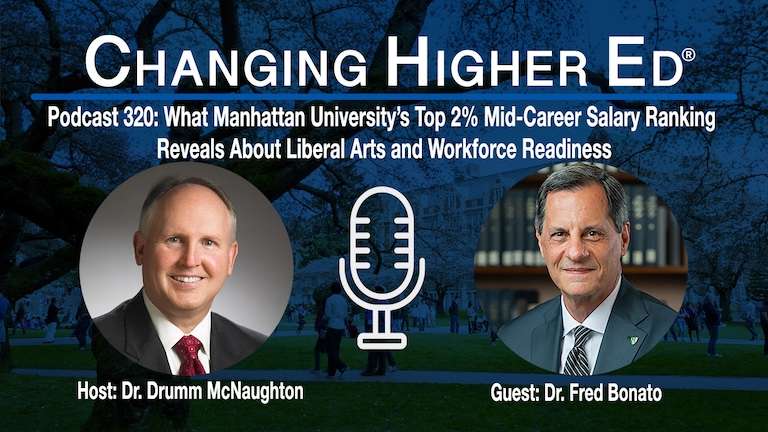

July 14, 2026 · Episode 320
Pairing Liberal Arts with Tech Readiness: Five Institutional Decisions from Manhattan University
34 Min · By Dr. Drumm McNaughton
Top-2% mid-career salary outcomes distinguish Manhattan University’s model pairing liberal arts, tech readiness, faculty adoption, and alumni pathways.
At Manhattan University, the case for liberal arts is being made with outcomes, not nostalgia. Its graduates rank in the top 2% nationally for mid-career salaries, and The Wall Street Journal ranked the university 73rd in the country for graduate salaries, social mobility, and cost-effectiveness. The episode examines the institutional decisions behind that performance, including interdisciplinary program design, technical preparation, faculty adoption, hiring, and alumni-supported career pathways.
In this episode of the Changing Higher Ed® podcast, Dr. Drumm McNaughton speaks with Dr. Fred Bonato, President of Manhattan University. Bonato’s career alongside interdisciplinary teams in the space program shapes the premise behind his program design: most of the world’s significant problems cannot be met with a single siloed discipline.
The Underlying Bet: Transferable Skills Paired with Technical Fluency
Bonato’s working definition of the liberal arts is functional rather than nostalgic. Liberal means free and open, a broad range of study whose payoff is transferable skills: problem-solving, creative thinking, and the ability to write and speak persuasively. He argues the durable outcome of college is learning how to learn, since course content largely fades while the capacity to think transfers everywhere, including into careers students never anticipated while enrolled.
The institutional wager is that those skills hold even greater value when paired with technical fluency. Technology touches every field, and in Bonato’s judgment the university would be failing its graduates if they left unprepared for that reality. Neither half of the pairing is treated as optional, and the five decisions below are how Manhattan operationalizes both.
Decision One: House Interdisciplinary Programs Outside Any Single College
Manhattan University’s new programs in AI, cybersecurity, and data science deliberately reside in no particular college or school. Bonato’s rationale is that these fields refuse siloing: cybersecurity can be approached from business, science, or computer science, with a cultural dimension besides, and an AI minor is meant for every student, not one school’s enrollees.
The governance implication is the useful part for boards. Where a program lives determines who can access it, who staffs it, and whose budget it draws on. Housing these programs under a university-wide umbrella, the new ARCH Innovation Exchange (analytics, research, creativity, and humanity), reduces the likelihood of an ownership dispute. ARCH also runs a speaker series open to the surrounding community, which extends the institution’s visibility beyond its enrollment base. Leaders evaluating similar programs should ask whether their current college structure would confine an inherently cross-cutting field to a single school by default.
Decision Two: Deliver a Universal AI Baseline Through an External Credential
Rather than waiting on a full curriculum overhaul, Manhattan partnered with IBM through its SkillsBuild approach. Every first-year student is required to complete an online course covering what AI is, what it can be used for, and how it works, and earns a digital badge they can list on a resume or LinkedIn profile, with further coursework available beyond it.
The decision separates two problems institutions often conflate: giving every student baseline fluency, which an external partner can deliver quickly and at scale, and embedding AI into disciplinary teaching, which depends on the faculty-led adoption described below. Bonato pairs the enthusiasm with a consistent caution. AI is a tool that augments human work; ARCH’s inaugural speaker, a cardiologist and Manhattan engineering alumnus who leads AI at his hospital, described AI-assisted symptom analysis in exactly those terms.
McNaughton reinforced the principle his guests return to across episodes: a human stays in the loop because a human makes the decision, which is itself an argument for the critical thinking the core curriculum is meant to build.
Decision Three: Fund Adoption and Let Faculty Peers Carry It
Bonato’s change-management position is grounded in his years on both sides of shared governance: no one likes being forced, and faculty are no different. If leadership can demonstrate why a change is necessary, faculty are smart people and will come on board, provided the institution supplies support and resources rather than exhortation.
At Manhattan the resources are specific. The university holds an institutional ChatGPT license, so faculty and staff pay nothing out of pocket, and it runs seminars and workshops on using AI for teaching and research. From there, adoption spreads through faculty champions, because in Bonato’s experience faculty learn best from other faculty. A presidential directive to use a tool will not work well; a colleague showing what worked in their classroom will. He is realistic about the ceiling: it takes time, an institution may never get everyone, and the target is critical mass rather than unanimity.
McNaughton added a diagnosis leaders should sit with: much faculty resistance traces to prior initiatives the institution executed badly, and faculty who hesitate are often asking for training, not exemption. Bonato also notes the framing that moves people is student benefit, repeated constantly.
Decision Four: Change Hiring Criteria Ahead of the Culture
Hiring criteria have moved in step with strategy. As provost, Bonato asked every faculty candidate how comfortable they were with online teaching, because at the time he did not want to hire anyone who was not. The screening question has now moved: how comfortable are you using AI as a tool, and what is your experience with it? The criterion applies beyond faculty. He wants staff using these tools as well, on the grounds that they save time and improve work.
For boards, the transferable point is that hiring criteria make strategy operational. An institution that says technology readiness matters but does not screen for it in faculty and staff searches has a stated priority, not an operating one.
Decision Five: Operate the Alumni Network as Employment Infrastructure
Most Manhattan students complete experiential learning, through internships or research with faculty. Bonato values it for two reasons: students learn the way work is actually done rather than the way it appears in a book, and the experience converts to employment, since organizations increasingly hire from their own intern pools. Many of those opportunities, though not all, originate with the alumni network, which Manhattan treats as infrastructure rather than a fundraising list.
Two examples from the episode show the range. James Patterson, an alumnus of the then-Manhattan College, provided seed funding for an honors program that launched last year with more than 160 students. Bonato is emphatic that it is a leadership development program rather than a conventional honors track, and Patterson participates directly, returning to speak with students about how to succeed. Board chair Steve Squeri, CEO of American Express, does the same. The pattern for other institutions is the design question, not the celebrity: whether alumni engagement is structured to produce internships, mentoring, and hiring relationships, or only gifts.
Three Takeaways for University Presidents and Boards
The following reflect Dr. Bonato’s closing counsel, offered from the president’s chair.
- Keep the liberal arts in every program, including technical ones. Bonato’s position is that graduates without the liberal arts will not be well-rounded and will be less prepared for the working world than those who have them. Boards weighing humanities cuts should examine what transferable-skill development, in writing, speaking, and problem-solving, would exit the curriculum with them.
- Build the capacity to pivot before the next change arrives. The world is changing quickly and institutions cannot fight or stop it. Bonato’s warning is that entrenchment in “this is how we’ve always done it” will no longer hold.
- Presidents need a deliberate way to disengage. The job can consume its holder. Bonato advises fellow presidents and aspirants to find a way to disengage even briefly, if only through adequate sleep, and return recharged. It is offered as personal counsel, and McNaughton, recognizing the point in his own schedule, endorsed it.
Quick Overview
- Career outcomes at Manhattan coexist with a required pairing of liberal arts and technical preparation; the episode presents the structure
- Interdisciplinary programs (AI, cybersecurity, data science) are housed outside any single college, under a university-wide umbrella, to prevent siloing by governance default
- A required partnership credential (IBM SkillsBuild) delivers baseline AI fluency to every first-year student without waiting for curriculum overhaul
- Boards should distinguish universal fluency, deliverable quickly through partners, from disciplinary AI integration, which depends on faculty-led adoption
- Faculty adoption was resourced (institutional ChatGPT license, workshops) and spread through peer champions; the target is critical mass, not unanimity
- Faculty resistance often signals unmet training needs and memory of poorly executed past initiatives, not opposition to change itself
- Hiring criteria now screen faculty and staff for comfort and experience with AI as a tool, turning searches into an operating expression of the strategy
- Experiential learning converts to employment through intern-to-hire pipelines; many of those opportunities originate with an alumni network managed as infrastructure
- Alumni engagement is structured for mentoring, internships, and leadership development (including a Patterson-funded program of 160+ students), not gifts alone
- AI is framed institutionally as decision support with a human in the loop, an argument for, not against, the critical-thinking core
About Our Guest
Frederick Bonato, Ph.D. joined Manhattan University in 2025 from Montclair State University, where he served as Interim Dean of the College of Community Health and was previously Associate Provost for Academic Affairs. He spent the first 17 years of his career as a professor of psychology at Saint Peter’s University serving as Chair of the Psychology Department, Director of Faculty Research and Sponsored Programs, and the President of the Faculty Senate. He then became the Executive Vice President & Provost of the university. He remains highly engaged in professional associations and publications with an academic focus on motion sickness, space motion sickness, and aeromedical topics. Dr. Bonato received his bachelor’s degree, master’s degree and Ph.D. from Rutgers University and is a resident of Paterson, NJ.
Connect with Dr. Fred Bonato on LinkedIn→
About the Host
Dr. Drumm McNaughton is the founder, CEO, and Principal Consultant at The Change Leader, Inc. A highly sought-after higher education consultant with 20+ years of experience, Dr. McNaughton works with leadership, management, and boards of both U.S. and international institutions. His expertise spans key areas, including accreditation, governance, strategic planning, presidential onboarding, mergers, acquisitions, and strategic alliances. Dr. McNaughton’s approach combines a holistic methodology with a deep understanding of the contemporary and evolving challenges facing higher education institutions worldwide to ensure his clients succeed in their mission.
Read the Podcast Transcript →
Transcript: Changing Higher Ed podcast 320 – with guest Frederick Bonato, Ph.D.
Introduction to Changing Higher Ed®
Welcome to Changing Higher Ed®, a podcast dedicated to helping higher education leaders improve their institutions. With your host, Dr. Drumm McNaughton, CEO of The Change Leader, a consultancy that helps higher ed leaders holistically transform their institutions. Learn more at changinghighered.com. And now, here’s your host, Drumm McNaughton.
[00:00:31] Welcome and Guest Introduction
Drumm McNaughton: Thank you, David.
Drumm McNaughton: My guest today is Dr. Fred Bonato, President of Manhattan University. Fred joined Manhattan about two years ago, but he’s had a long career in higher education. First 17 years as a professor of psychology at St. Peter’s University, moving up to chair, director of faculty research, and then president of the faculty senate.
He was also provost there, and that’s where he got a lot of his leadership abilities and practices. Fred was an interesting researcher, focusing on motion sickness, space motion sickness, and aeromedical topics. Fascinating to me.
[00:01:12] Manhattan University Snapshot
Drumm McNaughton: Manhattan University is an interesting place. It’s ranked the 73rd best college in the US by The Wall Street Journal based on its graduate salaries, social mobility impact, and cost effectiveness. They take a different approach. They require integration of liberal arts into the science and engineering and ensure that the students in the humanities are also exposed to science. This is why they’ve done as well as they have. And Fred joins me to talk about Manhattan, how they do it, and some of the things that they’ve got going on now. Fred, welcome to the program.
Fred Bonato: Thank you. Thanks for having me.
Drumm McNaughton: It’s my pleasure. I am just totally impressed with what you’re doing there at Manhattan University in New York.
[00:02:02] Bronx Not Manhattan
Drumm McNaughton: I’m assuming Manhattan is in New York because of the, I’m just kidding.
Fred Bonato: Yes, it is. But it’s in the Bronx, not Manhattan.
Drumm McNaughton: Oh, wait a minute. So your next thing is a branding move to call it Bronx University? No, I don’t think so.
Fred Bonato: No plans to change the name, but we moved to the Bronx about 101 years ago.
Drumm McNaughton: Well, you could tell I’m not up with current news for sure. So, well again, welcome to the program.
[00:02:30] Why Liberal Arts Matter
Drumm McNaughton: We’ve got a really interesting conversation today talking about how liberal arts education should be the foundation for all subjects. But before we get into that, give the audience a little bit of your background. I found it to be fascinating.
Fred Bonato: Sure.
[00:02:48] Bonato Career Journey
Fred Bonato: I’ve been in higher education for 30 years, and I started as a professor, a psychology professor, and I did that for 20 years.
Drumm McNaughton: Wow.
Fred Bonato: And at that point, it’s a decision, should I keep going or should I try something different and try moving to the dark side? The admin- they call it the dark side of administration.
And I did that in 2013, so I’m now in 13 years. It’s been great. I do miss my research area. My expertise is in motion sickness and space motion sickness and cyber sickness, and I’m still involved with that world to some degree, but not like I was before. But I’ve been really enjoying my time as a provost for seven years at St. Peter’s University, that a lot of people don’t know what provost means. It’s the chief academic officer, and been here at Manhattan since October of ’24, and it’s been about 18 months into this job and it’s a great place. Manhattan, love it here, love the people, love the students, wouldn’t want to be any other place.
Drumm McNaughton: Wow, that’s fabulous.
[00:04:01] Rankings and ROI
Drumm McNaughton: And Manhattan is ranked very high by The Wall Street Journal, number 73 in the top 2% based on your graduate salaries, the social mobility impact, and cost-effectiveness. Tell us a little bit more, please.
Fred Bonato: Yes, we’re very proud of our return on investment. College education costs a lot. It’s a big– it may, in some cases, be the biggest investment a person makes if they take loans out. But we’re very proud of our job outcomes. Not only do our graduates get jobs in the fields they study in, they get very well-paying jobs, and that figures a lot into these statistics and rankings, which they’re all different.
They all use different methodology, but we come out pretty high, and it’s because of our outcomes. Students get jobs, and they get really good jobs.
Drumm McNaughton: Well, your starting salaries are in the top 2% of all graduates. That’s saying a lot.
Fred Bonato: Yes. Very proud of that.
Drumm McNaughton: As you should be.
[00:05:05] Defining Liberal Arts
Drumm McNaughton: Now, we’re going to be talking about the importance of liberal arts education, but before we get into that, what does that mean? What is a liberal arts education, at least according to Manhattan?
Fred Bonato: Liberal arts, , from my perspective, is a broad range of topics that a student will study. Liberal meaning free, right? Open, it’s open. I think that’s very important, and a lot of, many people in academia will agree with me.
[00:05:35] Transferable Skills Focus
Fred Bonato: To come out of college well-rounded and what it instills in students that I think are the most important things are transferable skills, and they have to do with problem-solving, creative thinking, the ability to write persuasively, to write well, and to speak persuasively, to speak well.
You learn that in liberal arts, English, history, math, philosophy. All these different courses will give you pieces of that to make you well-rounded and have these transferable skills that really add to success no matter what the student eventually goes into. And we know they often land in a place that they’re not even imagining when they’re in school, but it’s not necessarily the major they majored in. This could be something totally different.
Drumm McNaughton: Yes.
[00:06:30] Learning How to Learn
Drumm McNaughton: In previous discussions, we talked about the importance of teaching students how to think and learn on their own. That’s really important.
Fred Bonato: It really is. To me, it’s the main thing about college because research shows very clearly that the content, the facts … I’ll give you example. If you take a history class, there’s a lot of facts. Most of it will be forgotten. But if you learn how to learn, which means you learn how to think, that is transferable and does not go away, and then you learn everything on your own.
It’s even more so in graduate school. But to me, that’s what college is about, learning how to learn no matter what it is, no matter where you are, and that will lead to success down the road.
[00:07:24] Degrees and Learning Levels
Drumm McNaughton: It’s interesting you bring that up because back when I was going through graduate school, we would talk about the levels of learning. And for a bachelor’s degree, you’re teaching people how to think. For a master’s degree, you’re teaching about a specific subject and they’re helping to become an expert.
And at the doctoral level, you’re bringing new knowledge into being. That’s right in line with what you’re talking about.
Fred Bonato: Yes, I think if we could instill that in our students, even if they’re undergraduates to some degree, they’re going to benefit greatly from that.
[00:07:57] Public Perception of Higher Ed
Drumm McNaughton: And, many times people nowadays, they’re saying there’s not a lot of… What’s the word I’m looking for? The public perception of higher ed isn’t really there, but yet they’re still learning great skills that are important. They’re becoming, it’s not only they’re learning a particular discipline, but they’re also learning how to think, and they’re getting a good education to be a good well-rounded person or citizen.
Isn’t that true?
Fred Bonato: No, it is true, and I think that the negative perceptions of higher education that are out there now, and they’re very strong, will lead many people to go directly into the workforce, get a job, and they might get a good paying job. But I have a feeling, I have a very strong feeling that there’s going to be a pendulum effect, and those people are going to regret not going to college.
Hopefully they’ll go back to college because they will gain the skills we’re talking about, these transferable skills. But they also, in my opinion, make life more interesting because you could think about all your experiences in a deeper way.
I hate to think that some people will miss out on that.
Drumm McNaughton: Yes. It’s sad in many respects.
[00:09:20] Dropouts and Lifetime Earnings
Drumm McNaughton: The graduates nowadays, they’re … It’s different. The perception to me and the data that I’ve seen, the negative perceptions of higher ed are coming from people who went to higher ed and dropped out or didn’t go at all. There’s 42 million people out there who dropped out of higher ed, and those numbers are big.
Fred Bonato: Those are huge numbers.
Drumm McNaughton: The most expensive college education is the one you didn’t get, that you dropped out. The stats are there. When someone gets a degree, their lifetime earnings are generally three times that of someone who didn’t.
Fred Bonato: Yes, and those are real hard numbers. Those are real statistics. And I tell people those statistics all the time, trying to encourage them to follow college education, even if it’s not in Manhattan, wherever, I think it’s worth doing.
Drumm McNaughton: I would fully agree with you.
[00:10:21] Interdisciplinary Core at Manhattan
Drumm McNaughton: And it’s important, one of the things that you do very well at Manhattan is interdisciplinary. It’s not just a particular area, but it’s exposure to a lot of areas. Tell us a little bit about that, please.
Fred Bonato: A lot of colleges, most colleges have something called the gen ed requirements or the core curriculum. And these are an effort to, like we talked about, lead to a well-rounded person. You’re going to learn history, you’re going to learn math, you’re going to learn science, you’re going to learn all these things, maybe not deeply, but you’re going to get a very broad sampling of them, and that will help you become a more well-rounded person.
[00:11:06] Programs Beyond Silos
Fred Bonato: But at Manhattan, we’re going to take it a little deeper than that because, in my opinion, most of the world’s problems and challenges are interdisciplinary in nature. Therefore, you can’t tackle and solve those challenges and meet those challenges with a single siloed approach. You would really will need a interdisciplinary team.
And I worked with a lot of people in the space program in my career, and if you think about space travel and putting humans into space, it’s one of the most challenging things you could imagine. It requires a vast interdisciplinary team to do that. So what we’re doing now is developing programs at Manhattan that don’t reside in any particular college.
I’ll give you an example. A minor in AI, that, that will be interdisciplinary in nature because it– AI will hit on all these different areas, and it won’t reside in a single college or school because it’s university-wide. We want all our students to engage with that.
Other examples, cybersecurity. You can look at it from a business perspective, a science perspective, computer science perspective. There’s a whole cultural thing. Any approach you can take you can see that it’s not just one siloed discipline. It requires more than that. So if the world’s like that, we want our students to be ready for the world.
That’s the kind of approach we want to take at Manhattan.
Drumm McNaughton: Yes. We live in a complex world and what you’re saying makes so much sense to me. You have to bring multiple disciplines to any complex problem that you have. I remember one guest that I had when I was first starting the podcast. She’s currently a professor emerita at UC Davis. She’s one of the pioneers for doing research on biotech, but when they’d have a problem, they’d have to bring in multiple PhDs.
The same with you for science. And that lends itself to some of those things that AAC&U brings up the keys for what employers want: critical thinking, working in teams. You mentioned a few of them as well. Being able to write well, to think well. These are all critical skills. You can learn them from a STEM perspective, but the broader experience makes far more sense, at least to me.
Fred Bonato: Yes, totally agree with that.
[00:13:40] ARCH Innovation Exchange
Drumm McNaughton: So tell me a little bit about your ARCH Innovation Exchange.
Fred Bonato: ARCH Innovation Exchange is new. It’s just launched this year, and I should first say what ARCH stands for. It’s an acronym. It’s analytics, research, creativity, and humanity. So if you’ll look at those four words, you can see the interdisciplinary nature already. ARCH is an umbrella under which this interdisciplinary approach at Manhattan will really live and thrive.
It includes the development of some of the programs that I mentioned, an AI program, a cybersecurity program, data science program. These are all under the ARCH umbrella. We have a very interesting speaker series that not only are all our students and staff invited to, the outside community is invited as well. It’s just open.
Our inaugural talk was really interesting. Dr. Anthony Mercando, he is a cardiologist, has a bachelor’s degree from Manhattan in electrical engineering, and at the hospital that he works at, he is the director or the head of AI. Now, AI in health is huge, and it’s getting bigger and bigger, and he came and told us about things that I certainly didn’t know about, but they were very interesting to see that how AI is changing healthcare and will make it better, quite frankly.
Drumm McNaughton: Yes. You have me really curious on that one.
[00:15:26] AI in Healthcare Example
Drumm McNaughton: Can you give me an example of how AI is changing healthcare?
Fred Bonato: AI can take a list of… let’s say a patient comes in and the, all the symptoms that patient have are listed and recorded and put into a database. AI can take those symptoms and diagnose literally what that person has, and the accuracy is amazing in some cases. And in some cases, some illness, some condition that a patient might have could have went unnoticed and undetected without AI.
So think about that. AI can save some lives, literally.
Drumm McNaughton: Yes. So doctors don’t have to have a good memory anymore, is that what you’re saying? No, I’m just kidding.
Fred Bonato: I think it just augments what they do and makes it better. It’s a tool. AI’s a tool.
Drumm McNaughton: Exactly. And many of my guests have said it’s critical for AI to have the human in the loop because ultimately it needs to be a human that’s making the decision. Again, coming back to the critical thinking piece.
Fred Bonato: Yes. Yes, I agree with that.
[00:16:43] Tech Ready with IBM Skills
Drumm McNaughton: So you’re getting students tech-ready. You’ve got the cyber, you’ve got the AI. We talked last time a little bit about engineering, how people are approaching that the liberal arts becomes a piece of that getting students tech-ready, does it not?
Fred Bonato: Oh, absolutely. And it’s just part of the well-rounded approach. We talked about the humanities in terms of, I don’t know how to describe them except that some of them are more verbal and written and analytical, but you’re talking about English or any language really, history, philosophy, all of these.
And then there’s the tech side. The tech side is very important because look around our world. Technology is evolving at a alarming pace in some cases. It seems like the pace is getting faster and faster. We would not be doing a service to our graduates, to our students if they did not leave Manhattan being ready for that world.
Technology just hits every field in some way, and they need to know how to use that. AI, of course, is the latest thing, but it’s more than that. It’s how to use computers properly. It’s how to use– Literally our phones are now become portable computers. How do you use that effectively in, in your job no matter what it is?
So one, one way to doing this, we have a program, a partnership with IBM. They have a, they have an approach called IBM Skills Lab. All of our students coming in can take an online AI course that gives them a very, good overview about what AI is, what it could be used for, how it works, and they actually get a credential out of that.
They get a certificate that they could put on their resume and put it on their LinkedIn page, whatever. And there’s more they can do after that. So we take it seriously. We think it’s really important, and that’s challenging higher ed. Higher ed doesn’t like to change very quickly.
Drumm McNaughton: Really?
Fred Bonato: No. But thankfully there are people in higher ed who do like to embrace all these new things and run with them.
We have professors like that who will initiate the charge forward in, in making changes that really will be valuable to our students.
[00:19:19] Faculty Buy in and Training
Drumm McNaughton: And you mentioned two really important points is getting the professors on board and the shared governance. Tell us a little bit, because getting faculty to teach out of their discipline or changing programs can be very difficult unless you have the faculty on board. How did you go about that with the shared governance and change management?
Fred Bonato: It’s a great question, and I know from experience no one likes to be forced to do anything, especially– and faculty are no different. But if you can demonstrate why you think certain changes are necessary, they’re smart people. They will come on board. And also give them the support and the resources.
We have a link– we have a ChatGPT license for the university, so they don’t have to pay out of their own pocket. Here, we’ll give you… You have a license to use this. We launch seminars and training workshops for faculty and staff as well, anyone, so that they can be supported in this.
And how do you use it for teaching? How do you use it for research? All of this. And what you d- what happens is they’re al- you always get these champions, these faculty champions who really are into anything new, and they want to run with it, and it becomes contagious. And I’ve seen that happen, and I think we’re at that point where people, when AI was first came out, it was frightening for professors.
They thought this was another way for students to cheat. But now we’re beyond that. We’re beyond that, and we’re looking at the value of it and how it can be used for so many good things. But it’s a cultural shift, for sure.
Drumm McNaughton: It is a cultural shift, and I think you nailed it. You’ve got to get that critical mass of professors on board. But the other piece with that is the training and you mentioned something about that. I think, and this is just me speaking personally, I think a lot of the faculty resistance to change is they’ve seen things happen that have not been done well by the university, by faculty, and some of them I hesitate to use the term afraid, but they’re hesitant to move forward with something where they’re not going to be able to teach as effectively as they did.
They’ve got the students in mind, and they’re just crying for training on how do we use these tools? How do we become more effective teachers? Does that make sense?
Fred Bonato: No, it does, and in my experience, faculty learn best from other faculty. But again, those are the ones who took the lead, those are the ones who embraced something new and now can share it with their colleagues. If I as the president of the university say, “I want all of you to use this because of this,” it’s probably not going to work. It won’t work too well.
And it takes time, and you may never get everyone. You may never get everyone, but you need to get a critical mass. It’s all about students and helping them, and I do remind people of all the time, and that I think does help get people on board.
Drumm McNaughton: It certainly does and you’ve got the faculty ambassadors who part of that critical mass to get things going, and then your hiring practices obviously need to change to make things work, correct?
Fred Bonato: Yes, I remember when I was provost, I would interview many faculty every year for positions at the university. And one question I always asked at that time was, “How comfortable are you with online teaching?” Because I didn’t want to hire anyone who wasn’t at that time. Now the questions are going even further.
How comfortable you are with using AI as a tool? What’s your experience with AI and using it as a tool? Those are the newer questions now when you hire someone. And it’s not just faculty, it’s everyone. I want my staff to use these tools. They could save a lot of time. They can make things better. We need to embrace them.
[00:23:43] Honors Program and Alumni Power
Drumm McNaughton: And another program that I really like what you’re doing is your James Patterson Honors Program. Tell me a little bit about that, please.
Fred Bonato: Yes, this is a great program that launched last year, and James Patterson, I don’t think I have to say who he is, but I will. He’s the leading bestselling author on the planet, literally, and he’s, he sold over 800 million books, I believe. It’s a lot of books.
Drumm McNaughton: Lot of books, lot of reading.
Fred Bonato: You probably know people, if you haven’t read his books, you know someone who has, or you’ve seen some of the television adaptations or film adaptations of his work.
So, Mr. Patterson is an alum. He graduated from that, at that time, Manhattan College. He is very much interested in the success of our graduates, so he has funded this program. He’s generously funded, given us seed money to launch it. I think we have over 160 students in the first class. We’ll get some more coming in the fall.
But it’s not just him funding something that’s an honors program. This is really a leadership development program, and he feels very strongly about that. He’s deeply involved in the program. He c- he came several times to speak to students. He speaks to everyone, but the students about what it takes to succeed in a g- again, it’s a general sense.
He’s an author, but some of the advice he gives to our students is applicable to anyone. How do you , get ahead? How do you do it? The speaker series is great. The students really enjoy it, and It’ll just grow, and he keeps adding his support. So it’s been a real game changer here at Manhattan, and we’re really grateful for Mr. Patterson’s support.
[00:25:44] Experiential Learning and Internships
Drumm McNaughton: It sounds like a fabulous program, and it also helps your students and people in there get on-the-job experience through internships, things along those lines, correct?
Fred Bonato: Most of our students do have experiential learning as part of their time here at Manhattan. It could be an internship. It could be working on some research projects with our faculty. I know that hands-on training matters a lot. It matters a lot in two, two ways in my opinion. You really learn it differently.
You learn it the way it’s going to be done, not the way it is in a book. But secondly, that experience leads to jobs. That’s the new way companies, organizations, hire people. They often tap into their interns. This student was an intern. They did really great. Let’s hire them after they graduate full time. That’s a common thing.
And we see that happening again and again and again. And at Manhattan, we’re really lucky that we have such a vast and rich alumni network because those are the people who are out there offering these opportunities. Not exclusively, of course, but in many cases, and help our students succeed with this experience.
I think it’s invaluable.
Drumm McNaughton: Well, the other piece with that that you just alluded to is the alumni network. How does Manhattan leverage its alumni? And I mean, you’ve got some pretty high-powered alumni, James Patterson being one of them. How do you leverage that to help your graduates and your students?
Fred Bonato: They come and– again, a lot of our alumni, as you said, they’re very successful, they’re generous to the university. I’ll give you an example. The chair of our board is Steve Squeri, and he’s the CEO of American Express. Steve came last year, spoke to a room full of students about what it takes to be a CEO, h-how does that– how did he gain his success, and that’s different than taking a class.
I mean, they’re hearing it right from the guy himself, you know? And the whole room was just totally engaged with him speaking, and he did a Q&A, and just a different way of learning. And it– I could see the students lighting up when he was speaking, and this is one example. Same thing when James Patterson comes.
When he comes and speaks, you could see their faces light up. They’re not looking at their phones, they’re listening to him. And that’s different. It’s more fun, and they’re going to remember that, and they’re getting it right directly from the people themselves who are successful offering their perspectives.
It’s really a great thing here at Manhattan.
Drumm McNaughton: Yes. That is neat.
[00:28:47] Leadership Reflections and Graduation
Drumm McNaughton: You’ve been there about two years now. As you look back on those two years, what are the things that really stand out for you of what has made Manhattan such a great school?
Fred Bonato: That’s a tough question because there’s so many things. I just, graduation day is the best day of the year, I think. And when I get to speak and talk with these graduates and their families and how grateful they are and what their plans are, I- that is just it reminds me what I, why I do what I do, and makes me very happy, quite honestly.
Drumm McNaughton: Yes. That’s neat. Graduation was always the most fun time. Just seeing people, they’ve accomplished something. They’re opening a whole new chapter of their lives. It’s just a phenomenal day.
Fred Bonato: Yes, great day.
[00:29:43] Three Takeaways for Presidents and Boards
Drumm McNaughton: Well, this has been just a wonderful, wonderful conversation, Fred. I so much appreciate your being on the podcast. Give us three takeaways for presidents and boards. Why is it critical for institutions to still teach liberal arts as part of the whole, whether you’re tech or not?
Fred Bonato: I would say if we don’t teach them the liberal arts, they will not be ready for the real world because they will not be well-rounded. They’ll, they… much more prepared with the liberal arts.
Another thing I would say, you have to be ready. The world’s changing quickly. You’re not able to fight that or stop it, so you have to be flexible, and you have to be able to pivot quickly and not be so entrenched in, “this is how we did it, and this is how we’ve always done it,” because that won’t fly anymore.
The third, I’ll give advice to fellow presidents or people who aspire to be a president. You really need to find a way, and even for a little while, you have to be able to disengage, even if it’s when you go to sleep. If you get good night’s sleep, you can get up and tackle the day because the job can consume you.
It is that busy. There are so many things you have to worry about and think about, but you will be better if you can find a way to disengage even a little bit and recharge that battery, and then you come back full force. I think that probably goes not just for presidents, right? Maybe anyone.
Drumm McNaughton: I think it does go for everyone, and all three of those are just wonderful pieces of advice. I’m at the point where I need to just turn it off for a little while, so thank you for reminding me. I appreciate it.
[00:31:33] What’s Next and Closing
Drumm McNaughton: What’s next for you? What’s next for Manhattan, Fred?
Fred Bonato: Just getting ready for another year, another group of students will be coming in the fall and some of the things we talked about I think will help make it better for them. I want them all again to be tech-ready, strong liberal arts education, be well-rounded. And it is a tough business.
It’s very competitive, as you know. A smaller school or medium-sized schools, private schools. But just going to want to keep adapting and changing as we need to. And again, it’s all about students. That’s why we do it. That’s why I do it, and we’re going to try to make Manhattan as good as it can be for the students.
Drumm McNaughton: And that’s why we’re in this business, is for the students. We want to be able to help people get that next step up on the ladder if that’s what they’re doing.
Fred Bonato: Absolutely.
Drumm McNaughton: Fred, thank you so much. I’ve enjoyed our conversation.
Fred Bonato: Thank you, Drumm. Thanks for having me.
Drumm McNaughton: Thanks for listening today, and a special thank you to my guest, Fred Bonato. Fred, thank you for coming on the program. I thoroughly enjoyed learning about Manhattan and all the great things you’re doing there, and wish you the best of luck going forward.
For my listeners, thanks again for tuning in. See you next week.