
October 15, 2024 · Episode 229
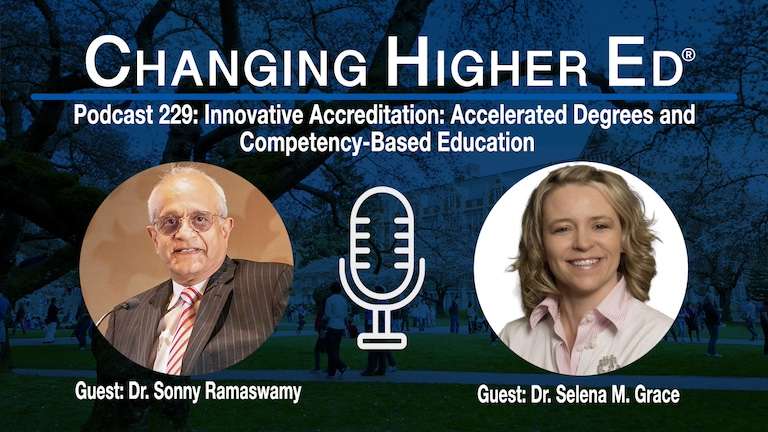
Innovative Accreditation: Accelerated Degrees and Competency-Based Education
33 Min · By Dr. Drumm McNaughton
Explore how innovative accreditation models, including accelerated degrees and competency-based education, are transforming higher education for today’s learners.
In this second part of our series, we explore the innovations in accreditation that are reshaping higher education from accelerated degrees to competency-based education and workforce development. Northwest Commission on Colleges and Universities (NWCCU) is at the forefront of these changes, piloting groundbreaking programs and reimagining accreditation processes to address the evolving needs of students and institutions.
Accelerated Bachelor’s Degree: A New Paradigm in Higher Education
NWCCU has approved a pilot program for an accelerated bachelor’s degree, allowing students to complete their degrees in just three years. This innovative approach, developed in partnership with Brigham Young University, Idaho, and Ensign College, challenges the century-old four-year model in American higher education.
Historical Context of the Four-Year Degree
The traditional four-year baccalaureate model in America originated from considerations related to professors’ pensions and workload, rather than pedagogical reasons. This underscores that the current model wasn’t necessarily designed with educational outcomes as the primary focus.
Program Design and Evaluation
The accelerated degree program aims to maintain educational quality while reducing time-to-degree and associated costs. It features a focused curriculum design, integrates core competencies throughout, and eliminates electives in favor of targeted coursework. NWCCU has implemented a rigorous evaluation process with interim checkpoints to ensure the accelerated program meets the same high standards as traditional four-year degrees.
Competency-Based Education (CBE): Redefining Learning Outcomes
Competency-based education is gaining traction in higher education. NWCCU, which accredits institutions like Western Governors University known for CBE, has a deep understanding of this model and its potential benefits.
Core Components of CBE
CBE focuses on demonstrable skills and knowledge rather than seat time. It allows for flexible pacing, enabling students to progress as they master content. This approach has the potential to reduce time-to-degree and associated costs.
NWCCU’s Evaluation Approach
When assessing CBE programs, NWCCU emphasizes clear learning outcome definitions, robust assessment methods, and comparisons of student achievement to traditional models. Institutions implementing CBE programs must develop appropriate policies and procedures to support this new educational infrastructure.
Innovations in Accreditation: Supporting Institutional Creativity
NWCCU views its role not as a gatekeeper but as a facilitator of institutional innovation. Their collaborative approach supports a wide range of innovations while ensuring quality and accountability.
NWCCU’s Innovation Support Framework
- Substantive Change Process: Encourages institutions to develop and propose new ideas
- Portfolio Model: Assigns senior leaders to work closely with specific groups of institutions
- High-Contact Approach: Maintains regular communication with institutions
- Educational Programs and Webinars: Helps institutions navigate the accreditation process
Workforce Development and Higher Education: Meeting Changing Needs
The shifting demographics of students and rapid technological advancement have pushed workforce development to the forefront of higher education priorities. An estimated 40 million Americans need reskilling and upskilling.
Addressing Diverse Student Needs
Higher education institutions are adapting by offering flexible learning options, partnering with employers to ensure curriculum relevance, and focusing on both technical skills and core competencies. Understanding student populations and assessing both programmatic learning outcomes and overall student achievement are crucial in these new educational frameworks.
Micro-Credentials and Certification Programs: Filling the Skills Gap
Micro-credentials and certification programs are emerging as valuable tools for workforce development and lifelong learning. These short-term, focused learning experiences often align with industry needs and can be stacked to lead to degrees.
Quality Assurance in New Credentials
NWCCU is addressing quality assurance concerns in these programs, working to integrate them into their processes efficiently to meet rapid demand. This involves balancing flexibility with maintaining high educational standards.
Assessment and Learning Outcomes: Ensuring Quality in New Models
As higher education embraces new approaches, rigorous assessment, and clear learning outcomes become increasingly important.
Effective Assessment Strategies
Institutions must clearly define learning outcomes at both course and program levels, use multiple assessment methods, and regularly review and adjust curricula based on results. Programmatic assessment is vital to capture disciplinary learning outcomes and determine the effectiveness of new educational models.
Future of Higher Education: Embracing Change and Innovation
The future of higher education demands institutional adaptability and innovation. Emerging trends include:
- Increased focus on workforce development and lifelong learning
- Greater flexibility in program delivery and credentialing
- Enhanced use of technology in teaching and learning
- Continued emphasis on equity and access
Education continues to be a powerful force for transforming individual lives and serving as a societal equalizer.
Enrollment Challenges and Opportunities: Adapting to Changing Demographics
Higher education institutions face enrollment challenges, particularly with traditional student populations. However, these challenges present opportunities for innovation and growth.
Factors Influencing Enrollment
Declining numbers of traditional-age students, increasing demand for workforce development, and growing interest in alternative credentials are reshaping the higher education landscape.
Institutional Strategies
To address these challenges, institutions are expanding offerings for non-traditional students, developing partnerships with employers, and creating flexible degree pathways, including stackable credentials.
Northwest Commission on Colleges and Universities (NWCCU): Leading Accreditation Innovation
NWCCU is positioning itself as a leader in innovative accreditation practices. Their approach emphasizes student-centered accreditation focused on outcomes and equity, support for institutional innovation, and data-driven decision-making to improve student success.
Higher Ed Innovations: Reimagining the Educational Experience
Innovation in higher education extends beyond new degree formats. Institutions are reimagining every aspect of the educational experience to better serve students and meet societal needs.
Innovative Areas in Higher Education
Artificial intelligence and adaptive learning technologies are being integrated into curricula. Institutions are developing interdisciplinary programs to address complex global challenges and creating lifelong learning models to support alumni throughout their careers.
Education Transformation: Preparing for a Changing World
Higher education is transforming to prepare students for a rapidly changing world. This involves developing adaptable, transferable skills, integrating technology literacy across disciplines, emphasizing global perspectives, and incorporating sustainability and ethical considerations into all programs.
Reskilling and Upskilling: Higher Education’s Role in Workforce Development
As technological change accelerates, the need for continuous reskilling and upskilling grows more urgent. Higher education institutions are uniquely positioned to meet this need.
Effective Reskilling Strategies
Institutions are collaborating closely with industry partners to identify skill gaps, developing short, focused programs that can be completed while working, and creating flexible, modular curricula that can be quickly updated as needs change.
Accreditation Standards: Supporting Innovation
As higher education evolves, accreditation standards must adapt to support innovation while maintaining quality. NWCCU is leading the way in reimagining accreditation for the 21st century.
Evolving Accreditation Approaches
NWCCU is focusing on student outcomes rather than inputs, supporting diverse educational models, emphasizing continuous improvement, and integrating equity considerations into all aspects of accreditation. They stress that accreditation policies can be rewritten to support necessary changes in higher education.
Insights from a Higher Education Accreditation Expert
Dr. Drumm McNaughton offers valuable perspectives on accreditation challenges:
Common Accreditation Hurdles
- Independence of governance: This is a significant area where institutions often struggle with accreditation requirements.
- Strategy: Ensuring institutions are headed in the right direction and are mission-driven is another crucial aspect of accreditation.
- Program assessment and review: This is consistently an area where institutions face challenges in meeting accreditation standards, particularly in relation to student learning outcomes.
Dr. McNaughton notes that having team members with specialized training, such as completion of the WASC Assessment Leadership Academy, can be particularly valuable in addressing program assessment challenges. These insights underscore the complex nature of accreditation and the importance of expert guidance in navigating the process successfully.
About Our Guests
Sonny Ramaswamy is president of Northwest Commission on Colleges and Universities, which accredits institutions in Alaska, Idaho, Montana, Nevada, Oregon, Utah, Washington, and British Columbia. President Barack Obama appointed Sonny to direct the National Institute of Food and Agriculture, which funded research and education in food, agriculture, and natural resources. He served as dean of Oregon State’s College of Agricultural Sciences, director of Purdue’s Agricultural Research Programs, university distinguished professor and head of entomology at Kansas State, and professor of entomology at Mississippi State. Sonny’s BSc (Agriculture) and MSc (Entomology) are from the University of Agricultural Sciences, Bangalore; his PhD (Entomology) is from Rutgers. He did postdoc research at Michigan State University.
Selena M. Grace is currently the Executive Vice President of the Northwest Commission on Colleges and Universities (NWCCU). She has been at NWCCU since 2020. Previously, she served as Vice Provost for Academic Strategy & Institutional Effectiveness at Idaho State University. She was a member of the inaugural cohort of the WICHE Western Academic Leadership Academy, and her previous experience includes Chief Academic Officer at the Idaho State Board of Education where she was the primary author and manager of the Complete College Idaho Plan. She is a first-generation college graduate. She has a B.A. in English with a writing emphasis and a minor in Native American Studies from Boise State University, an M.F.A. in creative writing and non-fiction from George Mason University, and a Ph.D. in public policy and administration from Boise State University.
About the Host
Dr. Drumm McNaughton is the founder, CEO, and Principal Consultant at The Change Leader, Inc. A highly sought-after higher education consultant with 20+ years of experience, Dr. McNaughton works with leadership, management, and boards of both U.S. and international institutions. His expertise spans key areas, including accreditation, governance, strategic planning, presidential onboarding, mergers, acquisitions, and strategic alliances.
Dr. McNaughton’s approach combines a holistic methodology with a deep understanding of the contemporary and evolving challenges facing higher education institutions worldwide to ensure his clients succeed in their mission.
Read the Podcast Transcript →
Transcript: Changing Higher Ed Podcast 229
with Drumm, Sonny, and Selena
Introduction and Guest Welcome
David White: Welcome to Changing Higher Ed, a podcast dedicated to helping higher education leaders improve their institutions. With your host, Dr. Drumm McNaughton, CEO of the Change Leader, a consultancy that helps higher ed leaders holistically transform their institutions. Learn more at changinghighered.com. And now here’s your host Drumm McNaughton.
Drumm: Thank you, David. Today we welcome back Sonny Ramaswamy and Selena Grace, President and Executive Vice President of the Northwest Commission on Colleges and Universities. Sonny has a long career in higher education and government service, having served as Dean of Oregon State’s College of Agricultural Sciences and multiple other places.
And prior to his joining the Northwest Commission, he served in the Obama administration, where he directed the National Institute of Food and Agriculture that funded research and education in food, agriculture, and natural resources. Selena Grace has been with Northwest Commission since 2020, and before that served as Vice Provost for Academic Strategy and Institutional Effectiveness at Idaho State University and Chief Academic Officer at the Idaho State Board of Education.
Innovations in Accreditation
Drumm: Now we join our conversation in progress where we start to talk about how Northwest is innovating multiple ways in accreditation. I want to know what’s the latest and greatest from Northwest, where you see Northwest going, where you see all of accreditation going.
Sonny Ramaswamy: You know, really Selena is a leader; she worked with Brigham Young University, Idaho and Ensign College in helping them think this through. And obviously we had multiple conversations at the commission with our commissioners. We don’t do anything on our own saying, okay, we’re going to go out on a limb and do whatever.
Drumm: When you say working with Brigham Young, Idaho, you’re talking about the accelerated Bachelor’s degree.
Sonny Ramaswamy: Okay. Thank you. That’s the one.
Historical Context of the Four-Year Degree
Sonny Ramaswamy: And I want to give you a little bit of context as well. And as I shared an article with you that Selena and I wrote in our newsletter, The Beacon, and your listeners might ought to go ahead and check it out.
*It’s nwccu.org/beacon and then see what we’ve got in there. We have a lot of wonderful articles written by many different people from across the United States. And in it, we’ve given a sort of a historical context. There’s a history to this whole thing, where we’ve come from 100 years plus ago. [Referenced article: V6I4: Letter from the President: Accelerated Baccalaureate Degrees
by Sonny Ramaswamy, President, NWCCU and Selena Grace, Executive Vice President, NWCCU
Historical Context of Undergraduate Degrees in the United States. https://nwccu.org/news/v6i4-letter-from-the-president/]
*Literally, the four-year baccalaureate model that we have in America came about because of pensions and workload for professors. That’s where it came from, because TIAA needed to get a definition of What the workload is and what pensions are and things like that. That’s where it comes from.
*And then it got basically set in stone. And then here a few years ago, Bob Zemsky and UPenn and others started asking these questions. Is this really the right model? In fact, even the Carnegie people who invented this whole four-year baccalaureate degree started questioning the premise of it.
And so here we are today. And we ended up getting this proposal from our colleagues at one of our member institutions, Brigham Young University. And like I said, Selena really took this on as a project and worked with them very, very carefully, very closely. And then, we had many conversations internally and with our commissioners, as I said.
So, we said, okay, we approved it. It’s a pilot and we didn’t want to just jump into it willy nilly saying, okay, open this up to everybody’s uncle. And we’re going to all be a happily moving forward. There’s also what’s called the Bologna process, all these different things that are going on across the globe.
And again, there’s a lot more detail that we provided in that article that I referred to in the Beacon itself. But that’s where it comes from.
Accelerated Baccalaureate Program
Sonny Ramaswamy: And the intent really is, this is one more, this accelerated baccalaureate program, like competency-based education, like direct assessment and things like these are all different types of innovations that are being invented to revitalize what we do in higher education as well.
And it comes down to that. It is revitalization of what we’ve been doing in higher education. And here we are as an accreditor. We decided we’re going to make this determination that we’re going to approve this, and we move forward. And right now, we’re still waiting for the, in quotes, the data to come in.
And Selena is going to work with a third party here to come in and review these data. To give us some input on what has happened here with these two institutions. And now, following our lead now, Higher Learning Commission has said they’re going to do it. And it was written up in the Chronicle and other places.
And New England Commission on Higher Education, has also provided some guidance and things like that. I think it’s going to open up and other accreditors are going to follow suit, other institutions are going to follow suit as well.
Selena Grace: Yeah, I think what really prompted this was the institution’s hard look at who their students were and how well they were and were not being served.
And so understanding, again, their unique student mix and demographics and were the degree paths that they were offering, meeting the needs of the students? And their answer was fundamentally no. They could see clearly that they had a lot of students stopping out, dropping out, and so how could they rethink and be innovative to better serve those students?
It was an iterative process. We’d been working with them for a number of years on their proposal and what they were seeking to do, and I think to Sonny’s point, we want to support innovation, but again, we want to protect the students. And so, the unknown with all of this really is how will students actually be able to go on to graduate school if they want, how will it impact those professional programs or job placement?
And will it? And will it not? And so having some of that assessment and assurances that student learning is happening at the disciplinary level within those degrees is really important.
Assessment and Learning Outcomes
Selena Grace: And so we’ve set some parameters, some interim checkpoints to monitor the institution’s progress. You can imagine that we’ve had high demand, like, well, we want to do that.
They’re doing it. We want to do it. So, lots of institutions and state systems have said, well, we’re going to approve it, and we want our institutions to do it. And we’ve said, well, hold on a second. It’s really important that we assess impact and that we understand what that impact will be and frankly that takes some time and so while we are supportive of that innovation.
We want to do no harm to students and so ensuring that this does support students in the right way is really important as a part of that process. And then there are also those out there who are like. We can’t change what is traditional, right? The bachelor’s degree is sacrosanct, and we are not going to change it.
And if you’re going to do it, you have to call it something else. And maybe we do, ultimately. Maybe it has to have another name. But to not be willing to give it a chance, for Sonny and I are in our internal conversations, even with commissioners and other staff, is why not? Why not try knowing the history of the bachelor’s degree and knowing the external demands that our students face and the different demographics of our changing students?
Sonny Ramaswamy: As part of the due diligence that Selena referred to, this has been going for several years, not something that happened overnight. It was an iterative process. As part of the due diligence, we also reached out to other accreditors. I’m talking about the programmatic accreditors. What are they thinking?
We went to the SHEOs, the State Higher Education Executive Officers. We went to the Federal Student Aid Office, asked them, what’s the impact on Pell Grants and things like that. We went to the Accreditation Office at the federal government level, and we went to multiple different entities and had these meetings.
iterative conversations. And it turns out there is no impediment to this other than what we’ve got stuck in our heads about this being sacred. It’s four years and nothing else is going to work. We also reached out to some employers, by the way, and what they talk about is does the student have technical content?
But most importantly what they look for is do they exhibit Core competencies, critical thinking, problem solving, communication skills, and all that. And again, we’re the first accreditor to incorporate that aspect, the core competencies, into our standards, by the way. It’s inserted in there. And so we track that as well.
And so that’s the approach that we’ve ended up using and how we went forward with creating this. And the intent really is. In your three year 90 credit hour accelerated baccalaureate degree program. Are you ensuring that the students are getting the knowledge and the skills and the abilities to do what they want to do
Drumm: in their lives?
Absolutely, AAC& U does the surveys every year, every couple of years on what employers need, critical thinking, the ability to communicate, data analysis, drawing conclusions, teamwork, all of these kind of things. And as I understand, of course, I don’t have the historical perspective that the two of you do.
Now I’m going to throw in the caveat in case I’m wrong on this one. It was your gen ed classes. Where you were supposed to develop all of these type of things, and then you’d go into your disciplinary courses once they were there. If your disciplinary courses can pick up some of the slack that your GE courses have, it makes perfect sense.
To be able to cut down the number of credit hours necessary for a bachelor’s degree. You got it. And that’s
Sonny Ramaswamy: how Selena, when she worked with a BYU, Idaho, and and enzyme college was the idea is that, you can incorporate a lot of these concepts and ideas into your courses and things like that too.
So what they did was to eliminate the electives part of it, but subsumed what was in the electives into their, Other credit hours that they require their students to do as well. So that there’s a process to it again You know this Drumm that technical knowledge shelf life is only anywhere from two to five years I mean with AI artificial intelligence now look at it.
I mean that technical Knowledge had a shelf life of maybe one month it’s just changing very rapidly. Where are these core competencies of critical thinking, problem solving and all that. They’re lifelong. And there’s a body of literature on that too. So that’s what she ended up doing.
Selena Grace: Yeah, I would just add, Sonny keeps touching on this term core competencies.
So we use that somewhat synonymous with what has historically been considered your general education. General education is more than just exposure to those fundamental core competencies like critical thinking and those other elements, but it’s also intended to give some. broad disciplinary exposure to students that if you don’t mandate some English classes, some science classes, some social science classes, mathematics, will students really take and participate in those?
And maybe there’s an opportunity lost if they don’t have that. So I think that gen ed framework serves two purposes. It’s one, that piece of exposure to various disciplinary ways of knowing ways of thinking, but also some of those core competencies. And what we’ve tried to do within our standards. Is recognize that we do have some institutions that are solely graduate institutions or solely health profession institutions and that they too must have core competencies within their own framework.
How do they integrate and assess those as part of that work? Those are key for us that you have those core competencies, that you have the depth and breadth of. Content from a disciplinary perspective and that you cover that from the spectrum of beginner knowledge to advance knowledge. So that whole time through the degree.
Drumm: And that integrates very nicely with how you should be assessing student learning outcomes, introductory, advanced, mastery. So it’s a very natural thing. So if you’re going to a three year degree, introductory the first year, advanced the second year, mastery the third year, it makes perfect sense.
Sonny Ramaswamy: So if I could, put in a pitch at our annual conference coming up in November here at Seattle, Washington.
We will be focused on offering workshops on assessment and learning outcomes and things like that. So we have experts from across America coming in to help us offer those and the most recent issue of our newsletter, The Beacon, there are articles related to learning outcomes and assessment. So some of the experiences some of our institutions have gone through in developing and deploying that as well.
Yeah,
Drumm: thank you. And I’ll, if we’re doing commercials, I’m going to throw one in as well, because when we come out and we work with institutions about accreditation, we typically see, there are three areas that. They usually fall down on one is independence of governance. That’s a huge one. So we work with the boards.
The other has to do with strategy. Are they headed down the right thing? Are they mission driven, et cetera, et cetera. And the last is always, always. Program assessment and review. It’s the student learning outcomes. And one of the things I’m very fortunate on my team is I’ve got somebody who’s gone through the WASC assessment leadership academy.
It was incredible. I know you guys have got something similar to that as well. Correct. Yes.
Micro-credentials and Certification Programs
Drumm: So the next thing we wanted to talk about a little bit was micro credentials and certification programs. HLC recently hired a good friend of mine, Melanie Booth, to start looking at how do we assess quality for that.
But I know this is something you guys are looking at. been talking about and even doing for a while.
Sonny Ramaswamy: Yeah. So as I said, earlier you asked a question about innovations and things like that. And I said, these are generated by the institutions and the platform that we use, the medium that we use for those is really our Substantive Change Process.
And so anytime any institution wants to come up with an innovative idea, they want to experiment. They want to test something. And so it lends itself, whether it’s a microcredential that they want to offer or an experimental setup where they want to do a certificate program, utilizing, let’s say, competency based education or direct assessment or something like that.
Those are all the approaches that one might want to use as well. So we do that as appropriate. My colleagues, Selena and the others will review and go through this process of making sure that they’re meeting all the requirements. Selena, for example, has a portfolio of approaches. 30 institutions and she works with them very, very closely.
Again, going back to the idea, we don’t want any surprises, right? And because we’re constantly in touch with our institutions, anytime they’ve come up with an idea, Hey, I want to test this. What do you think? Selena says, yeah, let’s try it, but submit a proposal to us. Needs to have these elements in it. And then we’ll look at it.
There’s an evaluation process and things like that too. As part of this evaluation of those substantive change proposals, there may or may not be, depending on the complexity and what is being proposed, of a follow up in a year or whatever. Those also happen as well. So that’s part of the context in how we do this.
We have a lot of interest, as you know, in non credit credentialing and things like that too. Particularly when it comes to workforce development. And so again, these are some of the things that we’re working on. We’re hoping to come out with some additional opportunities for our member institutions and for that matter, across America of these non credit type approaches and evaluations and accreditation and all that too.
Yeah.
Selena Grace: I would just add, I think the big unknown is people’s concerns about oversight for quality, right? Lots of institutions are doing this, but who’s ensuring that the programs, the micro credentials, those offerings have a level of quality assurance. And so really that’s what we’re looking at internally How do we integrate that within our processes in a flexible and expedient way, right?
Cause those things need to happen quickly to meet demand. And so not in your traditional academic review time. And so those are conversations internally we’re having. And so I would say with that more to come, right? We know it’s important and we’re focused on it and more to come.
Drumm: And I think that’s especially critical with all the workforce development work that needs to be done and that you’re doing as well to bring one of these credentials into place, it’s got to happen more closer to the speed of light than it does the speed of academics.
Selena Grace: Yep, absolutely.
Competency-Based Education
Drumm: Sonny, you touched on something that I want to highlight, which is competency-based education. Now you, the Northwest Commission, accredits Western Governors, which is what they’re known for. What are some of the things that you look for in CBE and when somebody establishes those programs because that too is a way of cutting down on the length of time to degree, which cuts down on the cost of the degree, the debt levels, et cetera, et cetera.
Sonny Ramaswamy: Yeah. So I’m going to share some thoughts with you that Salimah certainly can add to it too. This question about Western Governors and competency based education, and now there are other institutions that are doing this as well. Competency based education was not invented by Western Governors.
It was actually invented by medical schools and veterinary schools. Because these schools, way back when, invented it, which is the idea is you’ve got to develop these competencies before you go on to this next level. So let’s say you want to become a surgeon. You may start by cutting open an earthworm and making your way up, to a human being or something like that.
Drumm: But dissecting a frog back in biology in 10th grade. Yeah, no, I got it.
Sonny Ramaswamy: So in any case, competency base has been around for some time, and then Western Governors comes along and so also other institutions that started. Using that as an approach. And in our case, the really, the critical part of it is again, if somebody comes to Selena says, I want to create a brand new program with competency based education on whatever subject actuarial sciences or something like that.
And so what we look for, what Selena would say is, okay, we want to know what are the learning outcomes and how are you going to assess these things? What are going to be the outputs? There’s a whole series of things that we want to go through. It’s not just saying, Okay, I want to do this and bless me, I want to go forward.
No, there’s a process to it. And you’ve got to have a lot, exactly, a lot of details in it as well. And really, it stems from that idea that we talked about previously. It’s about learning outcomes. You want to make sure that the learning outcomes, traditional course based, credit based, research based.
Endeavor compared with a competency based education. And then you’ve also got the other avatar, which is the direct assessment. And so in all of these things, what we talk about is define your learning outcomes, define your assessment instruments, show us what you can do. And how do you compare with what may be the other model, the traditional inclusion, if I can use that term, traditional model.
Well, Selena?
Selena Grace: Yeah, I would just add, the expectations is that institutions have a framework, they’ve got to develop the appropriate policies and procedures to support a new infrastructure such as that. But really, again, the heart of all that we’re doing and what we’re looking at is focused on student learning and student achievement.
And so the institution needs to be assessing student learning from that programmatic perspective. And then student achievement, how are those students In this new model, this new framework, or an existing framework, how are they achieving? What do the achievement levels of your student look like?
Where are the gaps and what do you need to do to support them? So those two pieces, regardless of what model they’re using, are always critically important and integrated and required.
Drumm: It almost seems and this is a naive way of looking at it. It almost seems like CBE is integrating the assessment directly into the actual teaching.
Does that make sense?
Selena Grace: Yeah, it’s certainly a component of it. course level perspective. They’ve identified their outcomes and they’re assessing that student’s progress from a course perspective. But again, there has to ultimately be a programmatic assessment to capture those disciplinary learning outcomes and that assessment.
And is it effective? They have to know if their model is effective.
Sonny Ramaswamy: So going back to, You could have a nursing program that’s competency based, education based, or an education program, or whatever, and all of those have very unique competencies that they need to develop, and very unique learning outcomes as well, to demonstrate that competency as well.
Yeah, there’s a very significant level of assessment, review, and all that Selena and the others undertake in this process.
Workforce Development and Enrollment Challenges
Drumm: Let’s swap horses just a little bit and get into workforce development, because that is one of the critical things that are going on. The micro credential certificate programs are all part of that.
More and more, and you said it earlier, the knowledge that we learn now may be good for two to five years, especially with the technology increasing. This workforce development upskilling and reskilling is becoming far more critical than it ever was.
Sonny Ramaswamy: Yeah, I tell you that we’ve talked a little bit about enrollment declines.
That’s the traditional 18 year old. And in part that’s being driven by in America, we’re having fewer children, all these demographic lucky for us, we have all these immigrants coming in, people like me. Foreign born, came to America, right? So we have that. That is in contrast to what’s happening in some European, Eastern European countries, particularly, but even Western European countries and Japan, for example, there are very rapidly aging populations.
So these enrollment declines are in part the rapidly aging populations, having fewer children. Only in America, we’re only having 1. 8 children on average. And so that is not a replacement number, by the way. If we didn’t have this immigration happening, we’re tough, but globally, we’re having fewer children.
Even in countries like Africa and Asia, we’re having fewer children. That’s the context we’ve got. Then we’ve got about 40 million in America. That need to be reskilled and upskilled and things like that. They have some college credit hours. If they do, they had to join the workforce or maybe they joined the military, their veterans, all of these things are there and meeting them where they’re at is a critically important part of, you can’t say, I got this edifice here, this building, come on over to my institution.
I used to call them the click and brick approach. There’s parts of it that you click and get your education. And then parts of it that, coming to a brick building, because you’ve got to have this. Experiential learning opportunities as well. And there’s some very interesting things that have evolved over time that have been done.
And, oh, by the way, I discovered a brand new term yesterday. It’s called PHYGITAL, P H Y G I T A L, which is physical and digital. Okay. Got
Drumm: it.
Sonny Ramaswamy: Which
Drumm: is instead of hybrid,
Sonny Ramaswamy: you’re physically there, or you got a digital part of it as well, instead of hybrid and high flex and all these terminologies that we’ve got.
It’s jargon that we’re trying to develop.
Drumm: Is that an AI term?
Sonny Ramaswamy: No, I, in some article that I read, but some guy had utilized that. A professor, I think is what he is. In any case, and where I’m going with this is really this workforce development and what are the opportunities for our institutions?
But that are seeing these declining enrollments and this is really a phenomenal opportunity again. The idea is that you got to meet where the students are not be saying that they’re going to come to me Also, by the way, the other challenge that we’ve got is students today including the traditional 18 year old, right?
Being an entomologist. I use the honeybee metaphor. They want to go and take a class here Take another class there, maybe go hang out on a beach, maybe go and work on as a lumberjack or go to Alaska, do whatever, and come back and take another class. The model that we’ve got today in America is that the degree, the diploma that is given to that student, that’s what the beam counter is.
The registrar’s office wants to know, hey, how many credit hours do you take? How many dollars have you paid me? And if you’ve paid me at least some minimal number that is well north of 90 credit hours for a traditional credit hour reprogram, because they want that money. But we got to rethink that whole thing.
Students are coming in. They want a micro credential. We charge them some tuition fee, et cetera, et cetera. They go on and they go someplace else. get something else. So we shouldn’t be counting. So the state of Tennessee was the first one to do this outcomes based budgeting program and all that too.
Others are following suit. It’s not the butts on seats program, but really outcomes based, right? But the outcomes are based, unfortunately, on degrees granted. Which is wrong. Again, maybe think of credentials granted. We, Selena and I, we talk about credentials. We don’t talk about, when we say graduation, we don’t know about graduation, baccalaureate degree and all that.
It’s really how many got their credentials successfully. If a student comes to me only exclusively for wanting to get about 8 or 10 certificates and micro credentials that they want to stack on, shouldn’t your institution be willing to look at that stack and say, you know what, this makes sense for what I refer to as a baccalaureate degree?
So that’s, we’ve got to have a change in mindset as well.
Selena Grace: Yeah, I think that really is the heart of it is one, the institutions knowing who the students are, that they are one currently serving and to who they want to serve, who do they need to serve to support their communities, their mission, and a willingness to approach things differently and be innovative in meeting those needs.
We’re certainly supportive of that. And frankly, I think that’s part of our standards in that we ask them to Assess the landscape. What does it look like? What are the risks for your institution? What are the opportunities that you know and assess those and then that you’re supporting the students and we recognize that a Credential and a success for a student looks different dependent upon what that student is seeking to do and it’s not always the same Earn a degree, earn a traditional degree.
It’s often upscaling. I need a few classes. Now I can get a better job. Now I can get that promotion. And so those are successes and making sure that we recognize that based on the institution and their mission. I think those are really important for us as an accreditor.
Sonny Ramaswamy: I’ll give you an example of a conversation I had just last week with one of our colleagues and that individual’s son serving the United States armed forces.
and wants to go on to do other things, right? We got all these inane, insane approaches to how we do what we do in our colleges. It’s all set in stone. They’re not willing to, at least the ones that he went to, were unwilling to go ahead and think of a different approach to it. So you see this happening.
These students don’t want to get up skilled and re skilled and things like that. We got about 5 million veterans. that fought for us in these wars and in Iraq and Afghanistan and other places. And yet we’re unwilling to go ahead and meet them where they’re at and help them get to a better spot. And that’s what this is all about.
We got to figure out a better way of doing this.
Drumm: Oh I so much agree with you and I’m one of those veterans as well. So Yeah. My pleasure.
Future of Higher Education and Accreditation
Drumm: So in three minutes or less, what’s the future look like for higher ed, for accreditation?
Sonny Ramaswamy: I think it’s awesome. What limits us. Is our imagination or the lack thereof.
That’s what it is. We got to demonstrate the value proposition, right? You know We talk about this is a knowledge economy You ain’t gonna get no knowledge if you don’t have these institutions that are providing that knowledge What that knowledge is in the form of and how you deliver it what the platform is and things like that We need to be really thinking of innovative ways of making sure that we’re offering it and from our perspective As an accreditor bring it on We’ll help you.
We’ll think this through with you. I think that’s the critical part of it is that imagination or the lack thereof that’s really important. And I think it’s awesome if we can come up with a rethinking of how we re imagine, re engineer how we do what we do. Oh, so much.
Selena Grace: I would just echo, I think it’s exciting.
I think there may be some sentiments out there of doom and gloom, but I think it’s exciting. We have an ability to continue to transform individual lives and education in this country. is truly the great equalizer. It is the way for someone who comes from nothing to make something of their lives, to make their path, to create their journey, to transform their lives.
And so it’s our job to support institutions in meeting those local needs. And I think Sonny’s right. It really is imagination and institutions, willingness, and ability to be innovative and take risks.
Drumm: Thank you. That’s great.
Conclusion and Next Steps
Drumm: Sonny, Selena, I have so much enjoyed our conversation today. Thank you for taking this time.
This has been great. As we always do, three takeaways for university presidents and boards.
Sonny Ramaswamy: Use your imagination. Take risks. And let us help you help yourself.
Selena Grace: A hundred percent. Yep. Spot on.
Drumm: Very good. I wouldn’t add anything to that one. So thank you. Thank you. What’s next for y’all for, I’m sorry. I haven’t spent a lot of time with clients down in the South lately.
So I’ve adapted the word y’all. So what’s next for Northwest?
Sonny Ramaswamy: Well, really, what’s next for the Northwest Commission is to continue to support our institutions, to innovate and serve the students. That’s what’s next for us, again, going back to that BASF commercial, right? We don’t make the things people use, but we make them better.
And our role, really, that continuous improvement is not only for our institutions, by the way. Selena and our colleagues and I, we are constantly thinking, how can we get a little bit better, a little bit better, a little bit better? For more UN videos visit www. un. org And that’s what we’re focused on. So our standards and our eligibility requirements, we’re going to go through a review and revision process because it’s almost that time for us to do and so we want to get better at what we do. Yeah,
Selena Grace: absolutely. I think it’s just continuing to improve and support that growth and innovation. That really is, we are just committed to. the mission of our institutions and frankly supporting student success in all of the member institutions that we accredit.
So how do we get better at that? How do we better support them at the work they’re doing?
Drumm: Very good. Sonny, Selena, thank you again so much for being on the show. I’ve thoroughly enjoyed our conversation. I look forward to the next time. we get a chance to get together.
Sonny Ramaswamy: Thank you. Likewise, Drew. I appreciate it.
Drumm: Thanks for listening today and a special thank you to my special guests, Sonny Ramaswamy and Selena Grace of the Northwest Commission on Colleges and Universities. Sonny and Selena, thank you for a great conversation. I look forward to the next time we get a chance to work together and have you on the podcast.
Tune in next time when I welcome Caitlin Runachansky to the show. Caitlin is the Chief Scientific Officer for Science Interactive, and she’ll be joining me to talk about how higher ed institutions can improve their enrollment, retention, and graduation rates in STEM programs through better processes and lab sessions.
Thanks again for listening. See you next time.
David White: Changing Higher Ed is a production of The Change Leader, a consultancy committed to transforming higher ed institutions. Find more information about this topic along with show notes on this episode at changinghighered. com. If you’ve enjoyed this podcast, please subscribe to the show and we would also value your honest rating and review.
Email any questions, comments, or recommendations for topics or guests to podcast at changinghighered. com. Changing Higher Ed is produced and hosted by Dr. Drummmick Naughton, post production by David L. White.