
July 16, 2024 · Episode 216
Implementing Comprehensive Student Mental Health Programs in HE
35 Min · By Dr. Drumm McNaughton
How The Jed Foundation's student mental health programs are helping higher ed implement crisis management strategies; a UMass Lowell case study.
Suicide remains the second leading cause of death among young people ages 10 through 34, according to the Centers for Disease Control and Prevention (CDC). The stark reality of this crisis underscores the critical importance of addressing student mental health programs and developing effective crisis management strategies in higher education settings.
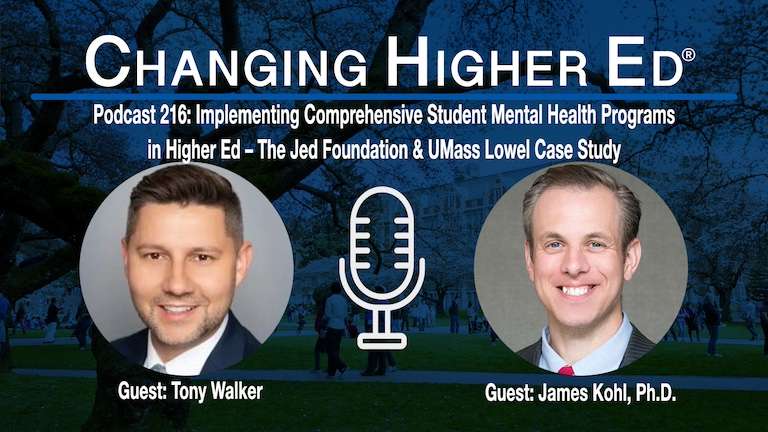
In this episode of the Changing Higher Ed podcast, Drumm McNaughton is joined by Tony Walker, Senior Vice President of Academic Programs at The Jed Foundation, and James Kohl, Dean of Student Affairs at the University of Massachusetts Lowell, as they share their expertise on addressing student mental health.
The State of Student Mental Health
Recent data from the Substance Abuse and Mental Health Services Administration (SAMHSA) reveals that approximately 12.6 million people between the ages of 18 and 25 experienced a mental, behavioral, or emotional health issue in the past year. This figure represents 36.2% of all young adults – a significant increase from 22% in 2016.
Nearly three in five college students currently face housing insecurity, food insecurity, or lack of access to affordable healthcare. These basic needs insecurities compound existing mental health concerns.
Marginalized communities face even greater challenges. For instance, 41% of LGBTQ youth seriously considered attempting suicide in the past year, with rates even higher among transgender, non-binary, and youth of color.
The Jed Foundation and Its Mission
The Jed Foundation, established in 2000, is a national nonprofit organization dedicated to protecting emotional health and preventing suicide among teens and young adults. Partnering with educational institutions across the United States, JED offers data-driven strategies and expert support to enhance mental health, substance misuse, and suicide prevention programs.
This collaborative approach leverages insights from over 500 campuses nationwide, allowing universities to benefit from shared best practices and a comprehensive framework. By tapping into JED’s expertise, institutions can potentially develop more effective and sustainable mental health initiatives than they might achieve independently.
❝ We work with institutions to not only prevent crises but also to develop effective crisis management strategies for when emergencies do occur. ❞ ~ Tony Walker, The Jed Foundation
JED Campus Programs Approach to Student Mental Health
JED Campus Programs is a four-year technical assistance initiative currently implemented at over 500 colleges and universities nationwide, impacting more than 6 million students. The program’s comprehensive approach spans seven key domains.
The Seven Domains Covered by the Program
- Developing life skills
- Promoting social connectedness
- Identifying students at risk
- Increasing help-seeking behavior
- Providing mental health and substance use services
- Following crisis management procedures
- Restricting access to potentially lethal means
The Implementation Process Outline
- Establish a cross-functional leadership team.
- Conduct a comprehensive needs assessment, including self-assessment and student surveys.
- Create a strategic plan based on the assessment results.
- Implement initiatives across the seven domains.
- Evaluate progress and adjust strategies as needed.
Impact and Outcomes of Comprehensive Student Mental Health Programs
The Jed Foundation’s recent 10-year Campus Impact Report revealed impressive results:
- 25% reduction in the likelihood of students reporting a suicide attempt
- 13% reduction in the likelihood of students reporting suicidal planning
- 10% reduction in the likelihood of students reporting suicidal ideation
Additional positive outcomes included:
- Decreased preconceived notions and bias about mental health treatment
- Reduced levels of anxiety and depression among students
- Higher student flourishing scores
- Improved crisis response times and effectiveness of crisis interventions on participating campuses
- Increased likelihood of clinicians screening for depression, anxiety, and suicidal ideation during primary care visits (55% at baseline vs. 77% at program completion)
- Greater likelihood of campus-wide programs and campaigns destigmatizing mental health (86% of campuses at completion)
JED Case Study: University of Massachusetts Lowell
The University of Massachusetts Lowell (UMass Lowell) began its JED Campus journey in 2019, driven by concerning data showing marked increases in students reporting suicidal ideation, increased demand for counseling services, and a rise in mental health concerns reported by faculty, staff, and students.
Implementation Process
- Administered the Healthy Minds survey in January 2019
- Created a robust strategic plan with 101 recommendations
- Implemented initiatives over four years
- Conducted a follow-up Healthy Minds survey in 2022
As part of their implementation process, UMass Lowell also prioritized enhancing their crisis management procedures. The university recognized that swift and effective responses to mental health emergencies play a vital role in overall student well-being. This focus on crisis management complemented their broader preventive efforts, creating a more comprehensive approach to student mental health.
Outcomes and Lessons Learned
Despite the challenges posed by the COVID-19 pandemic, UMass Lowell saw positive results:
- Better-than-national-average scores in flourishing, depression, and anxiety
- Reduced stigma associated with mental health issues
- Increased willingness to access counseling services
- Higher rates of students self-identifying their need for help
- Greater student recognition of mental health as an institutional priority
Key takeaways from UMass Lowell’s experience:
- Collaboration and partnership are vital to success
- Buy-in from stakeholders across the institution is crucial
- Leveraging existing energy and directing it toward a common goal is effective
- Showing students that they matter is essential (e.g., “You Matter Too” campaign)
- Balancing bureaucracy with personal connection is important
- Flexibility and adaptability are necessary to meet changing student needs
The Evolution of Mental Health Discussions in Higher Education
The COVID-19 pandemic brought unprecedented challenges but also shined a spotlight on mental health issues, making it impossible for institutional leaders to ignore the conversation. This shift has led to more open dialogues about mental health on campuses and increased recognition of its importance in student success.
In generations past, mental health was often stigmatized and rarely discussed openly. The current environment reflects a growing awareness and acceptance of mental health as an essential component of overall well-being. This evolution has paved the way for more comprehensive and proactive approaches to student mental health programs and support. The focus has shifted from purely reactive crisis management to a more holistic approach that includes both prevention and robust crisis response protocols.
Actionable Strategies for Higher Education Leaders
Prioritize Mental Health at the Institutional Level
Make mental health a campus-wide priority, involving leadership from multiple departments. Consistently communicate the importance of mental health initiatives and allocate resources and funding to support comprehensive programs.
Foster Collaboration and Break Down Silos
Create cross-functional teams to address mental health challenges. Encourage partnerships between academic departments, student affairs, and health services. Collaborate with community partners to expand resources and support.
Implement Comprehensive Screening and Early Intervention
Integrate mental health screenings into primary care visits. Train faculty and staff to recognize signs of distress and make appropriate referrals. Develop clear protocols for identifying and supporting at-risk students.
Destigmatize Mental Health Through Education and Awareness
Launch campus-wide campaigns to normalize conversations about mental health. Provide education on mental health topics for students, faculty, and staff. Integrate mental health awareness into orientation programs and ongoing campus activities.
Enhance Access to Mental Health Services
Expand counseling services and resources. Offer both in-person and telehealth options. Reduce wait times for appointments and provide 24/7 crisis support.
Develop Life Skills and Promote Social Connectedness
Incorporate life skills training into curriculum and extracurricular activities. Create opportunities for students to build meaningful relationships. Support student-led mental health initiatives and peer support programs.
Regularly Assess and Adjust Mental Health Programs
Conduct periodic surveys to gauge student mental health and program effectiveness. Use data to inform decision-making and resource allocation. Be willing to adapt strategies based on changing student needs and emerging best practices.
Address the Needs of Marginalized Communities
Develop targeted interventions for LGBTQ+ students, students of color, and other at-risk groups. Provide culturally competent mental health services. Collaborate with diversity and inclusion offices to ensure comprehensive support.
Leverage Technology and Innovation
Explore digital mental health tools and apps to supplement traditional services. Use data analytics to identify trends and predict student needs. Implement early alert systems to flag potential mental health concerns.
Cultivate a Culture of Well-being
Promote work-life balance for students, faculty, and staff. Integrate well-being practices into campus life (e.g., mindfulness sessions, stress-reduction workshops). Recognize and reward efforts to support mental health and well-being on campus.
Strengthen Crisis Management Protocols
Develop and regularly update comprehensive crisis response plans. Train staff on crisis intervention techniques and conduct simulations to test procedures. Ensure 24/7 crisis support availability and clear communication channels during emergencies.
The Road Ahead for Student Mental Health
As higher education institutions navigate the complexities of student mental health, programs like the JED Campus initiative offer a roadmap for creating comprehensive, effective support systems. By implementing evidence-based strategies, fostering collaboration across departments, maintaining robust crisis management protocols, and committing to ongoing assessment and improvement, colleges and universities can make significant strides in supporting student mental health and well-being.
The challenges are substantial, but so too are the opportunities for positive change. By prioritizing mental health and implementing comprehensive support systems, higher education leaders can create campuses where students are set up for success both during their academic careers and beyond.
As we look to the future, it’s clear that mental health will continue to be an essential issue in higher education. Institutions that take proactive steps to address these challenges will not only better serve their students but also position themselves as leaders in creating supportive, resilient campus communities. The investment in student mental health is an investment in the future of higher education and the success of the next generation of leaders.
About Our Podcast Guests
Dr. Tony Walker joined The Jed Foundation in November 2022 as Senior Vice President of Academic Programs. In his role, he structures, expands, and leads JED’s K-12 and higher education programs to meet the organization’s strategic plan objectives. To fulfill this work, he connects strategy, people management, operations, fiscal responsibility, partnerships, and school recruitment functions. Prior to joining JED, Tony served as Vice President of Education Strategy and Innovation at the Meadows Mental Health Policy Institute. He previously worked in multiple roles in public education, including as a teacher, school counselor, and, most recently, as an executive district leader over Student Support Services at a large public school district in Texas. Tony is a Licensed Professional Counselor and Certified School Counselor and holds a Bachelor’s degree in Education from the University of Missouri, a Master’s degree in Counseling, and a PhD in Counselor Education and Supervision from Texas Tech University.
James Kohl, Ph.D., is the Dean of Student Affairs and Experiential Learning at the University of Massachusetts Lowell. He has been at UMass Lowell for over 16 years and previously worked at George Washington University as the director of housing programs. He received a B.S. in Psychology from Lafayette College, an M.A. in College Student Personnel Services from University of Maryland, College Park, and a Ph.D. in Educational Policy and Leadership from University of Maryland, College Park.
About the Host
Dr. Drumm McNaughton is the founder, CEO, and Principal Consultant at The Change Leader, Inc. A highly sought-after higher education consultant with 20+ years of experience, Dr. McNaughton works with leadership, management, and boards of both U.S. and international institutions. His expertise spans key areas including accreditation, governance, strategic planning, presidential onboarding, mergers, acquisitions, and strategic alliances. Dr. McNaughton’s approach combines a holistic methodology with a deep understanding of the contemporary and evolving challenges facing higher education institutions worldwide to ensure his clients succeed in their mission.
Read the Podcast Transcript →
Transcript: Changing Higher Ed Podcast 261
Welcome
Drumm: Tony, James, welcome to the program.
Tony Walker: Thanks for having us.
James Kohl: Thanks.
Drumm: Looking forward to a great conversation with you talking about student mental health and the JED program that you guys are running through the foundation.
Tony Walker’s Background and Journey
Drumm: Tony, why don’t you kick us off and give us a little bit of your background, if you would, and how you got here and how did you get interested in student mental health?
Tony Walker: Yeah, sure drum. Thanks again for having me. So I’m Tony Walker and I am senior vice president of academic programs with the Jed Foundation.
In terms of credentials and background, I am a licensed mental health professional. I’ve got my doctorate in counseling, and I have the privilege in my role to really oversee all of the Jed Foundation’s programs and services that run in both K12 schools and districts as well as our programs for higher education institutions across the country.
My personal story is really just working in education my entire career. I actually started in the K through 12 sector, started as a high school teacher, became a school counselor, clinician worked my way up through many different roles in the K 12 sector until eventually I was at the executive level over student affairs work.
After about 15 years or so of being boots on the ground, I then transitioned over to really being a consultant. With school districts and colleges and universities across the country as they were thinking about building comprehensive mental health programs which is eventually how I ended up with Jed. Thanks for having me.
Drumm: Oh, great. Thank you for that background.
James Kohl’s Background and Journey
Drumm: James, you’re with the University of Massachusetts Lowell, which is near and dear to my heart because my brother-in-law and my nephew both graduated from there from their college of engineering. Thanks
James Kohl: Oh, that’s great. I’m glad that you have some River Hawks in your family. It’s a great place, and I’m so glad to be here with both of you today.
My name’s James Kohl. I’m the Dean of Student Affairs and Experiential Learning at the University of Massachusetts, Lowell among other things through that role, I oversee our offices of Student and Family Support Services and Prevention Education, as well as our Behavioral Intervention Team.
As an undergraduate student, I knew that I wanted to have a career that was focused on helping people, but I really wasn’t sure how. Then some mentors that I had at the time pointed out that I had naturally gravitated to student leadership positions, like being an RA, being a student center manager, student leadership intern, and that I was essentially already starting a career in student affairs and didn’t really even know it.
So that set me on my path and over the next 10 years, I completed my graduate work at the university of Maryland college park, go Terps, and worked at two great institutions of higher education until I found my professional home here at UMass Lowell, almost 17 years ago.
This work is so important to me because I still hold on to that career long drive to help others find success and I believe strongly that higher education has the ability to change the lives of students and their families for generations to come. But the mental health crisis is a real threat to students’ ability to be successful and to lead the happy and healthy lives that they so richly deserve.
Mental health challenges affecting students
Drumm: You are so right, especially since COVID. We’ve seen more and more challenges with student mental health. Tell us a little bit about what you’re seeing on how this mental health challenges are affecting your students.
Tony Walker: Yeah. James, I can start if that’s okay with you. So Drumm, I would say just broadly, young people are facing incredible stressors right now from financial burdens to comparisons on social media and new digital technologies, regular mass shootings and gun violence, across our nation worries about climate change and even our current political environment, they’re really managing a lot.
It’s a tough time to be a young person in this nation. And the decade leading up to the pandemic, youth rates of depression, anxiety and suicidal ideation were already at an all time high, which is something that, we sometimes forget as we’re so focused on the after effects of the pandemic, which of course only exacerbated the situation.
The thing is that the numbers have stayed significantly heightened, even as the pandemic subsided. Drumm, if I were to paint you a picture, unfortunately, it’s a pretty bleak one in terms of youth mental health the state of the state right now, which is that suicide is and remains the second leading cause of death amongst young people ages 10 through 34, that’s according to the CDC, nearly three in five college students right now are facing housing insecurity, food insecurity, or a lack of access to affordable health care.
About 12. 6 million people between the ages of 18 and 25 experienced a mental behavioral or emotional health issue in the past year according to research out of SAMHSA, which amounts to be around 36.2 percent of all young adults, which is higher than any other adult range. Of course, the scary thing here is that rate has just continued to increase significantly over the past several years, so that number that I just gave you, 36.2 percent of young adults right now experiencing a mental health issue was 22 percent back in 2016, so you can see the jump there and there’s lots of other things that we can talk about if you have specific questions, but, the overall picture is pretty bleak. Anxiety rates have gone up, depression rates have gone up and rates of suicidal ideation have also gone up.
Drumm: I’m going to put on my naysayer hat for just a little bit and say, every generation goes through these type of things. What is it with this generation that they can’t cope? Now I personally don’t believe that way, but I know there’s a lot of folks who are listening that may say, yeah, they should just suck it up and do it.
Tony Walker: Yeah, James, I don’t know if you have thoughts on that. I think that what we find when we talk to young people at the Jed Foundation, students are part of all the work that we do across the country and when we ask them, what are the things that worry you the most when you think about the future?
The issues that they tell us are often some of the things that I’ve already mentioned, right around. Financial burdens. They’re worried about things like the cost of home ownership and employment prospects and the cost of living and the way that our inflation rates are going like young people are aware of our economic situation and what it takes to be financially stable in this country now.
They often cite that as a chronic source of stress and worry about the future. As well as the advent of new technologies, the way that social media has really changed the way that young people view themselves and compare themselves to others what they want to emulate and be and structure their life like, the influencers and celebrities that they see online as well as just the uptick in mass shootings and violence.
Let’s be honest, the current political environment that our country is facing. Is also very different than what we have experienced in the recent past, so I think young people recognize and see that regardless of what side of the political spectrum you might be on it’s a tough time to be a young person.
Drumm: Yeah, I get that completely. James, thoughts?
James Kohl: It’s a tough question. Because I think I don’t have a good comparison between the way students are now and the way students were in another time. I certainly have my own, but that’s a sample of one.
I trust the data a little bit more than necessarily my own experience. But I think the things that Tony mentioned. Are accurate. I think there’s a lot more knowledge and constant information about what’s going on in the world and how to feel about that and the impact that, it has on students is pretty consistent.
I think social media in particular is something that keeps students in the context of what’s going on in the world, what, the image is how they should be and how they should be feeling and, how others are representing themselves as feeling, which often is, the more positive view and not necessarily reality.
I think that sort of constant messaging from 24 hours a day from social media, 24 hours a day from the news cycle. It just becomes overwhelming and because our students are so connected to social media and the 24 hour news cycle it’s really hard to get away from and even have a chance to be self-reflective and to think about the information that they’re taking in and to evaluate it rather than just being bombarded by it.
The Evolution of Mental Health Discussions
Tony Walker: Yeah. The only thing drum, if I could just add that, I think is important context here also is that in generations past, we didn’t really have an open conversation and dialogue about mental health, right? And many previous generations, it was something that, you know, you just, you suck it up. You don’t talk about it.
It doesn’t mean that those mental health issues weren’t there. I think that what we’re talking about today is, if the COVID 19 pandemic gave us one gift amidst all of the tragedy and loss, It was that I think it, shined a spotlight on this mental health topic where institutional leaders across the country, really across the world were faced with such mental health needs on their campuses and in their own lives that we could no longer ignore the conversation. Especially the way that it played out with our minority populations 41 percent of our LGBTQ youth seriously considered attempting suicide in the past year, and of course, for young people who are transgender, non binary or people of color, those rates are even higher.
That wasn’t data that we were even collecting necessarily, 15, 20 years ago, and so I think that part of this is that we’re just having the conversation. Now we’re looking into the data now in a different way and making space for this important topic in a way that maybe we didn’t before.
Drumm: Yeah, I would have to agree with all those points where I look at it is the one thing, if we reduce it down to one common denominator, that whole piece around social media, the 24 hour news cycle, you’re constantly being bombarded with these messages and you don’t have time to back away, which is critical for people’s mental health, wouldn’t you say?
Tony Walker: Yeah, I agree.
James Kohl: Yeah, I think that’s very true. And I think being self-reflective, being self-aware, having a chance to process things is part of how we deal with, the regular everyday issues that are coming up, and I think we have to recognize that there are certainly chronic mental health
concerns, illnesses that an individual will have, and then there’s also daily stressors and anxiety that are part of normal everyday life.
Well, even those daily normal everyday stressors, if they go unresolved, if they go undealt with, they build and they build and they build, and then the situation becomes much more acute. I think the more that people have the chance to pause, to step away from social media, other sort of external stimuli and be able to think and reflect and connect with their thoughts and resolve their concerns. I think that helps them to deal with those things help them not to build up.
I think it also builds confidence in our students and in just anyone that when they have those challenges that they can overcome them. So it’s both building the skills to do that, but then it’s also the confidence that you can do it so that it’s not just so overwhelming. When that inevitable failure or that inevitable concern comes up.
The JED Foundation and It’s Mission
Drumm: Those are great words. Thank you. One of the things I wanted to get into with you is Tony talking about the Jed Foundation and the Jed Campus Program. We’re going to swap horses just a little bit here. I think we’ve given listeners a really good background on the problems that students are having with mental health, and it’s not just students. It’s faculty members. It’s administration. I would say it’s a lot of people. But with the Jed Foundation, Tony, you folks are doing some really great things. And I’d like to know more about the Jed Foundation, your Jed campus program. Talk to us about that, would you please?
Tony Walker: Yeah, sure drum. The Jed Foundation is a national nonprofit organization that protects the emotional health and works to prevent suicide for our nation’s teens and young adults.
We do that specifically by partnering with high schools and districts and colleges and universities across the country. To really be a thought partner and advisor to them, to education institutions, as they work to strengthen their own mental health, substance misuse, and suicide prevention programs and systems.
How the Jed Foundation got started
I’ll tell you a little bit about our story and how we got started. The JED Foundation was founded in 2000, so we’re celebrating our 25th anniversary this year. Our story, unfortunately, like many other organizations that work in the suicide prevention space is really anchored in personal family tragedy.
In 1998, Jed Satow was a 20 year old sophomore in college and he died by suicide. Afterwards, his family went to the university president and basically posed the question to them, what are you going to do to make sure that this. doesn’t happen again at your campus. What actions are you taking?
The university president replied, and he said, I’ve got more than 30,000 students here on my campus. I don’t know. I actually don’t know how to support the mental health of that many students. What does mental health safety net look like? If someone told me what to do, I would do it. I just honestly don’t know how to get this work started.
That really became the underpinnings of eventually how our organization was formed as our founders brought together the nation’s leading suicidologists and other mental health experts all together in one room and basically posed the same question to them.
Was there something that this school could have done differently? Are there things that other institutions across the country could do to try to prevent suicide? The answer is yes, actually there are really clear recommendations that we know exactly what institutions can do to help reduce the risk of suicide and to improve youth mental health outcomes.
That is really what became the foundation of what the Jed Foundation now refers to as our comprehensive approach, which is the framework that we use as we do our work with colleges and institutions across the country.
JED Campus Program
You asked about the Jed campus program in particular, I’ll tell you a little bit more about that also. That is our higher education technical assistance program. It’s a four year program that we operate, currently at more than 500 colleges and universities across the United States with more than 6 million students being impacted. It’s a four year program, and really it’s anchored in what I’ve already been describing, which is that we work with colleges and universities to provide expert support, evidence based recommendations, practices, and data driven guidance on how to build a comprehensive mental health program that reduces suicide.
Over the course of the four years. Colleges and universities work collaboratively with our staff who are experts in this field, and they really guide them through this program, beginning first by establishing a cross functional leadership team at the campus that is going to drive this work forward.
Then they conduct a full needs assessment. This includes a self-assessment and surveys such as the healthy mind survey, which collects that student voice on their own mental health needs. Drawing from that data, the campus and their assigned advisor work to create a strategic plan that has really actionable opportunities that span over our seven different domains of our comprehensive approach. These are the areas that we recommend that institutions focus on as they’re building off these really comprehensive systems. So, we’re just boots on the ground alongside campus leadership as they’re going forth and building these programs and services.
UMass Lowell’s Experience with the Jed Campus Program
Drumm: Thank you. That is a great overview, Tony. James, you at University of Mass Lowell have been a JED campus since 2019. How did you get involved with JED and what have you learned and implemented as part of that program?
James Kohl: It all started for us in the fall of 2017.
Two of the associate deans I work with, one who oversaw counseling services and another one who facilitated our behavioral intervention team, shared some really concerning data with me that, like other colleges and universities, we are seeing marked increase in students reporting suicidal ideation, increased demand of the counseling center for services, an increase in reporting of student mental health concerns for our faculty, staff, and students. It really was a bell that went off that said, okay, we really have to do something different. We have to try something new.
We also knew that we weren’t going to be able to counsel our way out of that. What I mean by that is, mental health counseling is a critically important part of the solution to addressing this issue, but it isn’t sufficient. You really need a broader approach that would leverage the resources of the entire institution and all the ways that we interact with our students. It’s really an issue that’s just far too big for one office to handle.
Jed. Campus had actually done a presentation to the UMass Student Affairs leaders earlier that fall, and then in March of 2018, I was at an educational session at the NASPA conference, and there was a JED Campus program presentation there. That really reminded me of what I’d heard in the fall, and really was kind of the answer to this question that we were faced with.
Once I returned to campus, we quickly decided that we would start our JED campus strategic planning journey. We got all the things in place, and we actually began with our Healthy Minds survey administration in January of 2019.
It was a great comprehensive process and the team of consultants at JED were wonderful partners. We were assigned someone who was our go to that helped guide us through the process and we created a really robust plan that we worked to implement over the next four years, and we’re excited that we’re actually now, we’re JED campus alums at this point.
We’re past the end of our four-year process, but we’re still working on it. It’s a living document. We actually add to the plan even though we’re not working with JED in the same capacity. Of the 101 recommendations that we initially had, we’ve completed 89 of them, and we’re still going and we’re still adding as we work to adjust our strategy as the needs of our students change.
Drumm: Well, that to me from a grading perspective sounds like an A, maybe an A minus from putting all those in.
James Kohl: I would have to ask Tony, he would know
Tony Walker: I give him a solid a Drumm. Come on, no A minus’ here. That’s way too many initiatives implemented. That’s fantastic.
Drumm: That is fantastic, but I was always known as a tough grader anyway.
So what results have you seen, James? Surveys in the past to surveys now, tell us about the impact that the programs had for your students, faculty and staff.
Results
James Kohl: Sure. So it’s an interesting question for us, right? Because we had pretty much the worst possible timing for doing this.
We started right before the pandemic began, and then we ended really as we were coming out of it in 2022. One of the great things about this model is that you have the healthy mind survey administration that happens before you start implementing your strategy, and then at the end of the four years.
It gives you a great comparison to really understand the impact of what you’ve done. Except if you’ve put a pandemic right in the middle of it. It’s not a good experimental model.
I think the good thing is that even so, we did see that we were better in the national average in flourishing depression and anxiety scores. We’ve also seen a reduction in stigma associated with mental health issues. More students are willing to and are accessing counseling. Students are self-identifying that they need help at higher rates, and more students have recognized that this is a priority of the institution and that we’re working to address it.
We’ve also seen some helpful signs that, there may be some areas where we would like our ratings to be better. We had done a separate survey in the middle there, right around, late 2020, early 2021 and we saw a market increase in some of these indicators. When we did our second healthy mind survey, we saw those lower. We were hoping that was a trend that we were catching in the middle of their way back down to better rating.
What we feel, though is that even though the timing wasn’t great from experimental standpoint, it was great timing in that we had developed the strategy right before our students probably needed these interventions the most. We really believe that the work that we did with Jed helped to reduce and mitigate the impact that our students were feeling in a way that we wouldn’t have realized had we not been in that partnership.
Drumm: That sounds so smart. COVID really changed a lot of things and to have the programs there when they first went into COVID, I’ll bet you saved yourself a lot of grief and the family’s a lot of grief as well.
James Kohl: It really helped us to already be thinking in innovative ways. So, when we all had to completely switch gears and start doing things electronically, start doing things over video, we were already in that mindset of how are we leveraging these, new ways of reaching students? We were already in that mindset. So, it gave us a head start.
Positive Outcomes for the JED Foundation
Drumm: Tony, what have you seen with other universities? Same, similar positive results.
Tony Walker: Yeah, we have Drumm. It’s great timing that you asked that question. In April, Jed just completed and released our most recent 10 year what we call our campus impact report, which is an analysis of 10 years’ worth of our most recent data on the effectiveness of the Jed campus program. Honestly, our results were pretty phenomenal in terms of the impact that we had. I’ll give you a high-level summary.
The short version is that when a campus implemented the Jed campus program and did this kind of strategic planning around comprehensive programs and supports with Jed, what we saw were that students were 25 percent less likely to report a suicide attempt on that campus.13 percent less likely to report any sort of suicidal planning, 10 percent less likely to report any sort of suicidal ideation, again, because of all of these comprehensive supports and interventions that institutions are then putting in place.
I would say, some other sort of related results that were included were that when campuses like James implement so many different aspects of their strategic plan. We found a correlation there, right? The more things on the strategic plan that a school or campus does, the stronger and more positive that the outcomes were for students.
For example, there were decreased preconceived notions and bias about mental health treatment So, that’s really when we talk about like stigma reduction The more initiatives off of their strategic plan that a campus did, the more that decrease was around that stigma reduction.
We found that levels of anxiety and depression in students on JED campuses decreased. Again, the more initiatives off of the strategic plan that a campus did, the greater of improvement in anxiety and depression levels that there were. They saw even lower rates of suicidal ideation, planning and suicide attempts, and overall higher student flourishing scores.
Just a couple other things I’ll mention because I think that they’re really powerful is when we talk about this systems change work, what we found is that when a campus implemented this type of programming, leaders were more likely to report that emotional health was really seen as a campus wide issue and priority, meaningfully involving leadership from multiple different departments, rather than being siloed in just one department which happens often.
It’s what James was talking about earlier with, this example of the counseling team. We also found that when campuses took this approach, clinicians were more likely to screen for things like depression and anxiety and suicidal ideation during primary care visits. So, like 55 percent at baseline versus 77 percent at campus completion.
Campuses were more likely to have campus wide programs and campaigns that really destigmatized mental health. 86 percent of campuses had that at completion as well as a larger scale campaigns to educate students about the risks of substance misuse.
The list just goes on and on, and I would say for any of your listeners who are interested to check out that kind of data they can find a copy and an executive summary at Jed foundation.org forward slash CIR for campus impact report CIR 2024, and they can read their very own copy.
Key Takeaways for Higher Ed Presidents and Boards
Drumm: That’s great, Tony. Thank you. That’s fabulous information. As we’re coming toward the end of our time together today, what lessons have you learned from the UMass Lowell situation that you’d recommend for other colleges, James?
James Kohl: Sure, I think part of what we’ve learned, and I think one of the hallmarks of the JED campus approach is that collaboration and partnership are vital to success. That was one of the things that was really Heartening here, that you create this broad team of stakeholders from across the institution, and the goal there is to really try to get everyone bought in to understand.
What we were really excited about here is that took zero effort. Everyone was so dedicated to our students and wanting them to be successful. That buy in was quick and it was more of a question of, okay, so how do we harness all this energy and move it in the same direction so we can take advantage of its power.
I think that working together, sharing resources. It helps to broaden the outreach, and it’s also necessary, particularly in lean times when, as we’ve said, one small office can’t do it all. We all touch students in so many different ways and have so many different relationships. Everybody has an important role.
It’s also important that students need to know that they matter. That’s part of why we titled our campaign. You matter too campaign. They need to understand that they’re not just another number that they’re a person in that. Every interaction that we have with them should communicate that mattering and it really is an opportunity to make a difference.
It’s important that people be able to show their humanity. There’s always a balance between trying to get the work done, the bureaucracy and showing that you care, so taking that time to build the personal connection, even if it’s quick is really important. Also, different approaches are really necessary to meet the changing needs of our students. Our world is changing rapidly and so are institutions. And what worked a few years ago may not work any longer. So, it’s really important to try new things, to retry things that perhaps didn’t work in the past but may now.
As I talked about it before, we had our strategic plan and we’re continuing to add to it, to change it, to take new approaches to be aware of what’s available out there that folks are offering in terms of training modules or resources to constantly adjust to the new and changing needs of our students.
Drumm: Now, those are great. Thank you, James. Tony, thoughts?
Tony Walker: Yeah, I mean, first off, I agree with everything that you said, James. I think those are really great takeaways. If I were really speaking to listeners out there who specifically are university presidents or board members, I would say a couple things specifically for that group.
Number one This work can’t just be the usual doers, right? As James has said, it can’t just be the counseling center or the health service center, it really needs to be a comprehensive team in order to build a comprehensive program. So really breaking down those silos.
Number two, I would say, a philosophy of mine as a leader is that we name what matters. I don’t think that there is much out there, quite as powerful as the backing of a president and their senior leadership team. Presidents really need to give their support to this work and to be vocal about it and to say that it matters and then really stay with it, because it’s one thing to, to name it, on the front end, but then never talk about it again. Right? This needs to be consistently brought up, senior leaders should be involved in the process and really following through.
Finally, James, I would actually just double tap one of the things that you said, which is, talk to students they have a lot to say about this, and I’m not sure that we always do the best job of setting aside the time to listen to them. This type of work and programming really allows sort of the infrastructure of ways that you can talk to students and listen to their feedback through surveys. But, there’s many other ways to do it as well.
Drumm: Oh, those are great takeaways guys. Thank you so much. I’m going to add one more to that list is if you do truly believe that you have to put the student first, you cannot afford not to do this kind of program.
Next steps for The Jed Foundation
Drumm: It’s so critical in today’s day and age, gentlemen, what’s next for your Institute for Jed campus? What’s next for UMass Lowell?
Tony Walker: Well, for Jed, we’re currently at 502 colleges and universities across the country serving more than 6 million students. So, I think the plan for us is just to continue to scale and reach even more institutions, so we’re staffed. We’re ready to help.
I would say to any listeners out there, if you’re interested in learning more about how to partner with the Jed Foundation, please check out our website, jedfoundation.org.
Also, the only thing I would add there is that I would want folks to know that, as a learning organization, We’re constantly updating and improving the way that we do this type of technical assistance work.
For example, right now, we’re in the process of updating our JED campus program to build out specific tracks and very specific recommendations for different types of institutions that are out there, including community colleges, graduate professional schools, minority serving institutions, in addition to, traditional colleges and universities that are out there.
So we’re ready to help if anyone is interested.
Drumm: Great. Thank you, Tony. James?
Next steps for UMass Lowell
James Kohl: As I mentioned before, in 2019 we identified 101 components of our mental health strategic plan. At this point, we’ve completed 89 of them. The next order of business is to finish off the other 12 and to keep going.
So included that is, we have done some great things here on campus, but also in partnership with the city. We’re also working to put up some suicide prevention, signage and key locations around the city. In addition, we’re developing some more formal partnerships with our community partners to potentially provide therapy groups to our students.
We’ll also be focusing a little bit more of our attention on substance misuse and education as well and then, of course, all of that is within our continued campus wide commitment to this issue. It’s part of our strategic plan going forward and it’s important to note that, this really has been key to our success, and it’s been sustained even though we are now Jed campus alums and no longer in the four year consultative process.
Final Thoughts
Drumm: Well, gentlemen, thank you so much. I greatly appreciate your spending time. I want to make a deal with y’all. Let’s check back in a year. Redo this and bring us up to date on how things have progressed.
James, for you, of course, we’re going to want to see those other 12 things completed.
James Kohl: We’ll be on it. I’ll guarantee you 15 at least.
Drumm: Oh, there we go. Overachievers. I love it.
Tony Walker: Deal accepted, Drumm. The Jed Foundation would be delighted to be back and give you all the updates at that time. Yeah.
Drumm: That sounds great. Gentlemen. Thank you so much. This is such an incredibly important topic. I really appreciate your spending all the time to talk about it.
Tony Walker: Yeah. It’s our pleasure. It’s so important.
Finally, I would just like to say to all of the leaders out there who are doing this work at their universities and colleges across the country. Thank you. The work that you are doing is quite literally saving lives. You all really deserve all the credit and James; it was a pleasure to be on this show with you.
James Kohl: It’s great to be here and great to have this conversation. I look forward to following up.
Drumm: Thanks guys. Take care.
Tony Walker: Thanks.
James Kohl: You too.