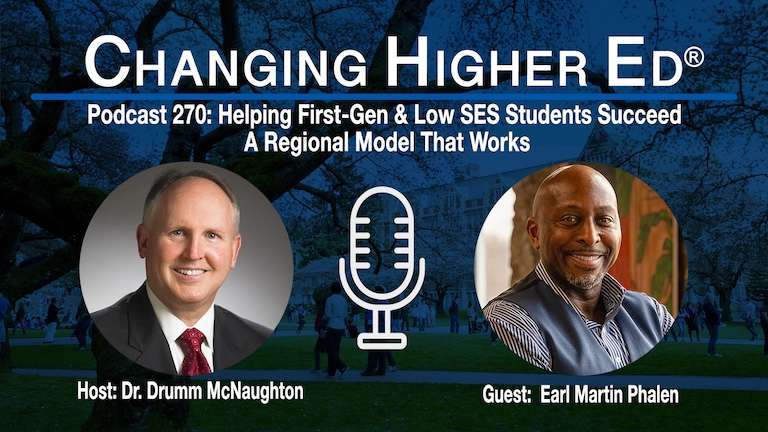

July 29, 2025 · Episode 270
Helping First-Gen and Low SES Students Succeed: A Regional Model That Works
38 Min · By The Change Leader, Inc.
Improve student outcomes for first-gen and low SES students through early scholarships, long-term advising, employer engagement, and regional collaboration.
Higher education leaders focused on improving college completion, student retention, and wraparound support programs for first-generation and low SES students can gain practical strategies from this episode of the Changing Higher Ed podcast, featuring Earl Martin Phalen, President and CEO of Great Jobs Kansas City (KC). Phalen outlines how his organization, funded by the Kauffman Foundation, regional universities, and community partners, has built a scalable model of student success that begins in high school and extends through college graduation and into career placement.
With nearly 1,000 scholarships awarded annually at $50,000 each, Great Jobs KC partners with 24 higher education institutions across Kansas and Missouri to provide students with financial support, long-term mentorship, career training, and job placement. The result: a 96% year-over-year college persistence rate, a 73% graduation rate, and a growing regional ecosystem of support for underserved learners.
A Holistic Framework for Supporting First-Gen and Low-Income Students
Phalen brings decades of experience in K–12 and higher education reform. His work has focused on building systems that address academic readiness, life stability, and long-term outcomes. Before launching Great Jobs KC, he founded Building Educated Leaders for Life (BELL), Phalen Leadership Academies (PLA), and Summer Advantage. These programs have collectively reached over 90,000 students through charter schools, extended learning, and literacy interventions.
His current efforts reflect a growing national urgency: first-gen and low-income students face steep disadvantages in college access, persistence, and career outcomes. Yet these challenges are not insurmountable. With intentional support, Phalen argues, higher ed can bridge the gaps that traditional structures too often overlook.
Early Engagement: Scholarships and Advising in High School
Most scholarship programs begin senior year or after college admission. Great Jobs KC starts earlier, awarding its $50,000 scholarships in 11th grade. This advance notice allows students and families to prepare with a clearer understanding of funding, institutional fit, and career alignment.
Students are immediately paired with a scholar advocate—an adult mentor who works with them every two weeks starting in high school and continues through college and into their first job. These advisors help students complete FAFSA, research colleges, select majors, and navigate the complexities of higher education systems.
The early timing transforms the student experience by turning college from a vague aspiration into a supported, attainable goal.
Scholar Advocates as Long-Term Navigators
What sets Great Jobs KC apart is its investment in continuity. Scholar advocates provide consistent, informed guidance over several years. Their support spans:
- Course planning and registration
- Housing, transportation, and financial logistics
- Emotional and social adjustment
- Academic challenges and study strategies
- First-job navigation and early career coaching
Advocates also build relationships with students’ families, many of whom have never navigated higher education. This inclusive approach strengthens the student’s support network and addresses challenges before they become crises.
Phalen emphasized that this advising system is structured and professionalized, with measurable outcomes and defined responsibilities that go beyond traditional mentorship. The organization tracks touchpoints and progress metrics, enabling data-informed adjustments.
Regional College Partnerships to Improve Student Retention and Completion
Great Jobs KC collaborates with 24 colleges and universities in Kansas and Missouri, including Metropolitan Community College and Johnson County Community College. These partnerships operate on shared accountability, with colleges and Great Jobs KC coordinating regularly on student outcomes and institutional alignment.
Institutions meet quarterly with Great Jobs KC to:
- Share enrollment, retention, and graduation data
- Identify systemic roadblocks
- Coordinate services for enrolled scholars
- Align academic and career planning strategies
This regional alignment ensures that students receive seamless support whether they attend a community college or a four-year university, and whether they transfer or enter directly.
Phalen noted that these relationships have fostered a new level of shared responsibility. Institutions are no longer operating in isolation—they’re co-designing student success pathways with Great Jobs KC as a central partner.
Financial Aid That Reflects Real Costs
The scholarship covers far more than tuition. Students can use funds for housing, food, transportation, laptops, books, and other expenses that often derail persistence.
This flexible design acknowledges that many students face life pressures that are invisible in traditional financial aid models. For example, an unexpected car repair or housing deposit could be the difference between re-enrollment and dropping out.
Colleges involved in the initiative have committed $293 million in funding over ten years to expand and sustain the scholarship program, building on the original $187 million investment from the Kauffman Foundation.
With nearly 1,000 scholarships awarded annually and plans to double that figure, the program is scaling rapidly to meet demand.
Dual Tracks: Degree and Credential Pathways
While much of the focus is on college degrees, Great Jobs KC also supports students who pursue technical and occupational training through its Skilled KC initiative. This track offers tuition-free credential programs in high-demand fields like:
- HVAC
- Welding
- Medical assisting
- Nursing
Students receive wraparound support, just like degree-seeking peers. With over 10,500 participants to date, Skilled KC boasts an 83% completion rate, a $12,000 average annual wage increase, and 91% one-year job retention.
This model redefines success as achieving long-term employment and financial stability, not merely earning a degree.
Bridge Programs and Peer Support to Build Belonging
First-gen students often enter college without the networks or cultural familiarity that ease the transition. Great Jobs KC addresses this through pre-college bridge programs and on-campus ambassador initiatives.
Incoming students attend summer orientations where they learn to navigate campus life—understanding syllabi, connecting with advisors, and building early peer relationships. Once on campus, peer ambassadors lead bimonthly gatherings that foster community and accountability.
This investment in belonging is backed by research. Phalen cited studies showing that social isolation is a leading factor in first-year attrition, especially among students from underserved backgrounds. Building authentic connection early increases resilience and engagement.
Internships and Job Placement for First-Gen and Low SES Students
Internships are available as early as freshman year. Nearly 100 regional employers have partnered with Great Jobs KC to provide real-world experience and job opportunities aligned with students’ academic paths.
Employers include hospitals, construction firms, logistics companies, schools, and financial institutions. Internship roles are designed to lead to full-time positions, and many do. Scholars receive coaching on resumes, interviews, and workplace expectations before placement.
Even after students begin their careers, advocates stay connected to help with issues like workplace conflict, communication challenges, or role transitions. The organization also hosts alumni workshops on adult milestones like buying a home or vehicle.
This sustained support into the workforce helps address a troubling national trend: first-generation students earn just 66 cents on the dollar compared to peers in their first job, and only 50 cents five years later. Great Jobs KC is working to close that gap by equipping students with both access and advocacy.
Lessons for Higher Ed Leaders
Phalen and McNaughton emphasized that Great Jobs KC’s success is replicable in part or in whole. Institutions don’t need a $50 million endowment to apply its principles. Strategies that colleges can adopt include:
- Pairing students with long-term mentors or advisors
- Building cross-campus coordination between financial aid, advising, and student life
- Starting outreach and support in high school
- Funding scholarships that cover non-tuition expenses
- Partnering with local employers for early, paid work experience
- Creating alumni networks that support transitions into adulthood
Leaders must also challenge the notion that access alone is enough. True equity requires persistence, belonging, and meaningful outcomes.
Building a Regional Ecosystem of Success
Phalen’s vision extends beyond individual success. Great Jobs KC is designed to raise the floor for the entire Kansas City region. Its target is 50,000 students moving into family-sustaining careers.
The organization connects K–12 schools, higher ed institutions, employers, and philanthropy into a coordinated ecosystem focused on long-term career outcomes. That model could inform state-level reforms or multi-institution consortia elsewhere.
Dr. McNaughton noted the importance of institutional courage in this work. “This isn’t about tweaking orientation,” he said. “It’s about fundamentally rethinking how we engage, support, and transition students—especially those who’ve historically been underserved.”
Three Takeaways for University Presidents and Board
- Invest in Continuity
Advisors who follow students across transitions (high school to college to job) provide unmatched consistency and trust. - Eliminate Hidden Costs
Scholarships must cover more than tuition. Students need help with housing, books, tech, and transportation. - Treat Employment as the Goal
Align academic pathways with employer needs and support students into—and through—their first job.
Bonus Takeaway
Great Jobs KC tracks metrics on scholar touchpoints, persistence, graduation, income gains, and employment retention. This data isn’t just for funders—it informs real-time support and institutional partnerships. Higher ed leaders can adopt similar systems to proactively flag risk and adjust interventions early.
Final Thoughts: Redefining the Value Proposition
This episode makes clear that the value of higher education cannot be measured by enrollment alone. Great Jobs KC offers a working blueprint for how institutions can demonstrate value through outcomes—especially for students who have been left behind by traditional models.
Quick Overview: College Success Strategies for First-Gen and Low SES Students
Key Highlights:
- $50,000 scholarships awarded to high school juniors
- Nearly 1,000 students are funded annually
- 24 higher ed partners in Kansas and Missouri
- Scholar advocates guide students from high school through their first job
- Pre-college bridge programs and peer ambassador networks
- Skilled KC credential track serves 10,500+ students with an 83% completion rate
- $12,000 average income gain for credential graduates
- 91% one-year job retention rate
- Employer partnerships with nearly 100 companies
- Goal to support 50,000 students into family-sustaining careers
About Our Podcast Guest
Earl Martin Phalen is the president and CEO of Great Jobs KC and founder of Phalen Leadership Academies, a network of 23 schools that consistently outperform local public schools. He also leads Summer Advantage, a summer reading program for K-8 students, and served as a trustee of the Ewing Marion Kauffman Foundation. Adopted after being abandoned at birth, Phalen credits his adoptive parents’ love with inspiring his lifelong commitment to helping others. A graduate of Yale University and Harvard Law School, he launched his first nonprofit, Building Educated Leaders for Life, while in law school; it now serves 20,000 students nationwide. Phalen’s work has earned him numerous honors, including a President’s Service Award from President Clinton.
Connect with Earl Martin Phalen on LinkedIn →
About the Host
Dr. Drumm McNaughton is the founder, CEO, and Principal Consultant at The Change Leader, Inc. A highly sought-after higher education consultant with 20+ years of experience, Dr. McNaughton works with leadership, management, and boards of both U.S. and international institutions. His expertise spans key areas, including accreditation, governance, strategic planning, presidential onboarding, mergers, acquisitions, and academic realignment. Dr. McNaughton’s approach combines a holistic methodology with a deep understanding of the contemporary and evolving challenges facing higher education institutions worldwide, ensuring his clients succeed in their mission.
Read the Podcast Transcript →
Transcript: Changing Higher Ed podcast 270 – with host Dr. Drumm McNaughton and guest Earl Martin Phalen
Introduction to Changing Higher Ed®
Welcome to Changing Higher Ed®, a podcast dedicated to helping higher education leaders improve their institutions. With your host, Dr. Drumm McNaughton, CEO of The Change Leader, a consultancy that helps higher ed leaders holistically transform their institutions. Learn more at changinghighered.com. And now, here’s your host, Drumm McNaughton.
[00:00:20] Introducing Our Guest Earl Martin Phalen
Drumm: Thank you, David.
My guest today is Earl Martin Phalen, president and CEO of Great Jobs Kansas City. Adopted after being abandoned at birth, Phalen credits his adoptive parents’ love with inspiring his lifelong commitment to helping others. Indeed, his life has been a life of service. He launched this first nonprofit, Building Educated Leaders for Life, while in law school. It now serves over 20,000 students nationwide. He founded the Phalen Leadership Academies, a system of 23 black run charter schools that consistently outperformed local public schools in the Kansas City areas. He founded its Summer Advantage, a summer reading program for K through eight students that’s changed the academic growth of over 50,000 students. And as President CEO of Great Jobs Kansas City, they grant a hundred million in scholarships and are creating jobs for working families through Great Jobs Kansas City Scholars, and Skilled US.
Earl’s is a great success story, and he joins me today to talk about the services that Great Jobs Kansas City and other nonprofits provide to first-gen and low SES students to make them successful. Things that colleges and universities can do to help retain and graduate new students.
Earl, welcome to the program.
Earl: Thank you so much. Great to be here with you today.
Drumm: I am looking forward to it as well. You’ve got an amazing background.
[00:01:55] Earl Martin Phalen’s Early Life and Inspiration
Drumm: Tell us just a little bit about who you are and what you’ve done.
Earl: Sure. Well, well, thank you. And my mom became pregnant with me at 16 years old and realized that she wasn’t going to be able to raise me, and decided to place me up for adoption. In 1967, I went into my first foster home. 1968 went into my second foster home, and there was a front-page article in the Boston Globe, I was in Springfield, Mass., that said that 70% of black boys in Massachusetts foster care would end up in prison by the time that they were 21. And I was blessed to be adopted into the Phalen family, an Irish Catholic, white, Irish Catholic family in Norwood, a little town outside of Boston. Went to public schools, Yale University, Harvard Law School, and I’ve been blessed to devote the last 32 years of my professional life helping love other children in the same way that I was loved by my social worker, by Catholic Charities, and then ultimately by the Phalen family, and all my great friends, coaches, and mentors throughout life. So just trying to give back the way others did for me.
Drumm: Well, you are testimony to that saying, “it takes a village to raise a child”.
Earl: Yes, it does. Yes, it does.
Drumm: So obviously there was a tremendous amount of love heaped on you from all those entities, and I would be willing to bet that that love was the impetus for you to be able to turn around and do things for others like you do.
Earl: Yes, I think that, when you’re adopted, sometimes you feel a little bit left out, especially when you’re in an all-white community. At my high school, Ingrid Tucker was a senior, I was a junior, and Eric Smoot was a sophomore. So all the rest of the students were white and wonderful classmates and great people.
Sometimes you can feel different and left out, so having so much love and support and reinforcement, again from within my household, but also from my coaches and my mentors and my closest friends, that made all the difference to sometimes fight through some of the negativity that emerges as it does for all of us.
Drumm: I would say that’s a very accurate statement, “as it emerges for all of us”. Everybody. I don’t care whether you’re white, brown, purple, green, or orange.
Earl: That’s right.
Drumm: Still experienced that kind of thing growing up.
Earl: That’s exactly right. Yes.
[00:04:07] Founding Phalen Leadership Academies
Drumm: So now you started the Phalen Leadership Academy some years ago. Tell us about that if you would.
Earl: Sure. Well, I told you a little bit about my short story, and my parents’ names are George and Veronica Phalen. So, I wanted to just honor my parents and named a network after them, called the George and Veronica Phalen Leadership Academies, but obviously that’s too long, so we either call it PLA or Phalen Leadership Academies.
That’s a network of charter schools that partner with districts, traditional districts, to really help turn around underperforming schools. There are above 5 million young people of the 50 million that go to school in the United States, going to absolutely abysmal schools, Drumm, to give them no chance of using education to change their lives as I was able to do.
We try to go into those schools and make them better. And we’re blessed. It’s a small network of schools. 10,000 children, and we’ve been able to turn numerous schools, almost all of our schools, from “F” rated schools into “A” rated schools.
Drumm: Wow, that’s amazing. And whereas we’re not going to talk about K-12 as much as we are going to talk about Great Jobs Kansas City and the things that you’ve learned.
[00:05:15] Great Jobs Kansas City: Mission and Impact
Drumm: I would have to say that by doing these charter schools, as you have, you’ve seen what it really takes for any kind of student coming from a low SES or first-gen student, what it takes to be successful when they get to college.
Earl: Exactly right. And I coached basketball for five years before COVID. So I’m in the schools every day. I’m with our scholars. I’m hearing what their highs are, I’m hearing what their challenges are. I’m hearing what their fears are and what their aspirations are, so being there with scholars and then obviously getting to know families by being in the schools so frequently, you know what the parents go through and you know what the parents’ hopes and aspirations and fears are as well. So that informs our work at Great Jobs KC as we award the scholarships in 11th grade and then support them all the way through graduation and into their first jobs.
Drumm: So nowadays we’re seeing a lot of pain points in universities. Declining enrollment, financial burdens, unique to first-generation students, and low SES students. You didn’t start Great Jobs, Kansas City; you came into that position.
Earl: I did.
Drumm: It’s a holistic approach to workforce development and getting folks through college to go into the workforce. Tell us a little more, I’m fascinated by it.
Earl: Yes, it was, Dr. Beth Jan Kramer and several others in the Kansas City community, really starting with Mr. Kaufman, when it was called Project Choice, created this program to say, “Listen, we know that there are so many bright and talented young people. We know that college is still the best way to get a good paying career that allows you to take care of yourself and your families. But we know a lot of young people will not choose college because of the financial burden that they cannot overcome, or their families cannot overcome”.
So, it started out just in 2016 as just a nonprofit scholarship program awarding several hundred scholarships. We were blessed last week to award 901 scholarships at $50,000 each.
So, it’s grown considerably over the years. But we’ve also learned that it’s not just the dollars that get a child to and through college, there’s a lot of other wraparound supports, particularly for first generation students, that are critical if you want those scholars to A: make it onto the college campus, and then B: succeed year over year until they walk across the stage with their cap and gown.
[00:07:41] Scholarship Programs and Student Support
Drumm: And the way you do things is very different than most scholarships. Because you start your scholarships early while they’re in the 11th grade, right?
Earl: We do, because one of the things we found that is if you wait till 12th grade, a lot of students, especially first generation, they just don’t know the way to go. So, we award in 11th grade so that we can work with them starting in April of their 11th grade year to start to think about what college is going to be the right fit for them. What major might be the right fit for them? What are the scholarships we can help them compete for and win to cover costs like room and board? Great Jobs gives a $50,000 scholarship, but there’s still other costs, at some of the more expensive in institutions, but also with room and board being expensive at many institutions. So, we help them with all those pieces.
And then we help them make sure that, again, they get to college. And I know that sounds like a small thing, but we’ve had scholars who their mom couldn’t give them a ride. Their car broke down, and all of a sudden, they weren’t going to go to college because the car broke down. So we make sure that they get to college, and then once they get there, there’s a real sense of belonging from the first day they start till they finish.
Drumm: That’s amazing. I’ve never heard of anything like that. The closest that I’ve heard to it is Madeline Atkins from Lucy Cavendish College, University of Cambridge. Their faculty starts going out and working with promising high school students. But to give a scholarship that early, that’s amazing. But the reasoning makes perfect sense.
Earl: Yes. You need time to figure out FAFSA. You need time to figure out all details of particularly the right fit college because a lot of young people, both choosing the right college and choosing the right major. Some of our scholars go. So, somebody says, “well, you have to fill it in right now and just take humanities”. Well, humanities might be the right thing for them, but probably it’s not the right thing for them. So, we want to give them a lot of time to begin to explore, “what are you thinking about long-term in terms of careers?” Let’s expose you to some internships so you get some experiences to say, “oh, I would love to do that, or I wouldn’t ever want to do that type of thing”.
So, we try to start early. And the critical part is we are working not only with the scholars, but we’re also working with families. because this is the first time that many of our families, 83%, have sent a young person off to college. And that creates a whole set of emotions and anxiety and sadfulness and joy amongst parents. So, we help our parents as they go through, again, the joy of sending their first child to college.
Drumm: That is fabulous. There are three parts to your program. There’s a scholarship programs, which we’ve talked a little bit about, the support to people and the workforce development, and we’ve talked a little bit about that. I am sure you have learned a tremendous amount about what these students need to be successful in college and the world.
Earl: Sure there’s a lot of things college needs. We had one scholar who was getting ready to head off to college and, again, was getting a ride one of our team members to get that transportation piece and came out with a pillow case with three pairs of jeans, four t-shirts, and an extra pair of sneakers thrown over his shoulders. That’s what he was going to take to college. And we didn’t want him to start college that way. We wanted him to have bedding and towels and other necessities that most of us, as our parents did for us, if they had had that experience, knew to send us off with a small refrigerator, X, Y, Z. So part of it is just making sure our scholars have what they need to get to college.
Second piece is a lot of our universities; we work with 24 in Kansas and Missouri. We have partnered with them to build bridge programs so that the scholars get one or two weeks on campus before the official start so they get a little exposure to the pace of classes and what the homework assignments are going to like. They find out where the library is, they find out where the mess hall is, they find out where the gym is, they find out where they can do their laundry, and they also build a community, because again, the number two reason young people don’t continue, and persistent college is they don’t feel a sense of belonging. They feel like there was nobody else that they could talk to or lean on.
We also make sure that every one of our scholars outside of the bridge have a scholar advocate. That’s somebody one-on-one who starts with them in 11th grade, who’s touching base with them every two weeks, sometimes by text, by phone, sometimes getting together, to make sure that they’re helping them encourage them, and helping them with the logistics of planning for college and then going off to college.
And once they get there, making sure they’re sticking with it. And they have that extra voice, and we do that all the way from 11th grade to the end of the first job after their first year. So, we try to do things like that that help our scholars. The same way that I had seven older brothers and sisters and a mom and dad who went to college. So, they all told me those things and taught me those things. Not everybody has that, and we just try to be that partner for our scholars.
Drumm: So, you’ve talked a little bit about the scholarship piece at the beginning. You’ve talked about the sense of belonging, the bridge program, that type of thing. What are some of the other things that you’ve learned, and we’ll get back to the scholarships because I think that’s really important. Especially the way Great Jobs Kansas City has raised money for all this.
Earl: Yes, we’ve learned a few things. We’ve learned that about 50% of kids in America, coming out of the urban communities in America, and we serve in greater Kansas City, Metro KC, half a choosing college, but half a choosing careers. So, we created a program called Great Jobs KC to help those who want to go on the career track as well, and I can talk more about that.
But the program has very similar elements of if you need help with childcare, if you need help with transportation, if you need help with utilities, all of those pieces. Everybody has a one-on-one scholar advocate and the program’s tuition free if you’re choosing our credential track, and not the degree track.
So, we just realize. You start to understand the obstacles that stand in the way of success. And then we are so proud that in our scholarship program, our scholars graduate, our first cohort graduated at 73 percentage rates, and that may not seem high, but it’s about two to three times larger than first generations. Students that don’t have any, type of supports like ours. So, we keep listening to our scholars about what they need. We had some graduates, we now have an alumni program for Great Jobs KC and our graduates said, please help us figure out how to buy our first home, how to buy our first car. So, we’re running workshops of those. We just keep listening to what stands in the way of helping our scholars achieve that great middle or upper class dream that we all aspire to, and we try to knock those down.
[00:14:20] Workforce Development and Career Readiness
Drumm: So how would something like the Great Jobs portion of this, how would that work with a college or a university or would it? I would say community colleges would be a perfect fit, but I would think continuing education or some other division of a college or university might work as well.
Earl: Yes, you are spot on. We have really three parts to our Great Jobs program. That’s for students who want to get a credential that will lead to a job that pays 45,000, 85,000, 125,000 plus benefits. And three components are, one is we do professional skills training, so time management, life management, stress managing, how do you open your first bank account? How do you use a credit card thoughtfully? How do you write a good resume and have interview skills? What do you need to look like in terms of your dress when you show up? So, we have one part is professional skills.
Second part is occupational skills. So, you want to become a CNA or an LRN, you want to become an HVAC technician or a welder. Those skills are taught by our trade school partners, our community colleges, and by other nonprofits who provide training program. So, the colleges and universities, as you mentioned, are critical partners in delivering our workforce.
And the third part of the program is our North Star, which is helping our scholars get the jobs. So we partner with employers who are excited to hire our graduates. And the neat thing is, in our scholarship program, we have 6,500 students right now who have received these $50,000 scholarships, and in our credential program we have 10,500, 10,500 young adults and adults who are choosing to get a short-term training program that leads to a really good paying job.
Drumm: Well, with so much pressure on colleges and universities right now, not only financial pressure, but pressure from outside entities about preparing graduates for the workforce, there are a lot of elements that would really apply to a four year or a graduate granting institution that they could take. It may not be a one for one, but I’ll give you an example. When one institution that we worked with, not all that long ago, had vice president for employment who really increased the number of first generation and students both that had high school GPAs of less than 3.0.
Earl: Yes.
Drumm: And you would think that that is a great thing. But there, they brought all these students in without any kind of bridge program, without any kind of scaffolding, support, et cetera. And the persistence rates and the retention rates dropped significantly because of these students. They weren’t ready and they didn’t give them any support. That’s what you’re doing.
Earl: That’s what we’re doing. And you see this on colleges throughout the United States. If you look at Pell eligible students, their persistence rates are incredibly low. Their graduation rates are incredibly low, and it’s the things that you described. Is there a bridge program? Do you have a one-on-one scholar advocate, which somebody would call maybe a case manager, who’s touching base with you on a regular basis, making sure you’re doing okay. We have partnerships with our universities so that we can get information, not after the scholars dropped out, but if a scholar is struggling or if they’re losing credits. Right?
So we know on an ongoing basis, “wait a second. Hey, I see you dropped this class. That’s okay. But you got to take out the class during the summertime if you want to graduate on time and let’s help you get enrolled and figure out how to get that paid for”. So you really need that person to walk beside you.
Drumm: Yes. So that’s a different person than a quote student advisor, though. Correct?
Earl: That is correct. That is correct. The scholar advocate is part of the Great Jobs team, and they literally start building a relationship in 11th grade. Once that scholar gets, so they’ve walked the journey with the parent, with the scholar. What major? What do you get excited about? Do you want to be in a big school or small school? You want to be an urban or rural or more, suburban environ. So, they’ve built a relationship, So, it’s almost like having a friend, a best friend that you can talk to as you’re struggling through nervousness about exams or nervousness about, I chose the wrong major, or, gosh, I don’t have friends to have lunch with all the things that you go through sometimes or you may go through when you hit campus, that may make you feel less than deserving, or less than confident that you want to stay.
Drumm: I’m trying to equate this to a four-year college degree, something like that, and reaching out from a college to 11th graders makes a lot of sense. But there is a parochial interest in that they want to get that person to enroll at their institution and not any institution and their institution might not be the right one to do. Without having someone from the outside doing this, which any entrepreneurs on the line right now, this is a great opportunity for you. How do you get this to work with a regular college?
Earl: Well, because we have 24 colleges and universities, and because we’ve had a longstanding relationship and because our students persist, we have a 96% year over year persistence rate that’s leading to the high graduation rates. So, the universities know we’re not going to force somebody into a major that they don’t want, we’re not going to force somebody into an institution that may not be a fit for their interest. But we’re still going to find you students. Because again, remember we awarded 901 scholarships of $50,000. So that’s a lot of young people who are choosing to go off to these 20 colleges, and universities in the region. Because we don’t want the scholars who now have hope, who families, who now believe that their lives are going to be better, we don’t want them to do that and drop out as happens in a lot of cases where you don’t have programs like Great Jobs KC.
Drumm: Well, it seems to me that. You’ve got Great Jobs KC, but you’ve also got this network of 24 schools, and I’m guessing Great Jobs KC may be the hub of the wheel.
Earl: Yes.
Drumm: They also talk to each other to be able to say, “Hey, I’ve got this one kid who really wants a program in business, we don’t offer something like that, or we don’t think he or she would be a good fit. Let’s pass them on to you. I’m just trying to brainstorm as a way of creating this kind of “regional system” to where you can really help each other as institutions.
Earl: Yes, you hit upon it. We do it two ways or multiple ways. We get together quarterly with all of our university partners to talk about best practices and highlight some of the things that some of our best universities are doing to help students persist, to help students get those internships and help students get jobs, help students get higher GPAs, and we just have so many good examples.
And then to your point, we have many two-year institutions, Metropolitan Community College, Johnson County Community College. So, some of our scholars are choosing the two-year piece, and then as you said, partnering with some of the other institutions that are four years, but they’re going in with full credits and ready to knock it out their junior and senior year. So, it is an ecosystem that is evolving and we’re very proud to have that.
Drumm: And it makes so much sense because if you’re partnering, if you’ve got these articulation agreements, and we all know that so many times, students will pick up credits from an associate’s degree or whatnot, and then they’ll try and transfer to a four year and, “oh no, we don’t take those”. It’s like, come on folks.
Earl: That’s exactly right. That’s exactly right. And we love the level of collaboration that we see with our universities. Kansas City, as most of you know, is in both Kansas and Missouri but it’s nice to see the level of collaboration. And we have a hundred percent attendance at all these post-secondary network convenings. And again, it’s best practices, it’s how can we work better for students, and how can we work collaboratively for the success of the region?
[00:22:29] Funding and Community Support
Drumm: One of the things we’ve not touched on, and I, you blew me away when we spoke about this a couple days ago, was the level of funding that you’ve gotten from outside agencies, foundations, et cetera. Let’s talk a little bit about that, because without that funding, you couldn’t make this work.
Earl: No. It started off, this was the dream of Mr. Kaufman in 1988 when he went to his high school. And a lot of students said they weren’t going to college. And he said, I promise you that if you are a good young person and you stay on track, I’ll pay for any college that you get into, and that was called Project Choice back in 1988.
And Mr. Kaufman ultimately created the Kaufman Foundation, which is now a $3 billion foundation in Kansas City. They made the initial investment in this program, $187 million over 10 years was their initial investment. And that allowed us to give 250 scholarships every year. And the university said, wow, you have 250 scholarships. But you had 1200 other students who were qualified, they had the right GPA, 2.5 or higher, they had incredibly compelling personal statements, but we didn’t have the resources for them.
So, we went out to the community first and raised millions, and then we went to the universities and said, as your enrollments declining, we have these incredibly talented kids who will persist and who will be great at your institution. And they said, “we’d love that”. So, our university partners have also contributed $293 million of financial support over the next 10 years in support of scholarships. And that’s why we’re able to nearly give 1000 scholarships a year.
And these are $50,000 scholarships. And we’re able to give 1000 a year, for students. Right in Kansas City to go to institutions, in the region.
Drumm: Which makes, from a financial sense for the universities, a great thing because you’re bringing qualified students in, they’ve got the support services that they need to persist, So, these scholarships certainly help the workforce, but more important, I wouldn’t say more importantly, equally as important, they help the institution not only from a reputation and a publicity perspective, but it also with the benefits to persistence, retention. That also helps them with their bottom lines.
Earl: 100% spot on. And our name is Great Jobs. Right? It’s Great Jobs KC. So, we’re also, which universities care about, we’re also helping our scholars get those summer internships and get those jobs when they leave that are good paying jobs. So not only can universities talk about the quality of persistence, higher graduation rates, but they can also talk about, and our graduates earn an average of $54,000 a year because they’re coming out of our institutions and getting great jobs right here in the region, which is powerful.
Drumm: Let’s talk about that piece because that workforce career component is part of your triad, and it’s one of, if not the most important thing. Getting students in, you’re keeping them in, you’re making sure they’re ready to graduate, but then they’ve got to get out and get that job.
Earl: That’s right. That’s right. And that’s why, when we created our credential program, which is again, somebody who’s not going to get a degree, but get a credential, and we have now partnerships with almost a hundred employers in Kansas City. We said, “listen, we want you to hire the folks who have credentials, and we want you to hire our graduates from our scholarship program”. And that’s been really powerful.
And a lot of our students said to us, ” I don’t think that I can get my foot in the door. I don’t have the network to get that internship at X, Y, or Z, and I don’t know if they want me here”. So, a lot of our scholars were leaving the region because they just didn’t think that there was a job opportunity.
And the employers are saying, “No, no, no, there are thousands of job opportunities here.” So, it’s been nice to, again, help our scholars while they’re freshmen, sophomore, juniors get those internship experiences and then hear, “oh my God, we’d love to have you back when you graduate”. It’s making our scholars feel better. It’s making our families obviously celebrate that their children are going to have good paying jobs when they graduate, and it’s helping boost the region’s economy.
Drumm: Well, the other piece with that is the internships, which lead to jobs helps with the relationship. But the other thing that you do, which is really unusual, and it makes perfect sense, you stay with them through their first year on the job.
Earl: We do, we do, because we just know that sometimes you, you take a job, and you find out immediately you don’t like your boss. Sometimes you take your job, and you find out, oh, guys, this job. That happens every once in a while. It happens every once in a while. So, sometimes you take a job and realize, “oh, this isn’t the job that I want. This isn’t the career path that I want. I don’t like what I’m doing on a day-to-day basis.” So, we want to be right beside them to say, “Yes, you still stay professional. This is how you have that conversation with your supervisor. And here, we are going to help you, if you decide to stay. We’re going to help you with some ways to manage that. But if you decide to leave, we’re going to help you with that as well”. because again, our mission is to help 50,000 people in Kansas City, get great jobs that allow them to take care of themselves and their loved ones. And I think the employers appreciate that because our scholars aren’t just not showing up, or all of a sudden now their attitude is changing. They know how to have a professional conversation to say, “Hey, Drumm, I really like you. I think this is a good company, but this isn’t touching my spirit, and I’d love to talk about a transition plan”. People can respect that. They don’t, may not like it, but they can at least respect the way that it’s done.
Drumm: Yes, one thing comes to mind, Cal State San Marcos has a program in their business school for undergraduates. Students contract out; they work in teams with local businesses. It’s a required course, so they’re getting critical thinking. They’re getting to work on teams, et cetera. It’s run through the business school. It’s an internship essentially, they’re doing. It’s called Senior Experience. I knew I’d come to it eventually, but they also have a great continuing education program.
What I’m seeing you doing at Great Jobs could be incorporated into the continuing education, could be incorporated into the business school where you’re creating those relationships and helping students along the way. Does that make sense?
Earl: It makes perfect sense. We have a program here in Kansas City supported by the Kaufman Foundation called Real World Learning, and that offers summer internships for 9th – 11th graders, again to begin to have them work on teams, have a job experience, understand what it’s like to have setbacks and have successes in the workplace, and build that muscle.
So, it’s just wonderful when you have programs like the Cal State program, like Great Jobs KC, that are continuing to give scholars those experiences and prepare them for success in whatever careers they choose.
Drumm: That is fabulous.
[00:29:50] Results and Future Goals
Drumm: Now let’s talk about results. We talked a little bit about that already, but the folks who have gone through, started with you in 11th grade and gone through their retention rates are 90 plus percent.
Earl: Yes. 96% retention rate year over year, and we’re most proud about the fact that that’s turning into a 73% graduation rate. The average scholar’s taken about five years to finish, So, we’re encouraging our scholars obviously to stay on that track, but we’re very proud of the fact that it’s a 73% graduation rate.
And we’re very proud of the fact that over half the scholars who are graduating now are making over $45,000 per year, plus full benefits for themselves. So, those are pieces that we really look at the scholarship program. On the workforce development program, Mathematica did an independent study, Drumm, we’re having a thousand people per month sign up for our credentialing program called Great Jobs, and the average graduates making $12,000 more than when they started the program, and they have full benefits for themselves and their loved ones. We have an 83% completion rate in our credentialing program, and 91% of those individuals, once they leave our program, have lasted at least one year in their first job.
So, we just, we love to try to change the community and again, give folks that economic boost that they need while also helping our economy grow and create more jobs for the next generation of our scholars and our families.
Drumm: That is fabulous. I know there aren’t a whole bunch of organizations similar to what you do across the US. In fact, I think there’re organizations do little pieces here and there, but how can higher ed institutions do this if they don’t have an Earl or a Great Jobs Kansas City in their area?
Earl: Yes, I think the blessing is a lot of colleges and universities are taking component parts and doing them. Having bridge programs for first generation, or for all students, is a great idea to get folks acclimated. We have an ambassador’s program on campus, which again, the older scholars welcome the younger scholars and then they have, bimonthly meetings. Maybe it’s a breakfast, maybe it’s a pizza party, maybe it’s a watching a sports game, but again, a sense of community and belonging. A lot of universities are doing programs that have a mentorship piece where upper class are welcoming and having regular touchpoints with others.
I think that the other piece is really having early insight into is this scholar succeeding academically or struggling academically is critical. And obviously we give a massive scholarship, a $50,000 scholarship, but a lot of universities have dollars. Well-used Pell Grants, but many other grants that former students, who may have been first generation, want to invest to make sure that there’s an economic, we have 13 universities throughout the United States that actually, if you’re under a certain income, your tuition and your room and board is completely free.
We have other states like Indiana, they have a 21st Century Scholars program that if you’re income eligible, your tuition is completely free at 53 institutions throughout the state. You have to figure out the room and board, but your tuition’s free, so the component parts. And the final thing I’d say is that sense of belonging and then the opportunity and support and finding that first job, and internship, summer internship, are so critical to the success of our scholars as well.
Drumm: So, what we’re seeing is, and you’re helping facilitate this thank you, is a changing of the higher education business model to make sure that kids, when they graduate, can be successful. Thank you. Thank you for doing this.
Earl: Well, you are welcome. You are welcome. We still know that about half the jobs require a bachelor’s degree in the United States, and we also know that enrollment has been steadily declining in the United States. Fewer and fewer people are choosing it, and quite frankly, fewer and fewer young men are choosing it. And we’ve got to make sure that when students do go off that they succeed and then they can tell their classmates, this was well worth it. This was worth the investment that I made or the loans that I took out because I had a wonderful experience. I grew as a young person. The university cared about me and I succeeded. So, we’re just trying to help more and more young people succeed.
Drumm: Well, thank you for what you’re doing there.
[00:34:25] Three Takeaways for Higher Ed Presidents, Senior Leaders, and Boards
Drumm: We are at the end of our time, and as we always do, we wrap up with two questions. So first question, what are the three takeaways for higher ed presidents, senior leaders and boards? What can they do to make sure that their first gen and low SES students are successful as you’ve done?
Earl: First, knock down financial barriers and make it affordable.
Second is make sure that there’s a strong sense of belonging. That the young people feel like you want them there and you want them to succeed through some of the programs I mentioned.
And third is make sure you walk with your students to help them get the right first job. There’s a statistic that says first-generation students make 66 cents on the dollar to their peers when they get their first job and five years out there making 50 cents on the dollar to their peers, and part of that is because of the lack of networks. So, help use the incredible university networks you have, the incredible alumni you have and the alumni who care and many of whom were first generation themselves, have them give back and open up those opportunities so our graduates are getting great jobs, and again, their message is, “college was worth it. The return on investment was worth it“.
[00:35:39] Bonus Takeaway
Drumm: I’m going to add one more to that is make sure that the students are getting the support, the sense of belonging is critical, but also the support through the program so that they can be successful.
Earl: that’s exactly right. You are 100 spot on.
[00:35:53] What’s Next for Earl and Gret Jobs KC
Earl: What’s next for you? What’s next for Greater Jobs KC? We have 17,000 adults in our program. Our goal is to help 50,000 adults get to family-sustaining jobs and to achieve either a strong middle class or higher economic status. So we’re going to continue to grow. We would love to, one day we’re giving, as I said, almost a thousand scholarships a year of $50,000.
We’d love to, over the next three years, grow that to double the program, so that 2,000 11th graders are getting $50,000 scholarships and the support to be successful. So that’s our plan, to continue to impact lives and to continue to get better. We love the fact that 73% of our scholars and, hopefully, next time I’m on this show, I’ll be saying 80% or 85% or 90% are graduating and getting those great-paying jobs. So, we want to get better.
Drumm: I have no doubt that you will. Earl, thank you so much for this. I so much appreciate your coming on the program. And I do, like you, I look forward to the next time we get a chance to do this.
Earl: Thank you so much for the opportunity to talk about Great Jobs KC. Thank you, Drumm.
Drumm: Thank you.
Thanks for listening today and a special thank you to my guest, Earl Martin Phalen, president, CEO of Great Jobs, Kansas City. Earl, thanks for being on the show. I thoroughly enjoyed our conversation, and I look forward to the next time you’re able to join me. To my listeners, thanks for listening. See you next week.