
June 9, 2026 · Episode 315
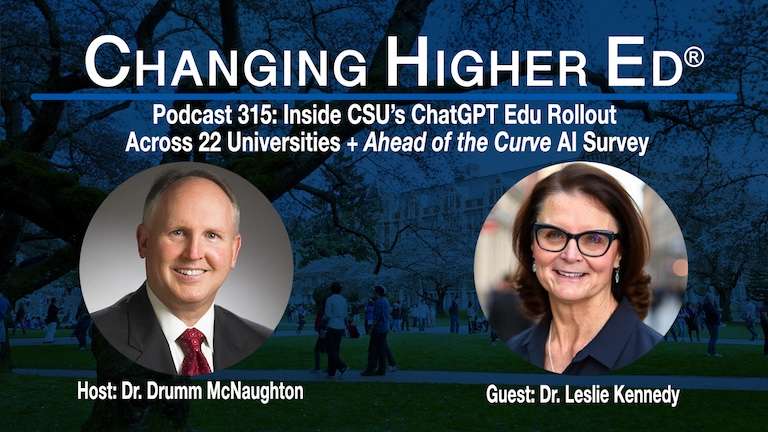
Inside CSU’s ChatGPT Edu Rollout Across 22 Universities
33 Min · By Dr. Drumm McNaughton
How CSU deployed AI to 225,000 accounts across 22 campuses in 18 months, and what 94,000 survey responses reveal about generative AI in higher education.
California State University expected about 50 faculty applications for its AI Educational Innovations Challenge last spring. It received 417. The system funded 63 projects with $3 million, and the projects will be showcased across disciplines this June.
The ratio is what should matter most to other institutional leaders. Faculty appetite for AI is running roughly eight times ahead of what one of the nation’s largest university systems planned to fund. Boards should be asking a different question: whether their institutions have the governance, training, communication, and measurement systems to support responsible AI adoption.
That data point sits alongside many more in Ahead of the Curve: What the Nation’s Largest University System Is Learning about AI, the largest AI perception survey ever conducted in higher education, with 94,060 responses from students, faculty, and staff across CSU’s 22 universities. The survey is one piece of a broader implementation that the system has run over roughly 18 months. ChatGPT Edu is now live across all 22 campuses with about 225,000 accounts active. More than 4,000 people have completed system-level training. CSU has moved beyond whether to engage AI and into how to govern, support, and measure systemwide adoption.
In this episode of the Changing Higher Ed® podcast, Dr. Drumm McNaughton speaks with Dr. Leslie Kennedy, Assistant Vice Chancellor for Academic Technology Services at the California State University Office of the Chancellor. Kennedy co-leads the academic side of CSU’s systemwide generative AI initiative and helped shape the Ahead of the Curve survey.
The full podcast conversation goes deeper into what surprised CSU’s own team in the survey data and how Kennedy is moving 22 independent campuses from innovation to mainstream adoption. Listen for the practical pieces other institutions can apply at very different scales.
Quick Overview
- The CSU is the nation’s largest four-year regional comprehensive university system, with 22 universities, more than 470,000 students, and more than 61,000 faculty and staff.
- A 2019 faculty resolution started the AI conversation; it was revived in 2023 after a COVID-driven pause.
- The systemwide GenAI Committee was convened in 2024, with subcommittees covering teaching and learning, research, productivity, and HR-IT.
- ChatGPT Edu launched systemwide in March 2025; all 22 campuses were provisioned by fall 2025.
- Roughly 225,000 accounts have been created in the CSU ChatGPT Edu instance.
- The fall 2025 CSU AI survey, Ahead of the Curve, drew 94,060 responses, the largest AI dataset in higher education to date.
- 95% of respondents have used at least one AI tool; the typical respondent uses three.
- ChatGPT dominates: 84% of students, 87% of faculty, 89% of staff.
- About 80% of students will not submit AI-generated work as their own; the pattern holds across all demographics and disciplines.
- 97% of faculty, 94% of staff, and 88% of students say verification of AI output is necessary.
- Faculty are the only group where a majority report both a positive impact at 56% and a negative impact at 52% from AI.
- 55% of faculty use AI in the classroom; 69% provide students with specific guidance; 68% include an AI statement in their syllabi.
- AI adoption is virtually identical across racial, ethnic, and first-generation lines.
- Demand for AI training is highest among first-generation, Black, Hispanic, and Latino students.
- The AI Educational Innovations Challenge received 417 applications against an expected 50 and funded 63 projects with $3M.
- More than 4,000 faculty, students, and staff have completed system-level training courses.
- Student hackathons with IBM, AWS, and NVIDIA are giving non-CS students hands-on enterprise AI experience.
- Communication is the operational discipline most institutions underinvest in during AI rollouts.
- All public resources are available at genai.calstate.edu.
The AI Rollout Sequence Other Systems Are Missing
When Drumm asked Kennedy how CSU actually pulled this off, the answer was sequencing, not technology, and not budget, as many would expect.
Faculty raised the issue first. The CSU Academic Senate passed a resolution on AI in 2019, before ChatGPT entered the public conversation. COVID derailed the follow-through. In 2023, with ChatGPT in everyone’s hands, the statewide Senate brought the resolution back and explicitly asked the system to provide an equitable, protected AI tool that students could access without their inputs training someone else’s large language model.
That faculty mandate produced a systemwide GenAI Committee in 2024, co-led by the system CIO and the deputy vice chancellor for academic and student affairs. The committee created subcommittees covering teaching and learning, research, productivity, and HR-IT procurement. Each represented a real institutional area AI was going to touch. The committee’s report recommended a single, enterprise-level AI tool for the entire system. ChatGPT Edu went live in March 2025. By fall 2025, all 22 campuses were provisioned.
What other institutions can replicate is the order, not the OpenAI relationship or the system’s scale. Faculty resolution first. Cross-functional committee second. Enterprise tool third. Training and funded experimentation in parallel. Most institutions are doing one or two of these pieces, in the wrong order, without governance anchoring any of it.
That’s what makes CSU’s rollout less a technology adoption story than a higher education change management case study.
What 94,000 Voices Are Telling Higher Education
The CSU partnered with San Diego State University, which had run an AI perception survey since 2023, to scale the instrument across all 22 campuses and the Chancellor’s Office. The result is the largest dataset on AI in higher education currently in existence. Three findings deserve the most attention from boards and presidents.
The first cuts directly against the cheating narrative. About 80% of students say they would not submit AI-generated work as their own. Drumm came back to this finding twice on the podcast. Drumm noted that, in a strategic planning engagement several years ago, faculty resistance surfaced when AI was used as a tool to help develop strategy language from existing planning inputs. Some faculty viewed the use of AI as plagiarism, reflecting a broader concern that continues to shape how higher education institutions approach AI policy and adoption. The CSU data suggests students’ ethical judgment may be stronger than the policing narrative assumes.
The verification numbers reinforce the read. About 97% of faculty, 94% of staff, and 88% of students say it is necessary to verify AI-generated content. Trust in AI accuracy, by contrast, sits at 30% for faculty, 38% for students, and 46% for staff. CSU students are not just refusing to pass off AI work as their own. They are also skeptical of AI outputs. That posture is workforce-relevant.
The second finding is the one boards should sit with longest. Faculty are the only group in the survey where a majority report both a positive impact from AI (56%) and a negative impact (52%) at the same time. Staff lean strongly positive. Students lean positive. Faculty alone carry the full complexity of AI’s promise and disruption in their work simultaneously. Any board treating “the faculty AI experience” as similar to staff or student experience is misreading the data. Faculty need different support, different training cadence, and different communication than other groups on campus. They are doing more cognitive work to integrate the technology than anyone else.
The third finding inverts what most institutions are watching for on equity. ChatGPT use ranges from 82% to 86% across racial and ethnic groups. Regular AI use varies by no more than five percentage points across all student demographics. First-generation and non-first-generation students report virtually identical adoption rates. There is no access gap. There is, however, a training gap. Demand for formal AI training is highest among the populations the CSU is built to serve. First-generation students want it at 53%, Black students at 52%, and Hispanic and Latino students at 50%, compared with 44% of white students. The students most likely to benefit from structured AI fluency are the ones asking for it most loudly.
Faculty Are More Engaged Than the National Narrative Says
Among CSU faculty, 55% are using AI in the classroom, 69% are providing students specific guidance on how to use AI effectively and responsibly, and 68% include an explicit AI statement in their syllabi. Drumm flagged the surprise on the recording. These are large numbers for a system the size of CSU, and they push back on the dominant story that older faculty are uniformly resisting.
Kennedy referenced Geoffrey Moore’s Crossing the Chasm framing in passing. The goal, she said, is mainstream adoption, and the chasm is real, but CSU has plenty of faculty who are creative and interested in change. The 55% figure suggests the chasm is closer to being crossed than the sector narrative implies. What made the difference, in Kennedy’s view, was a second statewide Academic Senate resolution recommending faculty take part in AI training, combined with training resources stacked across campuses. CSU Monterey Bay built the intro course on teaching and learning with AI. San Diego State built a 10-hour micro-credential. Fresno State built the staff version. More than 4,000 people have completed system-level training on top of campus-specific offerings.
The funding piece is the one other institutions should look at hardest. CSU’s AI Educational Innovations Challenge offered grants up to $60,000 per project. The system expected about 50 applications. They received 417. They funded 63 with a total of $3 million. The 63 funded projects are being showcased across disciplines this June, which gives the system a discipline-specific resource library faculty can draw from, rather than having to start from generic vendor case studies. Faculty appetite is sitting well ahead of capacity, which is itself a useful signal for any institution still arguing about whether its faculty are interested.
The Hardest Problem Was Communication
When Drumm asked Kennedy what the hardest part of the rollout has been, she did not point to technology, procurement, or governance. She pointed to communication.
In a 22-university system spanning 800 miles of California, with independent campuses each running their own governance, getting timely information to faculty, students, and staff is a continuous battle. Faculty are focused on their disciplines and often can’t take advantage of training during the semester. Information moves through strategic communications teams, campus leadership, and discipline-specific channels at different speeds. As Kennedy put it, in a large system, you cannot be redundant enough.
Tool selection is a one-time decision. Training programs are quarterly investments. Communication is the operational work that has to run as long as the technology keeps changing. CSU’s response includes the public AI Commons site, two faculty-led podcasts (My Robot Teacher from Cal Maritime and Unfixed from Chico State), quarterly GenAI Committee meetings, and more frequent subcommittee work. Other institutions trying to roll out at scale should plan for continuous communication rather than a launch campaign. Kennedy noted that the system launched on GPT-4 and has already moved through several major version updates. Training resources have to keep pace with the underlying tools.
What Comes Next: Domain Tools, Hackathons, and Embedded Credentials
CSU’s next priorities sit in two areas. The first is hands-on experience for students. Through a Workforce Acceleration Board structured with Adobe, OpenAI, Microsoft, AWS, IBM and other partners, the system is running student hackathons across campuses. IBM ran one for the LA campuses on Watson. AWS is supporting one at Cal Poly San Luis Obispo this summer. NVIDIA recently ran one at San Jose State. Cal Poly Pomona ran another. The participants are not just computer science majors. Philosophy, history, and health sciences students are solving real problems with enterprise-grade tools.
The second priority is embedding AI micro-credentials directly into curricula across disciplines, so students graduate with documented AI competency alongside their major. The survey backs the move. About 82% of students worry about AI’s impact on job security. Sixty-nine percent believe AI will be essential in most professions. The students are asking the institution to prepare them, and CSU is building the next phase of work around workforce readiness.
Three Takeaways for University Presidents and Boards
The following reflects what Kennedy shared in the recording, refined for institutional decision-makers.
- Plan strategically and measure deliberately. AI is going to affect teaching, learning, research, productivity, HR, and IT. Plan for it as a system rather than a series of departmental decisions. Set up governance first, deploy the tool second, layer in training and funded experimentation in parallel. Build the measurement framework into the rollout. CSU is still developing its measurement plan, but Kennedy was direct that having one in process is better than treating it as an afterthought.
- Build the team with faculty, students, and staff at the table. CSU’s rollout works because it started with a faculty resolution, was governed by a cross-constituency committee, and was supported by training resources built at campuses rather than imposed from the system office. The instinct to centralize will be strong. Institutions that build broadly will see higher adoption and lower resistance.
- Treat communication as an operating discipline. In a system or campus of meaningful size, you cannot be redundant enough. Use multiple channels. Accept that information moves at different speeds for different audiences. Update training resources continuously as the underlying tools change. CSU launched on GPT-4 and is now several versions ahead. The communication operation has to keep pace.
About Our Guest
Leslie Kennedy, Ed.D., is Assistant Vice Chancellor for Academic Technology Services at the CSU Office of the Chancellor, providing leadership for systemwide academic technology, libraries, online education, and affordable learning initiatives. She also co-leads the academic aspects of CSU’s Generative AI initiative, advancing responsible adoption to enhance teaching, learning, and administration. She holds a bachelor’s in German and secondary education from Grove City College; two master’s degrees—one in linguistics from CSU Long Beach and one in online teaching and learning from CSU East Bay; and a doctorate in educational leadership from CSU Long Beach.
About the Host
Dr. Drumm McNaughton is the founder, CEO, and Principal Consultant at The Change Leader, Inc. A highly sought-after higher education consultant with 20+ years of experience, Dr. McNaughton works with leadership, management, and boards of both U.S. and international institutions. His expertise spans key areas, including accreditation, governance, strategic planning, presidential onboarding, mergers, acquisitions, and strategic alliances. Dr. McNaughton’s approach combines a holistic methodology with a deep understanding of the contemporary and evolving challenges facing higher education institutions worldwide to ensure his clients succeed in their mission.
Transcript: Changing Higher Ed podcast 315 – with host Dr. Drumm McNaughton and guest Dr. Leslie Kennedy
Introduction to Changing Higher Ed®
Welcome to Changing Higher Ed®, a podcast dedicated to helping higher education leaders improve their institutions. With your host, Dr. Drumm McNaughton, CEO of The Change Leader, a consultancy that helps higher ed leaders holistically transform their institutions. Learn more at changinghighered.com. And now, here’s your host, Drumm McNaughton.
[00:00:31] Welcome and Purpose of This Podcast
Drumm McNaughton: Thank you, David. My guest today is Dr. Leslie Kennedy, Assistant Vice Chancellor for Academic Technology Services at the California State University’s Office of the Chancellor. Leslie provides leadership for system-wide academic technology, libraries, online education, and affordable learning initiatives. She also co-leads the academic aspects of the CSU system’s generative AI initiative, advancing responsible adoption to enhance teaching, learning, and administration.
*Report referenced in this podcast: https://www.calstate.edu/impact-of-the-csu/technology/ai-empowered-csu/Pages/ai-survey.aspx
[00:01:05] Meet Dr Leslie Kennedy
Drumm McNaughton: The Cal State system has a multi-pronged approach to AI strategy, which is driven by faculty and informed by multiple surveys. And Leslie joins me today to share how the CSU system is addressing and rolling out AI to the nation’s largest public education system in an ethical and responsible way.
Leslie, welcome to the program.
Leslie Kennedy: Thank you. It’s very nice to be here.
Drumm McNaughton: I’m looking forward to a really good conversation today.
[00:01:35] Why Systemwide AI Matters
Drumm McNaughton: You’re with the Cal State system, and you guys are doing some amazing things with AI. Really, in tune with what our focus is going to be today is, how do you implement AI as a system? So before we get into it, would you mind giving listeners a little bit about your background?
[00:01:52] Leslie’s Education Journey
Leslie Kennedy: Well, thank you very much. My background is very much in education. Out of undergrad, I was credentialed as a teacher, taught for a while abroad, and then segued into teaching in the college level, became a tenured faculty member in a community college, in a local college in the Southern California area.
[00:02:11] From Teaching to EdTech
Leslie Kennedy: And then slowly with additional training and education, segued into academic technology. So currently I’m the Assistant Vice Chancellor of Academic Technology Services, where we work on the intersection of academics and technologies to support instructional environments.
Drumm McNaughton: Well that, that’s certainly a mouthful. What’s the most interesting project that you’ve had, in your role as the AVC?
Leslie Kennedy: There have been so many. It’s just been a wonderful experience.
[00:02:46] Affordable Learning Wins
Leslie Kennedy: We do– One of the areas we focus on is affordable teaching and course materials. We have one of the largest programs in the country around driving down costs for students and their course materials.
[00:02:58] Adoption Curves and Change
Leslie Kennedy: And then this project, this AI project that we’re working on now, has been a fascinating journey and lots of learning paths intersecting there, but also growing, watching a system grow through a transformative time, which was something that I focused on my– just really quickly in my dissertation, was the adoption of technologies from the instructional side and the whole Rogers adoption level curve that talks about the mainstream versus the both ends of a adoption curve, being i- incredibly innovative or not interested at all.
And that’s definitely happening right now in our transformative and innovative time of adopting AI in the instructional environments of CSU.
Drumm McNaughton: It reminds me of a book that I read years ago by Geoffrey Moore called Crossing the Chasm, and it was talking about high-tech marketing, riding the wave, et cetera. When you’re talking about the Rogers diagram and I’m thinking innovative versus non-innovative, I hate to think where most of us in higher ed fall out.
Leslie Kennedy: Well, the goal is mainstream, and that chasm happens a lot in the images that you see of Rogers Curve, adoption innovation curve, because it is a large leap to get to that mainstream. So Yes. But we have plenty of faculty who are creative and interested in change and adopting new strategies based on what their students’ needs are. So it’s an exciting time.
Drumm McNaughton: It is, especially rolling out AI as you have.
[00:04:37] CSU Scale and Structure
Drumm McNaughton: Now, the CSU system is the biggest college system in the country, is it not?
Leslie Kennedy: It’s the largest four-year regional comprehensive university system in the country, correct.
Drumm McNaughton: Yes. 22 different campuses as I recall.
Leslie Kennedy: Yes, we have 22 universities, very independent, and throughout the state covering the 800 miles from one end to the other in the states. The idea is to provide as many options for students to attend university as possible so that the, so that there are campuses near large urban areas, but also in the rural areas as well.
Drumm McNaughton: Mm-hmm. And the AI initiative, you talked about that as being one of the most interesting.
[00:05:21] Early AI Roots at CSU
Drumm McNaughton: What’s the history behind AI at the Cal State system?
Leslie Kennedy: Well, I would say based on some conversations with faculty, several have been involved with AI at different levels for quite a while since AI, came out of the– in, in the late ’50s time period and then ’60s began to grow in different capacities, different areas of focus. So some of our faculty have been involved in various research projects around that, depending on what their discipline is.
[00:05:50] ChatGPT Sparks New Focus
Leslie Kennedy: But in the recent times, we saw that OpenAI released the ChatGPT tool in 2022, so then it became more of a focus for the CSU to consider the adoption of and support of strategies around AI, generative AI, which is now very much a part of many of our worlds and whether it’s our personal lives and/or our work lives and/or our instructional lives.
[00:06:22] Faculty Resolutions Drive Action
Drumm McNaughton: Well, something I didn’t know that you educated me on when we spoke last week was the faculty actually brought a resolution about in 2019 about AI, and obviously COVID got in the way of a lot of things, including this. But again, in 2023, the resolution was resurrected. It started with faculty.
Leslie Kennedy: Yes, it did start with faculty. Very interested in how AI, generative AI, and just access to the tools are– were going to impact our students, especially in the future when they graduated in their work environment, so that we needed to become more mature in that area and interested in potentially utilizing it in some of the curricula that were being created and/or currently were being offered.
Then in ’23, it was more about encouraging the CSU to even become more involved and to consider an equitable tool that the students can get access to and a powerful tool that was also protected it from, the large language models, training the large language models, et cetera.
[00:07:34] Building the GenAI Committee
Leslie Kennedy: So from that ’23 resolution, this is from the statewide senate, by the way, and from that resolution, they also recommended convening a committee, a generative AI, system-wide generative AI committee to address these issues and to think through all the different aspects that are affecting the university.
The teaching and learning research environment, the efficiencies area, like such as productivity, HR, IT, all these different areas were being impacted by the fast pace of AI that was growing so much and so many of the tools and structures that we were using. So we did convene that committee and in ’24, and so we, we looked for representation from the faculty and the students and the staff, and it was led by our system-wide CIO and our deputy vice chancellor of academic and student affairs area and from the chancellor’s office, but then folks from the campuses were part of this committee.
And so through the meetings that took place in the committee, and they created subcommittees in which I outlined a second ago, teaching, learning, research, productivity, and H-IT, meaning more procurement in those areas.
[00:08:51] AI Commons and Key Report
Leslie Kennedy: They came together and one of the recommendations– They created a report.
It’s posted on our AI Commons. We have this, this– a location on our online that– where we post most activities that are happening in the California State University system. And so that report recommended, one of the many things it recommended was access for all of our users to a private and a robust enterprise level AI, gen AI tool. And so that opens the doors for the next steps in the CSU.
[00:09:25] The 94000 Response Survey
Drumm McNaughton: So you’ve got an AI Commons, but you also you had the reports, you had told me before that San Diego State was doing a lot of work, but you recently just released a report that went out to, had 94,000 respondents about how AI is being used. That I, I’ve never heard a survey with that many people.
Leslie Kennedy: Yes, we’re very fortunate in that we were able to distribute and receive over ninety-four thousand responses to an AI perception survey from all of our campuses and also from the chancellor’s office. So we asked– The survey questions were based on a survey that San Diego State had been facilitating since ’23, and so then it was expanded for the entire system, and so they could have some longitudinal data, but also s- that this is a beginning point for the CSU system office.
And that data had questions for faculty, staff, and students. And so we have a broad section of responses based on the questions. I think there were twenty-four criteria or questions on the survey that are now informing us even further. So I’m not sure. We can talk about any part of that survey if you’re interested
Drumm McNaughton: Oh, I definitely am interested. 95% have used AI. When you say 95% of 94,000, we’re talking what, about 90,000 people in the system have used AI? That’s pretty impressive.
Leslie Kennedy: Yes, considering we’ve only been doing this, well now just a year, but we ran the survey at the nine-month time, I think it was, we’d been running, that we’d had the system-wide generative AI tool, ChatGPT Edu, available since March of ’25, and we ran the survey in the fall. So Yes, and we had a very short window when we kept– that we ran the survey, so this was a quick snapshot of activities in the system.
So 95% of the respondents said that they had used one AI tool.
Drumm McNaughton: And, faculty, 55% of faculty are leveraging AI in the classroom, 69% are guiding students how to use it. These are all big numbers, especially seeing that many faculty, especially older faculty, don’t necessarily like technology.
Leslie Kennedy: Yes. It just ranges from all the faculty groups.
[00:12:00] Training and Faculty Support
Leslie Kennedy: And so, yes, we’ve been providing lots of resources. Another statewide academic senate resolution recommended that faculty take part in some of the AI online training that we have available. We have some facilitated versions.
We have some self-paced. We have short courses, longer courses. So trying to focus on the introduction to what generative AI does, what tools are available, what types of strategies a faculty member may consider in their instructional environments, and then also considering the ethical responsible uses of it.
So we have quite a spectrum of resources there.
[00:12:42] Innovation Challenge Grants
Leslie Kennedy: And in order to provide support for faculty to explore using gen AI in, in their instructional environments, we released a AI Educational Innovations Challenge last spring., The faculty were able to apply for funding up to $60,000 depending on what their strategies were.
And so, we received way more applications than we expected. We thought we would get about 50, and we got 417 applications, and we were o-only able to fund 63 of them. But we were able to, with $3 million, we’ve been funding 63 programs or projects around the exploration of innovative use instructional strategies of using AI in their instructional environments, continuing to enhance critical thinking, promoting ethical AI use, and integrating it into their curricula as well.
And we have we’re– we’ve already received their interim reports. There’s been a lot of interest and excitement and experiences that are going to be sharing soon. We’re in the process of setting up webinars for them to showcase what they’ve been doing. And then we’re hoping that the resources by June, when the project is meant to end, we will have 63 projects to showcase across the disciplines in the system that will then hopefully be resources for faculty in their disciplines to consider as they move forward as well.
Drumm McNaughton: That is fabulous. And we’re jumping a little bit ahead because that’s part of the implementation which is really important.
[00:14:22] Student Ethics and Integrity
Drumm McNaughton: But one thing I did want to key back on is something you said about ethics. One of the key themes in your survey was that 8 of 10 students say they would not submit AI-generated work as their own.
I mean, that says a lot about the ethics that students, one, come in with, and two, what they’re learning in the Cal State system. Kudos to you folks.
Leslie Kennedy: Mm-hmm. Well, we’re trying very hard. We do have a AI micro-credential for the students, up to 10 hours where they can learn these perspectives, how to use it, what’s out there, and then also the responsible uses of it. And the faculty are guiding them as well as they are determining their syllabi statements as to how the students are able to use, whether or not, for– Actually, I should say whether or not they are able or can use AI in their instructional environments.
Drumm McNaughton: One of the interesting things that I saw about the survey was the ethical uses, and we just talked about that just a second ago. Verification of the output, 97% of faculty, 94% of staff, 88% of students say it’s necessary to verify the accuracy. Again, going into one of those ethics things. That, that relates right back to one of my previous guests who talked about the necessary of verification and making sure that there’s a human in the loop
Leslie Kennedy: Yes, that’s something that we encourage as much as possible around the responsible use of AI, that there definitely needs to be a human in the loop, and that the output from the tools is a support, if anything, but that a student needs to verify all or any of it. It’s something that’s in our responsible and ethical use statements, and we see it reinforced more and more in, in the classrooms as well.
Drumm McNaughton: Yes, and with that, again, I’m coming back to this, but I was blown away that students will not submit. Eight out of 10, they wouldn’t submit AI-generated work as their own That’s really neat. Especially when I think back, some of the clients that I’ve had early on, I would say it’s probably about three years ago, working a strategic plan with an academic institution.
It was the academic strategic plan, and we used AI to generate strategies. We already had the tactics, and the faculty there were horrified. They said that was plagiarism, which it isn’t. It’s just using a tool in a different way. But to say eight out of 10 said they would not submit AI-generated work to me is amazing.
Leslie Kennedy: Well, it’s, Yes, as I said, we’re trying very hard to help inform our students and the faculty are doing that. And, this is all relatively new, so it’s really about take– being cautious and learning the strategies and the tools as much as possible and the frameworks that are being developed by the tools and the resources that it’s, they’re creating that are going to impact us in the future.
So part of that is discussing and understanding what, what’s happening at the moment, and it’s changing so quickly on a regular basis and evolving. Students are understanding better and better, and so are the faculty, what is tolerable use of AI in the instructional environment and what is not.
[00:18:10] Rolling Out ChatGPT Edu to the CSU System
Drumm McNaughton: So Leslie, in the CSU system, your implementation has been fast. You’ve got the system, then you’ve got 22 institutions, universities under that. Talk us through how you’ve implemented this.
Leslie Kennedy: Well, we’ve started with a system-wide committee that helped recommend and provide guidance in various areas. And then once we went ahead with a resource from our own ChatGPT Edu license, we announced that to the system. We had already been pre-announcing that we were coming in that direction to their campuses, and we met with all of the leadership groups, meaning our president’s council, the CIO council, the, multiple other councils, the provost council, and the vice presidents of student affairs councils or council, and then just, the myriad of resource bodies that are within the system. We’ve got a procurement council, we’ve got the library deans council. We have lots of groups of constituencies.
So we continue to meet with them for input and their feedback. And then we slowly made the ChatGPT Edu tool available. In the meantime, we were creating training resources. So at the central office where I am, at the chancellor’s office, we had released a training course for faculty on introduction to teaching and learning with AI.
Then San Diego State offered, and that course, by the way, the intro course was created at our campus at Monterey Bay and then was offered to the system.
Then the San Diego State offered their shorter course, ten-hour micro-credential courses that we made available. And then Fresno State offered a staff introduction course for higher ed professionals, so we offered that.
So we’ve got a myriad of tools that are being made available as the campuses began to ramp up their potential resources within their programs on their campuses. So we’ve had over four thousand faculty and/or students and/or staff taking part in these training courses at the system level.
And then the campuses are providing theirs as well. So let’s see, the implementation then the campuses slowly began to provision the, um, ChatGPT Edu tool into their system. They had to make sure single sign-on worked and all those different aspects. So by this fall, class of ’25, all campuses were live.
So currently, we know that, and this was from last week’s numbers, about two hundred and twenty-five thousand accounts have been created in the system in our ChatGPT system. And so that could be faculty, students, and staff. So it’s been a rollout at pace. The campuses chose to, to roll it out for their campus based on their capabilities and governance requirements and discussions and so, but by fall of ’25, everybody was using our ChatGPT Edu instance.
So then there’s been other a-activities around how it’s being used, how we can leverage that tool for efficiencies in the HR procurement, those areas, activities, facilities, et cetera. But a real focus on supporting the students and the faculty as this is impacting instruction in various ways.
Drumm McNaughton: Mm-hmm. You’ve rolled it out, you’ve been doing it fully deployed for a full semester now. If anybody wants to find out more about this, can they go up to your AI Commons and find out this information, any university?
Leslie Kennedy: Yes, it’s a public website, and it has quite a lot of resources there from the process that we went through to what’s available throughout the system. Our ethical responsible use statements are there and the training resources are there. And we not only have that aspect of what we have created in the system or are supporting at the system level, my office, but also because we’ve partnered with many of our technology vendors in a workforce acceleration board, which is quite unique for the CSU, they have also shared their free training resources.
And so we have a section on our AI Commons that provides access and windows into Adobe, OpenAI, Microsoft, AWS, IBM, and more as we continue to grow that area of resources that are being made available as well.
Drumm McNaughton: Yes, and that website for, your listening is Gen AI, that’s genai.calstate.edu. Is that correct?
Leslie Kennedy: Correct.
Drumm McNaughton: Great.
[00:23:19] How CSU is Keeping Up with AI Changes
Drumm McNaughton: As we’re drawing down to the end of our conversation today, tell me how you’re staying abreast of changes in the AI world. Is that challenging given how fast things are changing?
Leslie Kennedy: Yes, we work closely with OpenAI because since we rolled this out, it was on the 4.0 version, and now I’ve– I haven’t checked today, but, it’s moved through the 5-point-something version. And each time we see different elements made available. So we try to inform, keep that information on the website, and then also they facilitate training webinars for our– anybody who’s interested in viewing those.
Our courses that we have been, we’ve been offering at the system level, the online training courses have– were just recently updated in the late fall time period, and so we’re trying to update them on a regular basis as well. And Yes, change is very quick, and it’s exciting because of all the new resources that are being made available.
So again, as I said, we’re informed the, of the changes from the OpenAI perspective, and then we try to filter that information out to the system. From the teaching and learning side, it’s changing quickly as well. We try to– We have that the Gen AI system-wide committee meets on a regular basis, almost quarterly, the subcommittees even more often, so that these groups can, can discuss and share resources and provide input on where we should be headed.
We’ve got two faculty that are running their own podcast. It’s called My Robot Teacher, and they’re exploring. They’re from our Cal Maritime Academy, and they are, they have a great number of activities around interviews around where we’re going again and how we’re adjusting with our interviews with faculty.
We also have another podcast by two other faculty at Chico State called Unfixed, and they also talk regularly with faculty about some of the changes that are happening in their disciplines and how they’re addressing them, et cetera.
Drumm McNaughton: Nice.
[00:25:27] Cal State Systems Key Learnings
Drumm McNaughton: What are some of the key learnings? Cal State system’s been doing this for three-four years now. What are some of your key learnings?
Leslie Kennedy: I would say that, it’s the, one of the key learnings is to be flexible and to, in the, in this process of trying to provide innovative learning and teaching environments for our students and our faculty, and even our staff, is to be as open to change and providing as many resources as possible to adapt to the changing environment that is being affected by gen AI.
So flexibility and openness to change, has been very much a learning experience for us.
Drumm McNaughton: What other learnings have you found out, on a system-wide level, if there’s another system who wants to roll something like this out?
Leslie Kennedy: That there’ll be some hiccups along the way. Communication is, Yes, communication is vital and sometimes very challenging to filter into the ranks, into the faculty and student ranks. And so, and not as much the staff, but even there, and because of the nature of the university environment, faculty are focused in their areas, plus also are sometimes very busy and not able to take advantage of all the opportunities for training during the semester, and to be aware of the changes that are happening so quickly.
So, yes, just communication is in a large system, you can’t be redundant enough. And share as much information as possible on a regular basis, whether it’s through your strategic communications team and also connecting into the campus leadership, and then also the key areas where there might be some interest in the AI tools, in, in whether it’s the teacher ed education group or it’s computer science or history or writing.
We’ve been really fortunate that we’ve been able to distribute additional funding around first year writing programs which is an area that’s been probably the, one of the most challenged in regard to using Gen AI.
Drumm McNaughton: Of course. Well, thank you. This has been a fabulous conversation for me and one of the neat things about doing the podcast is I always get a chance to learn from experts such as yourself, so thank you very much.
Leslie Kennedy: Well, my, my pleasure, and thank you very much for being interested in the California State University system rollout.
Three Takeaways for System Leaders, Presidents, and Boards
Drumm McNaughton: Well, absolutely. As we always do, our last two questions. Three takeaways for system leaders, presidents, and boards. What do you need to do about AI?
Leslie Kennedy: Well, to definitely be aware and to be planning strategically for its impact in the teaching and learning environments, also in other areas of the university. And to work closely with a team including faculty, students, and staff for their perspectives and to make sure that you’re meeting their needs as much as possible.
Also having a plan for measuring the success of the program, of the project as well is really important. And that’s something that we’re develop– we’re in the process of measuring at, as we speak, and that’s very important to have that ahead of time as well. Or at least in process as you roll out an AI initiative at your system
Drumm McNaughton: Will those types of things be also be up on AI Commons?
Leslie Kennedy: Yes. When they’re available, they will be.
Drumm McNaughton: Great. That’s going to be a great resource for so many schools outside of the Cal State system, so thank you for making that available. What’s next for you? What’s next for the Cal State system?
Leslie Kennedy: Well, we’re again continuing to create opportunities for the students to have experience in the AI world. So we’re very fortunate to have been able to offer several hackathons for students that where they get access to certain tools. IBM just facilitated a hackathon for the LA five campuses, and was extremely successful.
The students got access to their Watson, their supercomputer, and other AI tools. So these are students that were just, had to solve real-world problems using these advanced systems. And we have that also happening this summer at our Cal Poly San Luis Obispo campus with AWS supporting that. And we just saw NVIDIA do that for our students up at San Jose and Cal Poly Pomona just ran a hackathon.
And these are for not just for computer science students. We have philosophy students, students of history, a real cross-section of students, health sciences students that have been participating and learning the ins and outs of the technologies that could be impacting their work in the future.
So the more we can do those kinds of hands-on resources and potentially embedding micro-credentials into the curricula so that students not only have that experience in their current curricula or instructional environments but also have some evidence of that micro-credential in certain areas of using AI is also another area that we’re exploring right now.
Drumm McNaughton: Some fabulous things going on there. Thank you so much for sharing those.
Leslie Kennedy: My pleasure.
Drumm McNaughton: Leslie, again, thank you so much for being on the program. I look forward to the next time our paths cross about AI.
Leslie Kennedy: Thank you so much, I do look forward to that as well. It’s been a pleasure
Drumm McNaughton: Thank you.
Thanks for listening today, and a special thank you to my guest, Leslie Kennedy of the Cal State system. Leslie, thanks so much for helping us to understand how Cal State system is rolling out AI. Very, very impressive. Thank you.
To my listeners, thanks again for tuning in. See you next week.